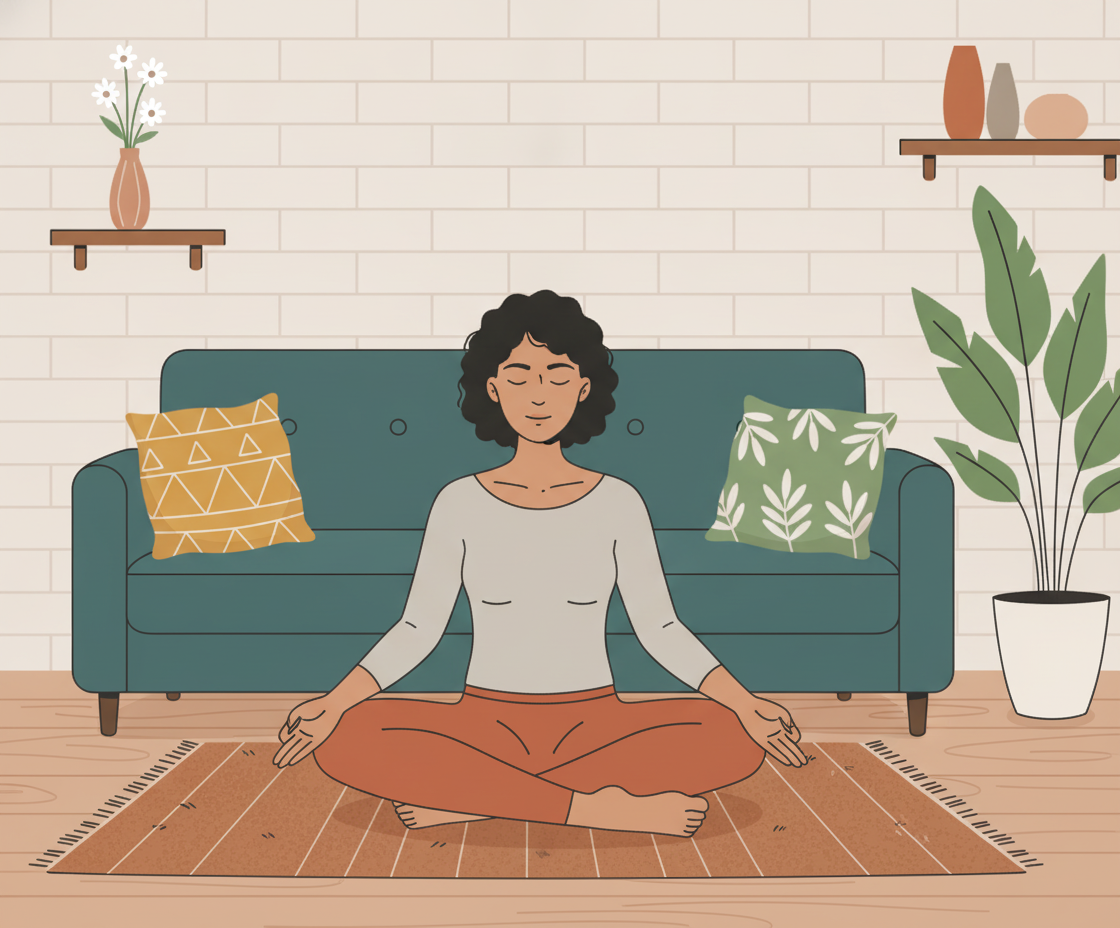
You're sitting cross-legged, eyes closed, following your breath like every meditation app tells you to, when your chest suddenly locks up and a memory you hadn't touched in years surfaces, sharp and uninvited. If that has happened to you, you're not broken and you're not doing it wrong. You've just bumped into one of the strangest, least talked about corners of meditation practice.
So does meditation release trauma from the body? The honest answer is yes, meditation can stir up trauma patterns stored in the nervous system, but whether that stirring becomes healing or harm depends almost entirely on how you approach it. Sitting in silence with an untrained nervous system is a fundamentally different experience from sitting in silence with the right preparation, pacing, and support. The nervous system doesn't know the difference between an old wound and a present threat until you teach it to.
This article won't scare you away from your cushion, and it won't sell you a fantasy of instant release either. It sits in the middle: real hope that embodied practice can help you process what got stuck in the body, alongside real caution that meditation done carelessly can retraumatize instead of heal. We'll look at what actually happens physiologically, why some people get flooded instead of calmed, and what a genuinely safe path forward looks like.
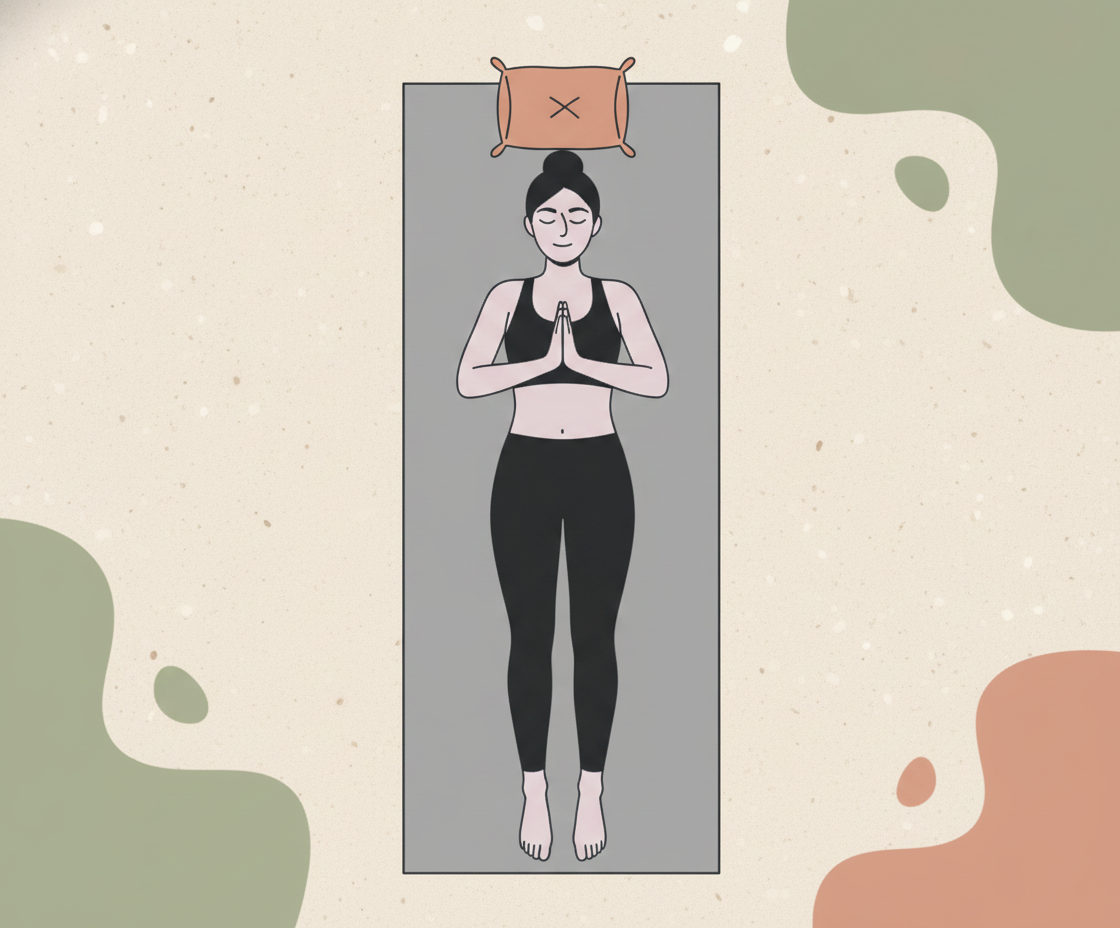
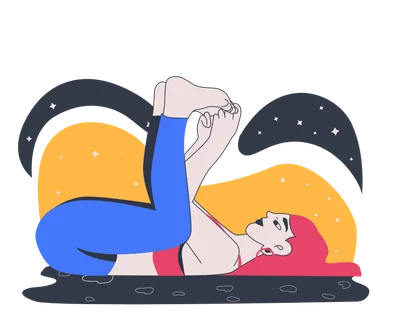
Happy Baby Pose ermöglicht dem Körper, Spannungen authentisch freizugeben statt sie zu unterdrücken.
Can Meditation Release Trauma Stored in the Body?
Here's the biology behind it. When something overwhelming happens, your nervous system picks a survival strategy: fight, flight, or freeze. Normally, once the threat passes, the body finishes the response, a shudder, a deep exhale, a wave of shaking, and resets. Trauma happens when that completion never occurs. The activation gets stuck, not as a memory you consciously recall, but as a pattern locked into muscle tension, breath restriction, and a nervous system stuck scanning for danger. Peter Levine, the psychologist who developed Somatic Experiencing, built his entire body of work around this exact observation: the problem isn't the traumatic event itself, it's the survival energy that never finished discharging.
Meditation quiets the noise that usually keeps that pattern buried. Your everyday vigilance, checking your phone, planning dinner, monitoring the room, takes up bandwidth. When you sit still and that mental traffic clears, sensations the body has been holding down for years can surface. The Yogawiki teachings on trauma work describe this directly, noting that yogic techniques can be used to address trauma held in the body, not just in the mind.
But here's where people get the science wrong. Sensing something is not the same as processing it. Feeling a flood of old fear in your chest during meditation is your body showing you the wound. It is not, by itself, closing it. Raw activation without a way to metabolize it just retraumatizes, the nervous system relives the emergency without any new outcome, reinforcing the exact loop meditation was supposed to soften.
This is my core point, and it's the one people skip past: meditation can genuinely shift the body toward parasympathetic activation, the rest-and-digest state where healing becomes biologically possible. That shift can, in theory, give a frozen trauma response room to finally move. But activation is not release. A calmer nervous system creates the opportunity for processing; it doesn't automatically deliver it. Without proper regulation, pacing, and support, you can open the door to old material and have nowhere safe to put it.
This isn't just theory. A trauma-sensitive mindfulness pilot study using mixed methods found a significant drop in PTSD symptoms, complex PTSD, dissociation, and self-hatred after a structured mindfulness intervention. A RAND systematic review of ten randomized controlled trials on meditation for PTSD found real, measurable effects across that body of research. Research from the US Department of Veterans Affairs found that MBSR and present-centered group therapy helped combat veterans with PTSD, and a meta-analysis of Transcendental Meditation studies documented clinically meaningful reductions of ten or more points on the PCL, the standard PTSD symptom scale, across every study included. The evidence that meditation can move the needle on trauma symptoms is solid. What none of these studies claim is that stillness alone, unguided and unstructured, does the work by itself.
So when someone asks whether meditation releases trauma from the body, the honest answer sits in that gap. Yes, it can loosen what's frozen. Whether that loosening becomes healing or another form of harm depends on what happens next, and that's exactly what the rest of this piece gets into.
The Paradox: Why Meditation Can Trigger Flashbacks and Panic
Here's the part nobody puts on the meditation cushion poster. The entire technology of meditation was built on one move: turn attention away from the world and toward the inside. Close the eyes, soften the senses, let the room go quiet. In yoga philosophy this inward turn has a name, Pratyahara, the withdrawal of the senses, listed as a limb of practice long before anyone worried about trauma or nervous systems. The tradition treated it as a doorway. It never promised the room behind that door would be empty.
For a nervous system that learned to survive through hypervigilance, scanning the exits, tracking every shift in tone, watching the door, that outward scanning isn't a bad habit to be corrected. It's an anchor. It's what kept the body oriented and, in a real sense, alive. Take away the external stimuli that meditation asks you to release, and you don't necessarily find peace underneath. Sometimes you find whatever the scanning was covering for. That's the paradox: the very mechanism that makes meditation work for a calm nervous system is the same mechanism that can destabilize a hypervigilant one.
This isn't a fringe concern, and it isn't a secret among clinicians who work with trauma. It's well documented that meditation and mindfulness practice can trigger anxiety, intrusive memories, and heightened sensitivity in people carrying unprocessed trauma. That's precisely why trauma-sensitive guidance matters so much before anyone sits down expecting to meditate the trauma away on their own.
The yogic scriptures never really claimed meditation was universally gentle. They describe the mind, Chitta, as something that must be steadied, and steadying an untamed thing was always understood as work, not relaxation. What's changed is how meditation got marketed centuries later: as a wellness reset, a stress-relief app, something safe by default. Safe for a regulated nervous system and safe for a traumatized one are not the same category of experience, even though modern language uses the same word for both.
So when someone asks whether meditation releases trauma from the body, the honest answer sits inside that gap between two very different meanings of stillness. For one person, stillness is rest. For another, stillness is the first time in years nothing is holding the door shut.
Meditation Without Guidance: Dissociation, Panic, and Overstimulation
Picture someone new to sitting practice, cross-legged on a cushion, following an app that tells them to "notice sensations in the body without judgment." For the first few minutes, nothing dramatic happens. Then their chest tightens. Their hands go cold. A memory surfaces that they hadn't thought about in years, not as a thought but as a full-body jolt, heart pounding, throat closing. They didn't ask for this. They were just trying to relax.
This is not a rare glitch. Findings from traumatherapie-muellensiefen describe exactly this pattern: meditation without professional support can trigger panic, dissociation, and nervous-system overstimulation in people carrying unresolved trauma. Some feel the panic first, a surge of adrenaline with no obvious trigger. Others slide the opposite direction, into dissociation: a foggy, far-away feeling, like watching themselves from across the room, disconnected from their own hands and breath.
Here's the part that gets missed constantly, including by well-meaning teachers: this isn't someone "going deeper" into meditation and stumbling on something meaningful. It's an unsupported nervous system losing its moorings, because stillness removed the very defenses that were keeping it upright. Freeze is a protective state. It exists because, at some point, staying frozen was safer than feeling. Asking that system to just relax, alone, with no map back, is asking a lot.
This is where trying to process meditation trauma solo tends to backfire. Nervous systems don't downshift out of protective freeze through willpower or good intentions. They need co-regulation: another steady, attuned nervous system nearby, signaling that it's actually safe to soften. Without that, the body has no reliable off-ramp. It either stays braced, or it overshoots into the panic and dissociation described above, neither of which resembles healing.
I've watched students describe this exact arc after solo practice: calm, then a wave, then hours of feeling strangely unreachable afterward. That's not a personal failure or a sign they're "bad at meditation." It's a predictable dysregulation pattern, and it's exactly why the next sections matter so much: what actually happens in the body during release, and how professional, titrated support changes the outcome entirely.
Trauma-Sensitive Yoga and Somatic Practices: A Different Pathway
Here's something I've watched play out on the mat hundreds of times. A student who shuts down within minutes of closing their eyes in seated meditation can stay present, even soften, in a supported forward fold. Same nervous system, same trauma history, completely different outcome. The difference isn't the person. It's the pathway.
Why Asana Offers a Different Pathway Than Stillness
Sitting meditation asks you to turn inward and let external stimuli fall away. For someone whose body learned safety through scanning the room, that's the opposite of grounding. Asana, yoga postures, works differently. Your skin still feels the mat. Your joints register weight and angle. There's a wall against your calves, a blanket under your hip. The body stays anchored to the physical world instead of dropping fully into the internal one, and that anchoring is what makes gentle movement more accessible than pure stillness.
This isn't just theory dressed up nicely. Yogawiki, writing on trauma work through yoga, points out that yogic techniques can address physical, emotional, and psychological trauma holistically rather than through one narrow mechanism. Asana gives the nervous system several entry points at once, breath, sensation, gentle effort, so it doesn't have to rely on internal focus alone to feel safe.
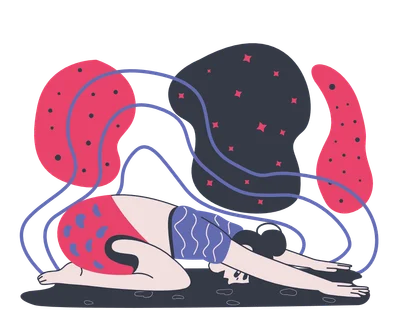
That anchoring matters, but it isn't the whole story. Meditation also asks for a kind of surrender. You sit, you stay, you let go. For a nervous system shaped by helplessness, that instruction alone can feel like a threat. Asana offers something meditation rarely does: active, moment-to-moment choice. You move into Balasana, Child's Pose, and you can shift your knees wider, prop your forehead on a fist, or come out entirely whenever you want. That small, constant negotiation between you and the pose rebuilds a sense of agency that trauma often strips away.
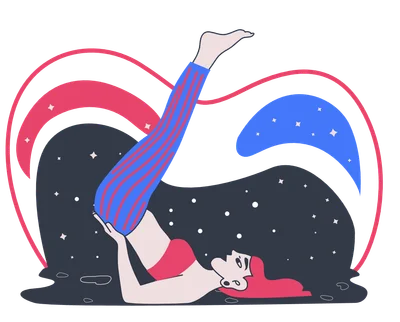
I've seen students visibly exhale, shoulders dropping an inch, the moment they realize they're allowed to adjust. That's the body learning safety through small, grounded movement rather than forced introspection. Viparita Karani, Legs Up the Wall, works on the same principle. Elevating the legs calms the nervous system and encourages gentle release without demanding intense inward attention, so relaxation arrives almost as a side effect of the shape itself, not as something the mind has to chase.
Anchoring and choice work together, not separately. The wall under the calves gives the nervous system a sensory reason to trust the room. The freedom to adjust the pose gives it a behavioral reason to trust itself. Neither alone would be enough. A student pinned into a fixed shape, however cushioned, can still feel trapped. A student floating with no sensory reference, however free to move, can still spiral inward with nothing to hold onto.
This is the somatic groundwork that makes deeper emotional processing possible later. The body has to feel it can leave before it trusts staying, and that trust, built pose by pose, choice by choice, sets up what actual release can look like when it's allowed to happen on the body's own terms.
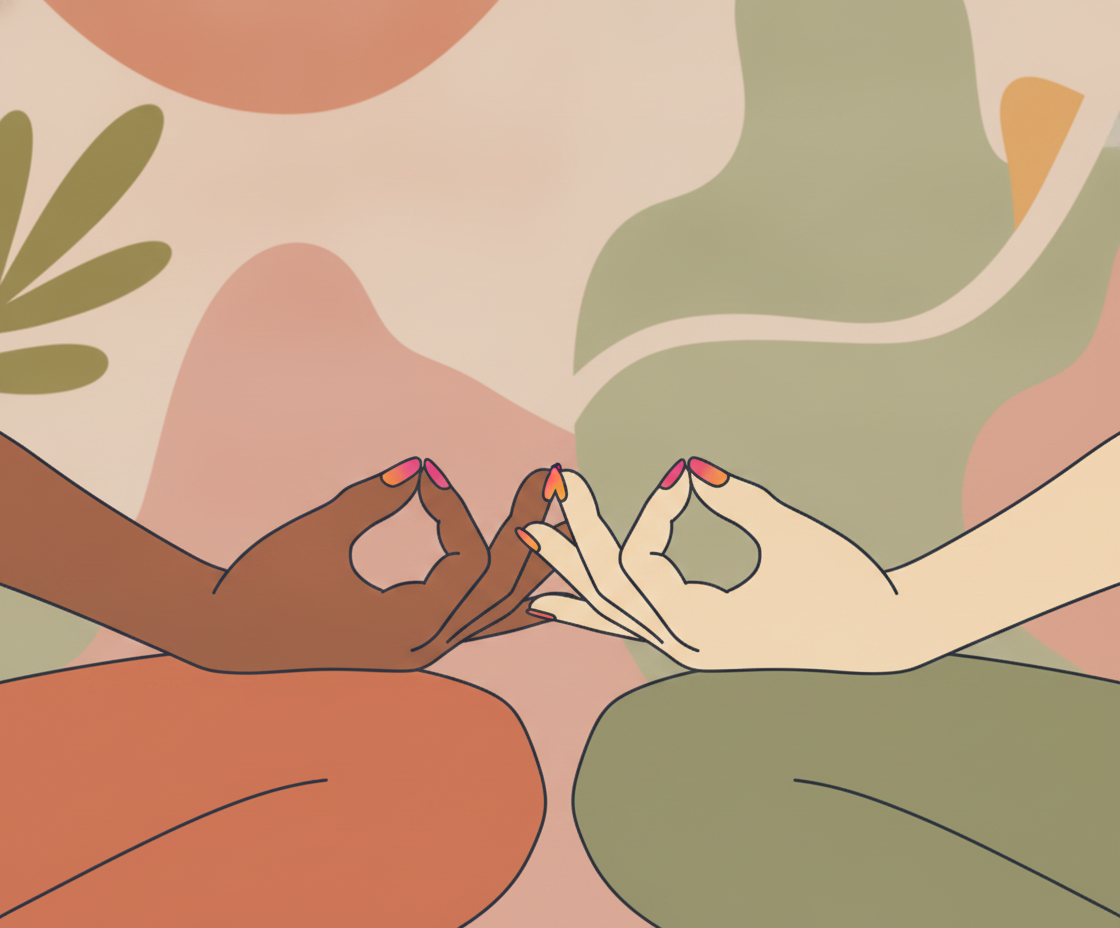
Bewusste Handhaltung und Atemwahrnehmung verankern den Körper im gegenwärtigen Moment.
Releasing Trauma Through Embodied Awareness, Not Mental Forcing
Here's something I tell every student who asks me if meditation trauma processing means the mind has to figure it all out: it doesn't. Trauma isn't a thought problem. It's a body that never got to finish what it started. A punch that never landed, a scream that got swallowed, a run that never happened because running wasn't safe. That energy doesn't vanish. It stays coiled in the muscles, the fascia, the gut, waiting for a moment safe enough to complete itself.
Real release doesn't come from a still mind. It comes from a body finally allowed to finish the movement it froze mid-way through. That's the whole game. Not calming the thoughts, but letting the nervous system discharge what it's been holding in a low, constant hum for years, sometimes decades.
This is where Ananda Balasana, Happy Baby Pose, earns its keep. You're on your back, knees drawn wide toward the armpits, hands gripping the outer edges of the feet. It looks almost silly, which helps. The pose opens the hips, groin, and inner thighs, exactly where a lot of stored tension lives, especially for anyone whose trauma involved feeling exposed or unable to protect themselves. Because you're grounded, on your back, feet anchored in your own hands, the body gets to explore vulnerability while staying in control of it.
I've watched this pose do strange, honest things to a room. Someone's leg starts to tremble. Not from effort, the pose isn't hard, but from something older shaking loose. A breath catches and turns into a sound nobody planned. One student once stayed in the shape for a full two minutes with her jaw trembling before she let out a long, unforced exhale that sounded almost like a laugh and a sob at once. Nobody told her to do that. Her body simply took the opening. This is discharge: the body's own mechanism for completing a stress response through tremor, sound, or spontaneous movement. It's not a breakdown. It's closer to a system finally exhaling something it's held for a very long time.
Letting the Body Lead, Not the Mind
This is the opposite of forcing stillness. If you tell a shaking body to be quiet and meditate through it, you're recreating the original injury: a system told to suppress, override, comply. Somatic work says the opposite. You feel the tremor, you let the sound come, you trust the body's timing over your schedule. That distinction, between imposed stillness and honored movement, is everything when meditation and verdrängtes trauma (suppressed trauma) meet in the same room.
The mechanism itself is straightforward once you've seen it a few times. A tremor moves through the thighs in small waves, not a single shake but a rhythm, almost like the leg is remembering how to run. A held breath finally breaks into a shudder, then evens out on its own. These are not signs of something going wrong. They're closer to what happens when a hand that's been clenched for hours finally opens: a little shaky at first, then quiet.
None of this is something I'd hand someone as a solo homework assignment. This work asks for a trauma-informed teacher or therapist in the room, someone trained to recognize when discharge is healing and when it's overwhelm. Done with support, it's some of the most honest work I've ever witnessed a body do.
Preparing Safely: The Role of Titration, Grounding, and Professional Support
So here's the practical question. If you're a trauma survivor and you still want to meditate, how do you do that without gambling with your own nervous system? The answer isn't willpower. It's a method called titration, a term borrowed from chemistry that trauma therapists use constantly: you introduce the smallest possible dose of something intense, watch what happens, and stop before it overwhelms the system.
In practice, that means meditating for thirty seconds. Maybe two minutes, tops. Not twenty. You sit, you notice one sensation, and you get up before your body starts sliding toward that old freeze response. This is the opposite of the all-or-nothing approach most meditation apps sell you, and for a nervous system shaped by trauma, that's exactly the point. You're teaching your body that stillness is optional and reversible, not another trap it can't escape.
What Trauma-Informed Meditation Looks Like
Grounding is what makes titration survivable. Before and during any short sitting, you keep at least one foot in present-tense reality: naming five things you can see, feeling your actual feet on an actual floor, a hand pressed flat against your chest. These aren't relaxation tricks. They're anchors that remind a hypervigilant nervous system it's not back there, it's here, in a room, safe, with an exit available. That's the difference between meditation as körpererinnerung, a body memory quietly resurfacing, and meditation as a flood you can't stop.
This is exactly why processing meditation trauma isn't a solo project. Reporting from tagesschau.de on the risks of mindfulness notes that meditation can trigger anxiety, traumatic flashbacks, and heightened sensitivity in people carrying trauma, and explicitly requires trauma-sensitive Begleitung, professional accompaniment that can read your state in real time and adjust before things escalate.
Red Flags and When to Stop
Some signs mean pause, not push through. If sitting consistently produces panic, dissociation, or intrusive memories rather than occasional discomfort, that's data, not failure. Analysis from traumatherapie-muellensiefen.de makes the same point: meditation can provoke panic, dissociation, and overstimulation, and without professional support it isn't something to recommend uncritically to traumatized people.
None of this means meditation is off-limits forever. It means you approach it the way you'd approach any powerful tool, with informed precaution, someone qualified watching your reactions, and brutal honesty with yourself about what's actually happening in your body. If sitting still keeps opening doors you can't close, somatic yoga or EMDR-informed work might be the better starting point, with meditation added back in later, in smaller, safer doses.
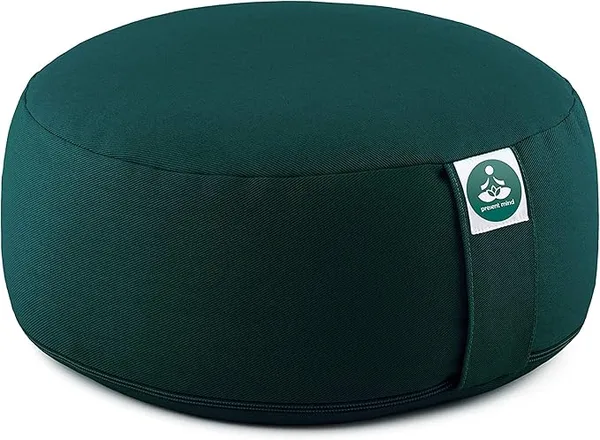
Sichere, titierte Praxis erfordert Dokumentation und bewusste Vorbereitung – nicht Spontaneität.
From Trapped Activation to Conscious Release: What Truly Heals
So let's answer the question straight. Does meditation release trauma from the body? Sometimes. Sometimes it just reopens a door and leaves you standing in a draft. The honest answer isn't yes or no, it's under what conditions. Every thread in this article points to the same place: the practice itself is neutral. What decides whether meditation heals or harms is the ground it's built on, the pace it moves at, and whether someone qualified is holding space while your nervous system does its work.
There's a reason Shiva shows up so often in yoga philosophy as the one who destroys in order to transform. Not destruction for its own sake, but a conscious letting go, one that only happens when there's enough stability to survive the collapse. Your nervous system works the same way. It doesn't release what it's held onto out of fear just because you asked it to sit still. It releases when it feels, at a bodily level, that it's finally safe enough to stop guarding.
The mantra Om Namah Shivaya carries that same spirit of conscious letting go, honoring what needs to transform rather than forcing it, and trusting the process over rushing it. As a daily reminder, our Shiva shirt lets you carry that steady presence with you, on and off the mat.
That's the real function meditation can serve in trauma healing: not a forced dive into the unconscious, but a quiet permission slip for the body to downshift, offered only once the system already trusts that downshifting won't be dangerous. The actual repair rarely happens in stillness alone. It happens in the space between stillness and safe movement, tremor, breath, sound, the things your body wanted to do back when the trauma first happened and couldn't.
If you're carrying unprocessed trauma and wondering where to start, don't start with silent sitting. Start with gentle asana, grounding practices, or a trauma-informed therapist who can read your particular nervous system and pace things accordingly. That professional relationship becomes the container everything else happens inside. Meditation can absolutely come later. It often should. Just let it arrive after the foundation is solid, not as the foundation itself.