Sit down for five minutes, think of nothing, and you are already enlightened, right? No. It is precisely these myths that keep most people from even starting. This guide clears away the nonsense: you don't need incense, a lotus position and certainly not an empty head. What you need is a chair, a few minutes and the willingness to calmly observe yourself for once.
I have been teaching people for years who firmly believed they couldn't meditate because their heads were too loud. Spoiler: those are exactly the ones who benefit the most. Inner calm and mental clarity are not a talent but trainable, like a muscle.
In this introduction I show you how meditation really works, which technique suits you and how to build a practice that still stands even after the first week.
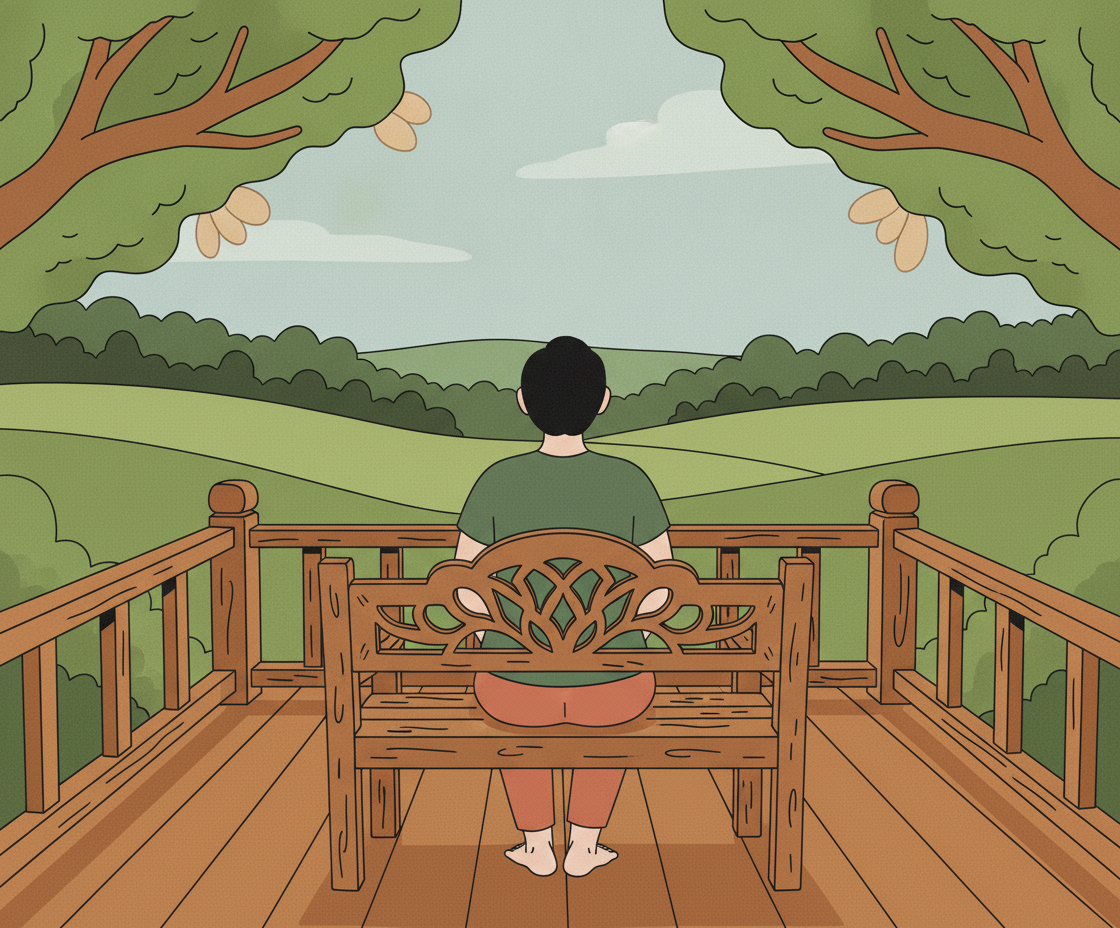
A beginner sits in the correct meditation posture on her mat
What Is Meditation for Beginners? Understanding the Basics
Myth vs. Reality: What Meditation Really Is
Many imagine meditation as a vacuum: thoughts off, head empty, calm forever. That is nonsense, and it is also the reason why so many give up after three days. Meditation is not an absence of thoughts but a different way of dealing with them. You practice consciously bringing your attention back again and again, gently and without judging yourself. That is exactly what makes a solid meditation-for-beginners guide: realistic expectations instead of glossy spiritual images.
The Psychological Dimension: How Meditation Changes the Brain
Here it gets concrete, not esoteric. The meditation researcher Dr. Ulrich Ott explains in an interview that regular meditation fosters serenity, the ability to concentrate and a more stable self-confidence, measurable on a neurological level. Your brain changes through repeated practice; this is called neuroplasticity. Areas for attention control and emotion regulation are used more actively, similar to a muscle that becomes stronger through training. So anyone who wants to know how to meditate correctly should squint less at mystical experiences and more at this very real, trainable change in the mind.
Why Beginners Often Fail and How You Avoid It
Most people fail not at the technique but at the expectation. They sit down, want instant silence, notice a carousel of thoughts after two minutes and think they can't do it. That is exactly where something tenses up inside, a slight pressure in the belly, the impatience in the neck. That is normal. The first steps in meditation mean enduring precisely this resistance without wanting to push it away. Learning meditation step by step means: small units, real repetition, no claim to perfection. As a skill, you train it like any other, with patience and without self-criticism when things get shaky.
The Right Sitting Posture: The Body as a Gate to the Mind
Before we talk about technique, let's talk about the seat. It sounds trivial, but it isn't. Your spine is the connection between body and nervous system. How you sit decides how your breath flows, how alert your mind stays and how stable your whole system feels. The anatomy behind it is simple: a compressed spine restricts the diaphragm, the breath becomes shallow, and a shallow breath keeps your nervous system in alert mode. For a mindfulness meditation for beginners, that is poison. Jon Kabat-Zinn, founder of the Stress Reduction Clinic in Massachusetts and developer of the MBSR program for stress reduction through mindfulness, emphasizes again and again in his work how closely posture and mental clarity are connected with each other. His approach has shown worldwide that meditation is not a purely mental act but begins in the body.
Cross-Legged Seat (Sukhasana): The Classic Meditation Posture
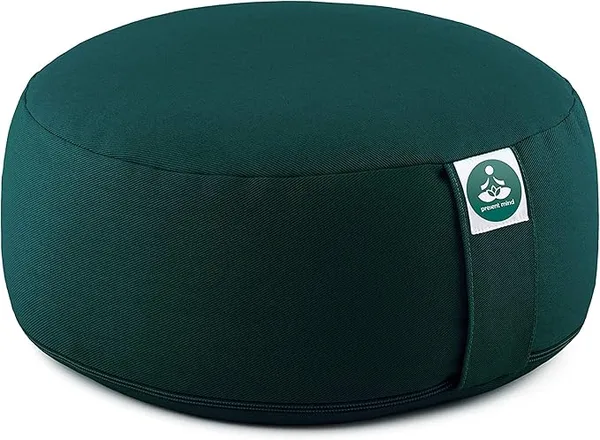
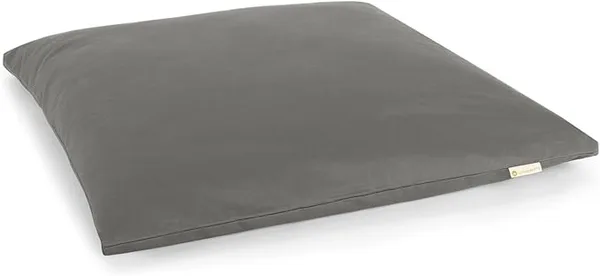
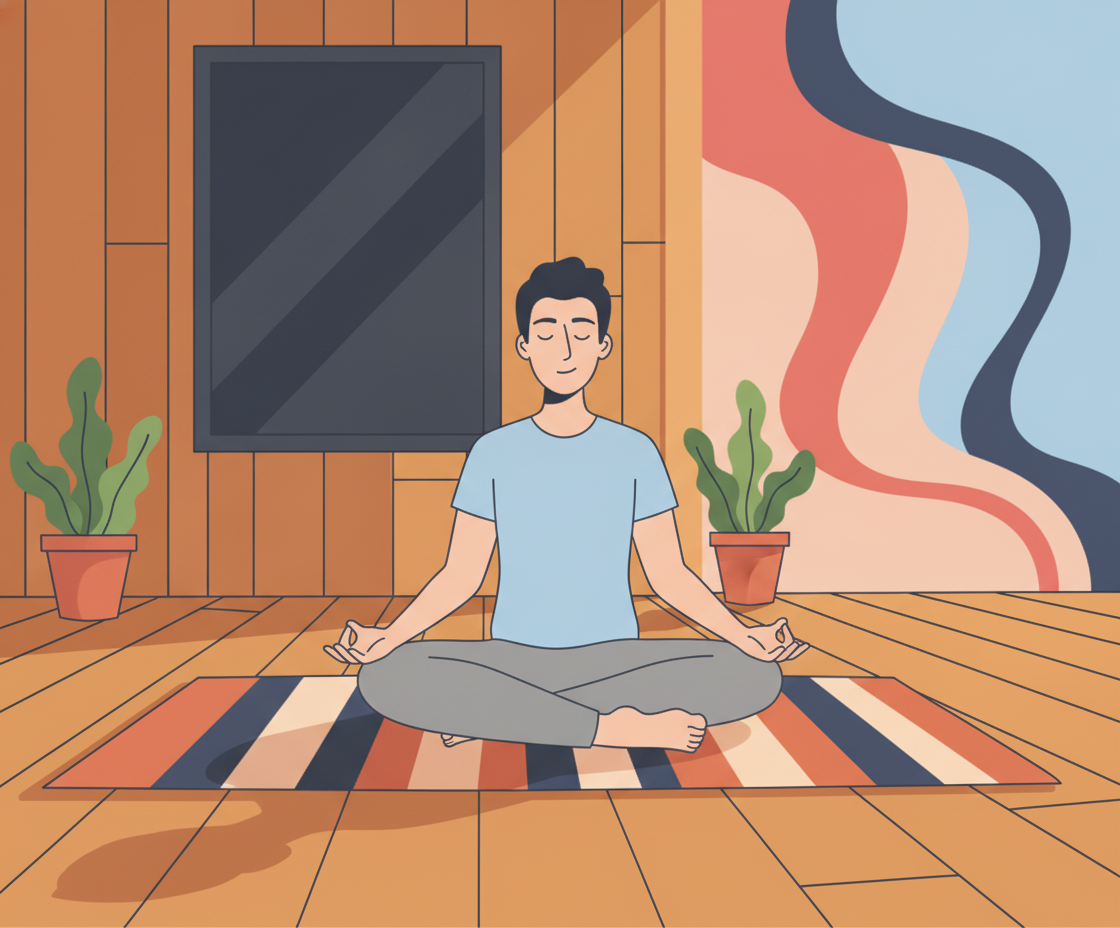
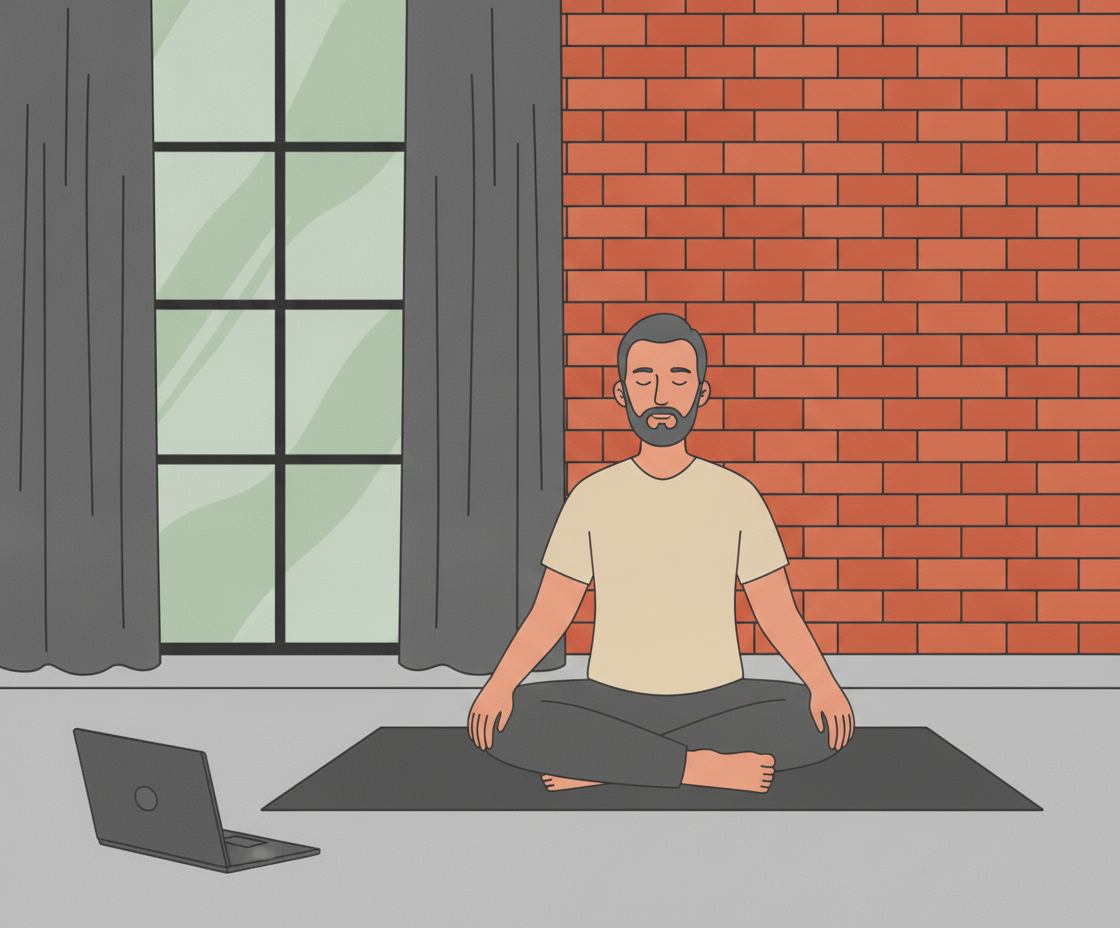
The cross-legged seat, Sukhasana, is the classic among the meditation postures, and for good reason. It gives you a broad, stable base without overwhelming the hips. Sit on a cushion so that your knees stay below hip height, cross the lower legs loosely and let the knees sink gently toward the floor. The hands rest on the knees or in the lap. What matters is not the perfection of the leg position but that your pelvis tilts slightly forward. This opens the lower back and makes the straightening almost automatic.
Upright Spine: Why Posture Determines the Mental Quality
Sitting upright is not an act of discipline but a signal to your nervous system: I am present, I am safe. In body psychology, an upright posture is directly connected with self-confidence and inner stability. You may know this from moments in which you slumped down and made yourself small and promptly felt that way too. For the complete guide to meditation for beginners, that means: the spine long, the crown draws gently upward, the chin stays neutral. Not military-stiff, but an alert, effortless length, like a bamboo that carries itself without stiffening.
Alternatives for Less Flexible Beginners
Not every hip is ready for the floor, and that is completely fine. A meditation chair with a straight backrest, a stool or simply the edge of the bed do the job just as well. As first steps in meditation, only one thing counts: the spine free and upright, without tension in the shoulders or jaw. Anyone who approaches learning meditation step by step may adjust the posture as often as necessary. That is exactly why a look into guided courses is also worthwhile for beginners. At RE:TREAT Vienna, you learn the basics of the sitting posture in beginner courses corrected directly by experienced teachers, and at the MEDITAS Meditation Center Vienna you get time and space in special beginner programs to find your individually suitable posture, without pressure and without comparison with others in the room.
The cross-legged seat (Sukhasana) with correct posture for meditation beginners
First Steps: Performing Meditation Correctly Step by Step
The 5-20-Minute Rule for Beginners
A guide to meditation makes it clear: as a beginner you start with 5 to 20 minutes and gradually increase the duration until you eventually reach an hour, if you even want that at all. There is no hurry. I have seen students give up frustrated after three days because they wanted to sit for 30 minutes right away. Start small; that is not weakness, that is wisdom.
Breath-Focus Technique: The Bridge Between Body and Mind
The breath is your anchor. It is the only element of your experience that happens automatically and can be consciously controlled at the same time, which is exactly why it works as a bridge between body and mind. In mindfulness meditation for beginners, it is enough to simply observe the breath: how it comes, how it goes, without changing it. As soon as the mind wanders, you gently guide the attention back to the next breath. That is the whole exercise, no secret science.
Dealing With Wandering Thoughts and Mental Distractions
Here lies the biggest misconception in the meditation-for-beginners guidance that many have in mind: thoughts are not the problem. The problem is the unconscious reaction to them, the getting hooked, the thinking about thinking, the self-criticism because you have wandered off again. Your nervous system has learned over years to chase after every thought; that does not settle in one session. When you notice that you have drifted off, that is exactly the moment of mindfulness, not the failure. Cultivate compassion here instead of frustration, the way you would meet a child who is just learning to walk and falls down. This first-steps-in-meditation experience, the gentle coming back without inner reproach, is the actual practice. Anyone who takes the complete guide to meditation for beginners seriously understands: it is not the absence of thoughts that is the goal, but a friendlier relationship with them.
Preparation and Closing: Integrating Meditation Into the Body
What many overlook in their meditation-for-beginners guidance: the practice does not begin in sitting. It begins in the body, long before you close your eyes. Your nervous system carries tension with it throughout the day that cannot simply be thought away by willpower. That is why I always work somatically with students: first the body, then the mind. Anyone who ignores this order often sits there restless and wonders why the thoughts just won't come to rest.
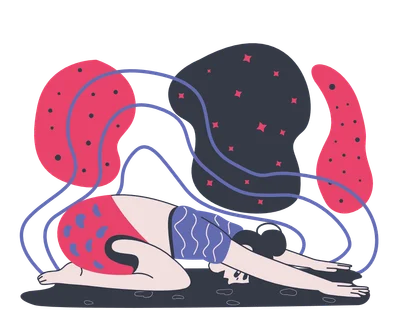
Child's Pose (Balasana) for Tuning In
Child's pose (Balasana) is a calming, introspective asana that is perfectly suited for the preparation and the closing of a meditation practice. The forehead sinks to the floor, the arms lie loosely next to or in front of the body, the breath is automatically directed deeper into the back. This posture switches almost reflexively to inward. For first steps in meditation, that is worth gold, because it signals to the nervous system: you are safe, you may let go. Stay here calmly for three to five breaths before you straighten up.
Body Awareness Before Meditation: Calibrating the Nervous System
Somatic psychology shows: unprocessed stress settles as muscular tension, often in the shoulders, jaw or belly, without us consciously noticing it. A few asanas before meditation gently dissolve this stored tension and recalibrate the nervous system. That is exactly why learning meditation step by step is never just a matter of the head. Anyone who switches directly from the screen to the cushion meditates practically still in an alarm state. A few minutes of movement create the necessary transition.
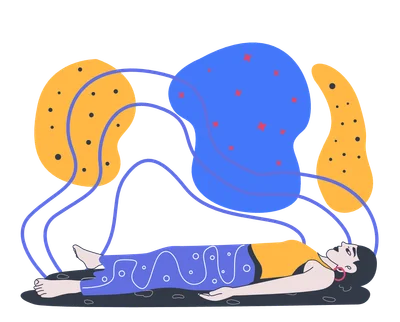
Savasana (Corpse Pose) for Integration and Deepening
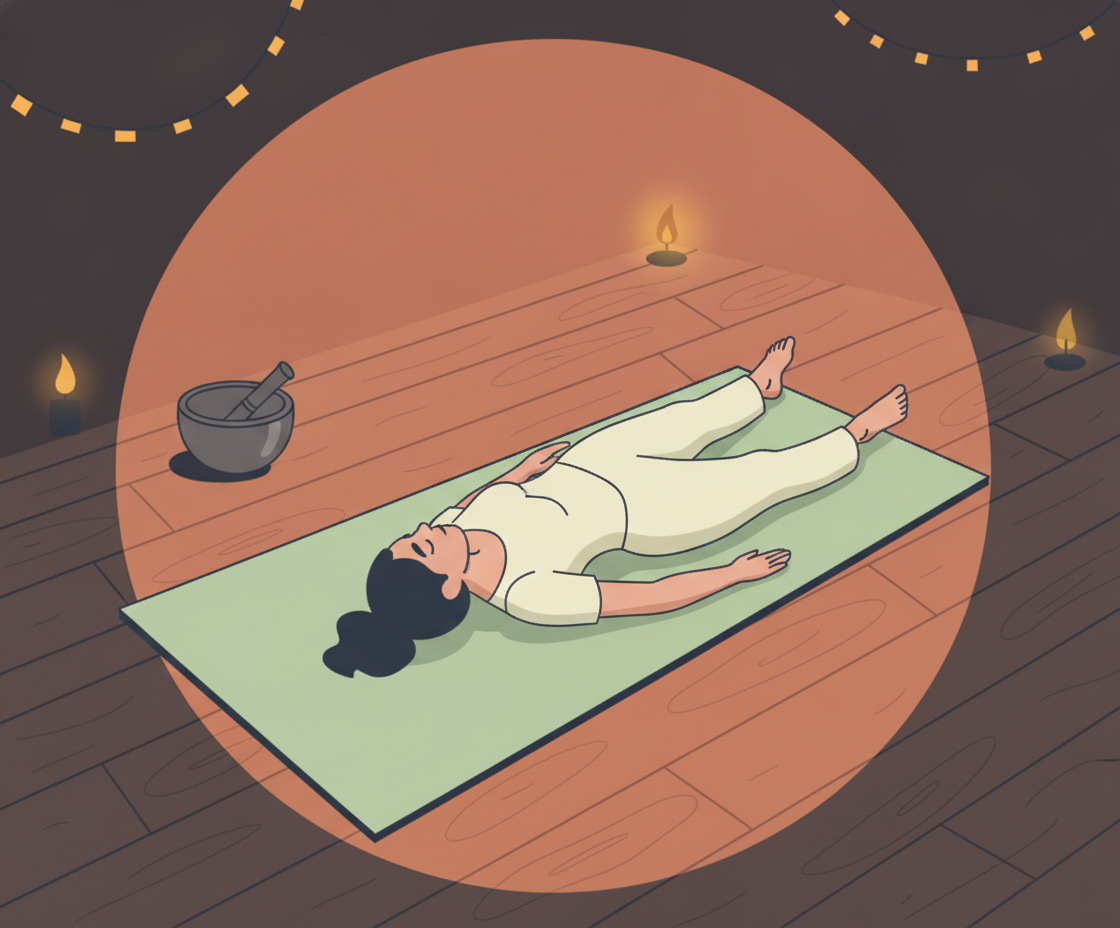
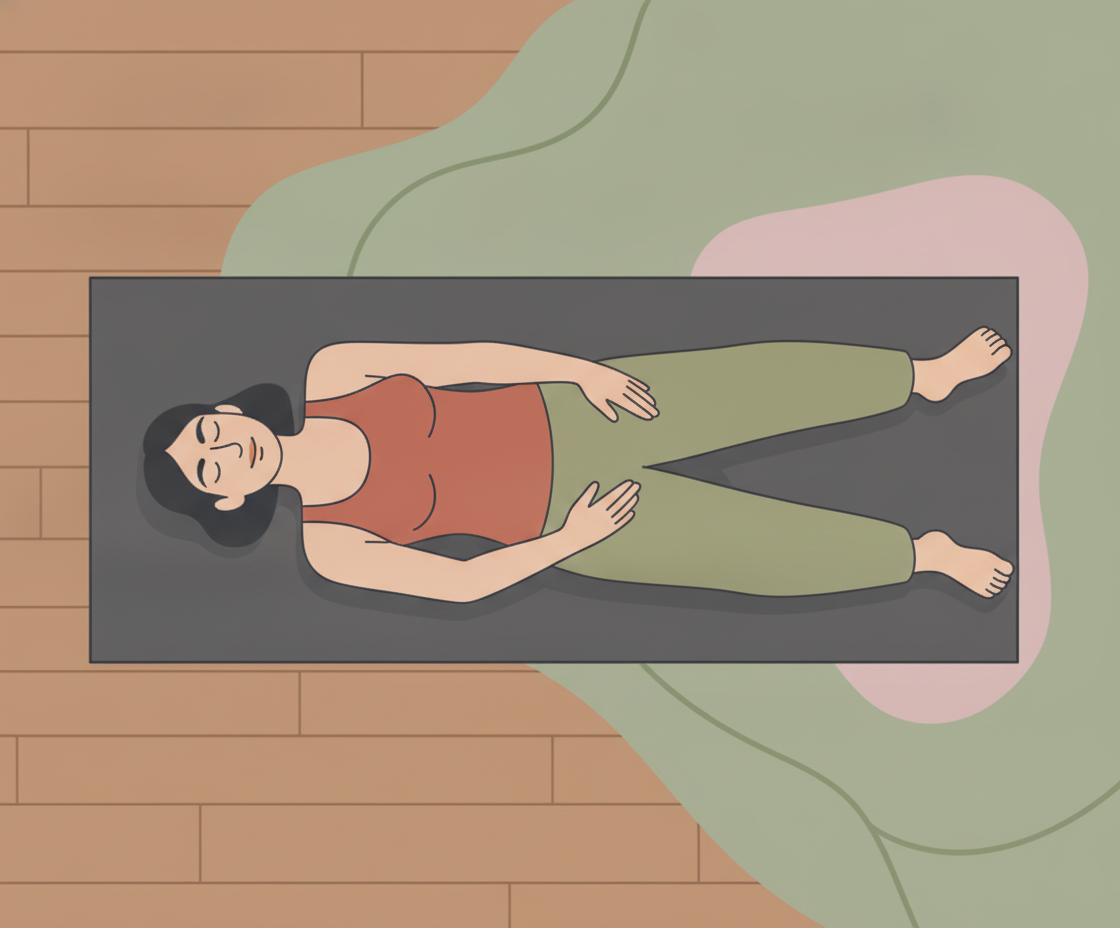
The corpse pose (Savasana) is the ultimate closing posture after meditation, which enables a deep relaxation and integration of the practice. Stretched out on the back, palms open, the body no longer needs to fulfill any task here. It is precisely in this non-activity that the transformative potential of the preceding mindfulness-meditation-for-beginners exercise really unfolds. Treat yourself to at least five minutes before you go back into the day.
Savasana (corpse pose) for integration after the meditation practice
Beginner Tips for a Sustainable Meditation Practice
Enough theory, now it gets practical. Because a meditation-for-beginners guide only helps you if it also survives in real life. Your nervous system does not learn through insight but through repetition. That is exactly where it gets stuck for most people who try learning meditation step by step and give up after two weeks because nothing feels spectacular. Here come the things that really count.
Regularity Over Intensity: The Continuity Principle
Your brain loves repetition more than duration. Five minutes every day anchor themselves more deeply than one hour once per week, because habit formation runs on frequency, not on intensity. A complete guide for beginners that I often recommend puts it in a nutshell: consistent little things beat sporadic feats of strength. I have taught this myself hundreds of times and experienced how students report more inner calm after four weeks of a daily five-minute practice than after a single weekend retreat. The trick: set the bar low so that you actually clear it.
Environment and Rituals: Supporting the Inner Space With the Outer Space
A ritual is more than organization, it is psychological anchoring. When you always sit at the same time, in the same spot, you signal to your nervous system: now comes calm. The cushion, the candle, the place, they become anchors that pull you into the state more quickly. This is not esotericism but simple conditioning, as also described in behavioral psychology. For your meditation practice for beginners, a corner in the room, a cushion, maybe an alarm clock are enough. Nothing more is needed.
It is precisely this ritual, returning again and again and letting go of old thought patterns, that the mantra Om Namah Shivaya stands for: devotion, letting go and the awakening to pure awareness. As a daily reminder of this, there is our Shiva shirt, so that you carry this attitude visibly with you even away from the cushion.
The biggest mistake: perfectionism. Anyone who searches for meditation tips for beginners and expects to have an empty head immediately will be disappointed and stop. Progress is subtle; often you only notice after weeks that you stay calmer in a traffic jam. That is exactly mindfulness as an everyday practice, not only on the mat. Impatience is the second stumbling block. If you ask how to meditate correctly, the honest answer is: imperfectly, again and again. Your first steps in meditation don't have to shine, they just have to take place.
Your Next Step: From Theory to Personal Practice
Now you have the map. What is missing is the first step on the path. I see this in my courses almost every week: people nod during the explanation, note down concepts, ask clever questions, and right after that comes the point where they would rather watch one more video than simply sit down. Learning meditation step by step does not mean consuming one more article. It means putting the screen away and closing the eyes. Meditation is not an escape from your life; it is the conscious turning toward what is here right now, even when that is uncomfortable.
Concrete Action Steps for This Week
Set a fixed time; in the morning after getting up works best for many, before the phone interferes. Sit down for five minutes for seven days, no goal, no evaluation. Use a simple mindfulness meditation for beginners: count the breath up to ten, start over when you wander off. That is the whole exercise. In the evening, note down in two sentences how it was. These observations will become your most honest feedback, more honest than any meditation app.
Resources and Continuous Support
A good meditation-for-beginners guide accompanies you but never replaces your own experience on the cushion. Find a group, a course or at least a person you can exchange with, because meditation practice for beginners rarely thrives in complete isolation. And then: stick with it, even when week three feels tough. That is exactly where the actual practice begins.

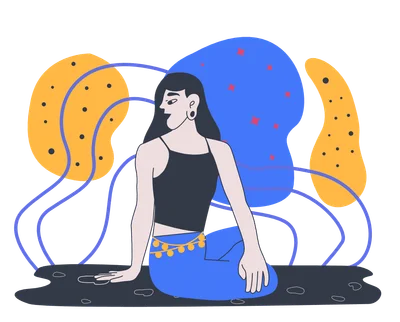 AsanaRevolved Easy PoseParivrtta SukhasanaTo the asana →