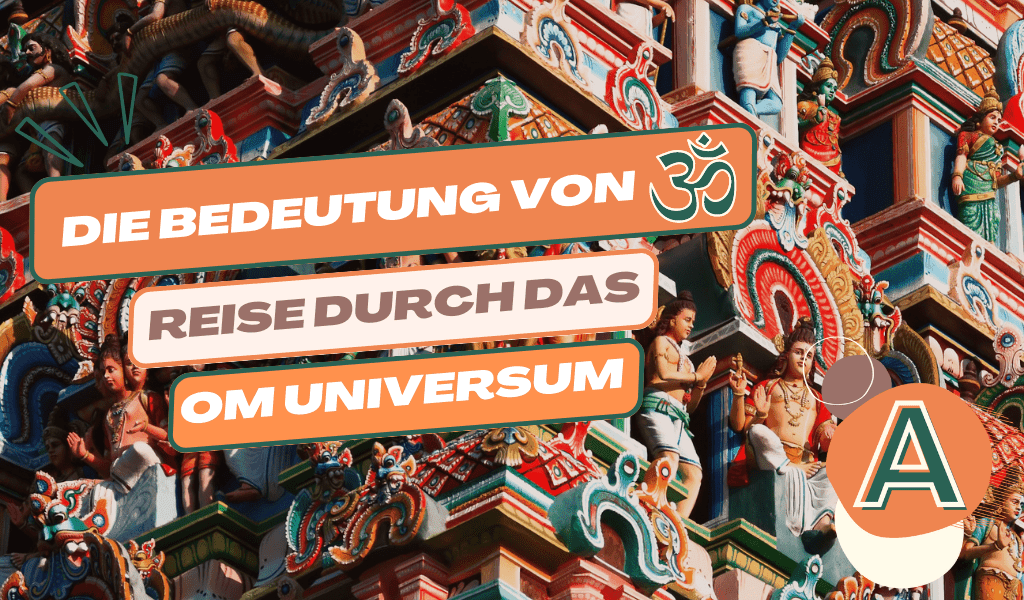
Die Bedeutung von OM, Die Reise durch das OM Universum
OM, ein Mantra, das in unsere Yoga-Stunden hallt und unsere Seelen in einer mystischen Melodie umhüllt. Dieses uralte Symbol ist so einzigartig, dass seine Bedeutung auf den ersten Blick fast ungreifbar wirkt, doch hinter dem schlichten Klang verbirgt sich ein ganzes Universum spiritueller Tiefe. Begleite uns auf einer faszinierenden Reise, die das OM als kosmisches Tor zu unserem inneren Selbst enthüllt.
Meine persönliche Begegnung mit dem OM
Während meiner Kindheit, im lebendigen und faszinierenden Indien, war das OM-Symbol mein ständiger Begleiter. Es flüsterte aus den Ecken alter Tempel, strahlte von den Halsketten der Pilger und vibrierte in den Chants der Sadus, die sich wie eine melodische Welle durch die Gassen schlängelten. Es war wirklich allgegenwärtig.
Meine Oma trägt stolz ein OM-Tattoo, ein dauerhaftes Echo ihrer Hingabe und Spiritualität. Bis heute schmücken OM-Symbole unser Haus, sie hauchen den Wänden Leben ein und erinnern uns an unsere Wurzeln.
Mit der Zeit begann ich, mich zu fragen: Was bedeutet OM wirklich? Was verbirgt sich hinter diesem Symbol, das meine Kindheit und meine jetzige Praxis so stark geprägt hat? Also begab ich mich auf eine spannende Reise der Entdeckung, um den wahren Sinn dieses universellen Klanges zu ergründen.
Ich lade euch ein, mit mir in diese faszinierende Reise einzutauchen. Lasst uns gemeinsam das OM, unser kosmisches Tor zum Universum und zum inneren Selbst, erkunden.
Du lernst:
- Entdecke die spirituelle Tiefe des OM und seine Rolle in der modernen Yoga-Praxis.
- Erfahre, wie OM verschiedene Bewusstseinsstufen repräsentiert und unsere Realitätswahrnehmung formt.
- Lerne, wie die Durchschauung von Maya oder Illusion zur Erleuchtung und zum höchsten Bewusstseinszustand, Turiya, führen kann.
Was ist OM? Die universelle Vibration
OM, diese Silbe ist mehr als nur ein Klang, sie ist eine Erfahrung, ein Gefühl. Es ist eine symphonische Verbindung, die uns an das pulsierende Herz des Universums bindet. OM repräsentiert die allumfassende Vibration des Universums, die sich in jedem Atemzug, jedem Herzschlag und jeder Welle, die gegen den Strand rollt, manifestiert.
Die Silbe OM ist ein Fenster zu den verschiedenen Stadien des Bewusstseins und eine Brücke zu unserem wahren Selbst. In ihrem sanften Klang finden wir die Schlüssel zum Wachstadium (Jagrat), wo wir die Welt um uns herum wahrnehmen, zum Traumstadium (Svapna), in dem unsere innere Welt zum Vorschein kommt, und zum Stadium des Unbewusstseins (Taijasa), wo wir uns in einen tiefen, traumlosen Schlaf sinken lassen.
Die drei Bewusstseinsstadien im OM
Nachdem wir uns mit der Bedeutung von OM vertraut gemacht haben, tauchen wir tiefer ein in die verschiedenen Bewusstseinsstadien, die durch dieses mächtige Mantra repräsentiert werden.
Jagrat, Der Wachzustand
Im Wachzustand, auch Jagrat genannt, sind wir völlig in die Welt des Hier und Jetzt eingetaucht. Unsere Sinne sind voller Leben und Aufmerksamkeit, sie ziehen eine Vielzahl von Eindrücken aus der Außenwelt an sich: das zarte Streicheln des Windes, das lebhafte Farbspiel der Natur, das Summen der Stadt, der Geschmack des morgendlichen Kaffees oder der Duft von frisch gebackenem Brot.
Es ist ein Zustand der totalen Wachsamkeit, der uns ermöglicht, uns mit dem Leben zu verbinden und mit unserer Umwelt zu interagieren. Wie ein gut gestimmtes Musikinstrument sind wir bereit, die Melodie des Lebens zu spielen und unsere Rolle in der großen Symphonie des Daseins zu erfüllen.
Svapna, Das Traumstadium
Das Svapna-Stadium, das Traumstadium, ist wie ein magischer Garten, in dem unsere innersten Gedanken, Gefühle und Fantasien zu blühen beginnen. Wenn wir unsere Augen schließen und in den Schlaf sinken, betreten wir diese geheimnisvolle Landschaft der Seele. Hier sind wir frei von den Fesseln der physischen Realität, und unser inneres Auge wird zum Zeugen unserer inneren Welt.
Unsere Träume sind wie Botschaften aus dem Unterbewusstsein, die uns Einblicke in unser inneres Selbst geben und uns auf verborgene Wahrheiten und ungeklärte Fragen aufmerksam machen können. Im Svapna-Zustand sind wir in der Lage, eine tiefere Ebene des Selbstbewusstseins zu erreichen und unsere innere Welt zu erkunden.
Taijasa, Der Tiefschlaf
Schließlich kommen wir zum Taijasa-Stadium, dem Tiefschlaf. In diesem Zustand herrscht absolute Ruhe und Stille. Es gibt keine Gedanken, keine Träume, kein Bewusstsein von uns selbst oder der Welt um uns herum. Wir sind vollständig in einen Kokon der Dunkelheit eingehüllt, entfernt von der lauten und hektischen Außenwelt. Doch trotz der Dunkelheit und Stille ist dies ein Zustand tiefster Entspannung und Erholung.
In diesem Zustand sind wir am nächsten bei unserem wahren Selbst, jenseits von Gedanken und Wahrnehmungen, jenseits von Illusionen und Verwirrungen. Hier können wir unsere innerste Essenz berühren und uns mit der unendlichen Quelle des Seins verbinden.
Maya, Die Illusion durchschauen
Nachdem wir die verschiedenen Stadien des Bewusstseins beleuchtet haben, stoßen wir auf ein weiteres Konzept, das tief in der Philosophie des OM verankert ist: Maya, die Illusion. Es ist, als ob wir in einen Spiegel schauen, der die Welt reflektiert, aber die Reflexionen sind verzerrt, trügerisch. Wie ein gut ausgetüftelter Zaubertrick hat uns Maya glauben gemacht, dass die Welt, wie wir sie kennen, die einzige und absolute Realität ist.
Wait, I need to actually translate this into English, not leave it in German.The Meaning of OM, The Journey Through the OM Universe
OM, a mantra that echoes through our yoga classes and wraps our souls in a mystical melody. This ancient symbol is so unique that its meaning seems almost intangible at first glance, yet behind the simple sound lies an entire universe of spiritual depth. Join us on a fascinating journey that reveals OM as a cosmic gateway to our inner self.
My Personal Encounter with OM
During my childhood, in the vibrant and fascinating India, the OM symbol was my constant companion. It whispered from the corners of ancient temples, radiated from the necklaces of pilgrims, and vibrated in the chants of the sadhus, who wound through the alleys like a melodic wave. It was truly omnipresent.
My grandmother proudly wears an OM tattoo, a lasting echo of her devotion and spirituality. To this day, OM symbols adorn our house, breathing life into the walls and reminding us of our roots.
Over time, I began to ask myself: what does OM really mean? What lies behind this symbol that has shaped my childhood and my current practice so strongly? So I set out on an exciting journey of discovery to grasp the true meaning of this universal sound.
I invite you to dive into this fascinating journey with me. Let us explore OM together, our cosmic gateway to the universe and to the inner self.
You will learn:
- Discover the spiritual depth of OM and its role in modern yoga practice.
- Learn how OM represents different levels of consciousness and shapes our perception of reality.
- Learn how seeing through Maya, or illusion, can lead to enlightenment and the highest state of consciousness, Turiya.
What Is OM? The Universal Vibration
OM, this syllable is more than just a sound, it is an experience, a feeling. It is a symphonic connection that binds us to the pulsing heart of the universe. OM represents the all-encompassing vibration of the universe, manifesting in every breath, every heartbeat, and every wave that rolls onto the shore.
The syllable OM is a window to the different stages of consciousness and a bridge to our true self. In its gentle sound we find the keys to the waking stage (Jagrat), where we perceive the world around us, to the dream stage (Svapna), in which our inner world comes to the fore, and to the stage of unconsciousness (Taijasa), where we sink into a deep, dreamless sleep.
The Three Stages of Consciousness in OM
Now that we have familiarized ourselves with the meaning of OM, let us dive deeper into the different stages of consciousness represented by this powerful mantra.
Jagrat, The Waking State
In the waking state, also called Jagrat, we are completely immersed in the world of the here and now. Our senses are full of life and attention, drawing in a multitude of impressions from the outer world: the gentle caress of the wind, the vivid play of colors in nature, the hum of the city, the taste of morning coffee, or the scent of freshly baked bread.
It is a state of total alertness that allows us to connect with life and interact with our environment. Like a well-tuned musical instrument, we are ready to play the melody of life and fulfill our role in the great symphony of existence.
Svapna, The Dream Stage
The Svapna stage, the dream stage, is like a magical garden in which our innermost thoughts, feelings, and fantasies begin to bloom. When we close our eyes and sink into sleep, we enter this mysterious landscape of the soul. Here we are free from the shackles of physical reality, and our inner eye becomes a witness to our inner world.
Our dreams are like messages from the subconscious that give us insights into our inner self and can draw our attention to hidden truths and unresolved questions. In the Svapna state, we are able to reach a deeper level of self-awareness and explore our inner world.
Taijasa, Deep Sleep
Finally, we arrive at the Taijasa stage, deep sleep. In this state, absolute peace and stillness reign. There are no thoughts, no dreams, no awareness of ourselves or the world around us. We are completely wrapped in a cocoon of darkness, removed from the loud and hectic outer world. Yet despite the darkness and silence, this is a state of the deepest relaxation and rest.
In this state we are closest to our true self, beyond thoughts and perceptions, beyond illusions and confusion. Here we can touch our innermost essence and connect with the infinite source of being.
Maya, Seeing Through the Illusion
Having shed light on the different stages of consciousness, we now encounter another concept deeply rooted in the philosophy of OM: Maya, the illusion. It is as if we are looking into a mirror that reflects the world, but the reflections are distorted, deceptive. Like a well-crafted magic trick, Maya has made us believe that the world as we know it is the only and absolute reality.
But in reality, our sense experience is only a fraction of what exists. Like a great iceberg hidden beneath the surface of the water, there is more beneath the surface of our perception than we can see. Our eyes can only see a certain range of the light spectrum, our ears can only hear certain frequencies, and so our sensory perceptions limit us to a particular reality.
Maya is not only a deception of the physical senses, but also a deception of the mind. Our ideas, beliefs, thoughts and emotions shape our perception of reality. Recognizing maya is the first step on the path to spiritual insight. It is as if we take off the glasses of illusion and see the world for the first time as it truly is. Yet the journey does not end here: there is one more step that leads us to the highest stage of consciousness, turiya.
Turiya, the highest stage of consciousness
Now that we have seen through the illusion of maya, we stand before the gate to the highest stage of consciousness, turiya. Turiya is the summit of the spiritual journey, the place where we finally take off the glasses of illusion and see the world in its purest and truest form. It is the stage of consciousness that lies beyond waking, dreaming and sleeping.
Here, in the radiant clarity of turiya, we are directed neither inward nor outward. We simply are, in the here and now, fully present and yet beyond time and space. In this state we are like a still lake, untouched by the waves of life. No thoughts, no emotions, no sensory perceptions distract us from our true nature.
This is the place that OM symbolizes, the highest goal of all spiritual practice. It is the ultimate goal of our journey, the place where we recognize that we are all part of the same universe, connected to one another through the universal vibration of OM.
Conclusion: OM as a guide to the true self
Now that we have explored the powerful mantra OM in all its depth, it becomes clear: from the various stages of consciousness through the illusion of maya to the state of highest insight, turiya, OM is more than just a sound or a symbol. It is a guide, a map to our true self and our deepest nature.
But as with all spiritual practices, knowledge alone is not enough. It is the experience, the living through and the practicing that count. So chant the OM, meditate on it, let it resonate within you and see how it transforms you.
Manish Rana is a yoga teacher and founder of asanaverse.de. He writes about topics related to yoga, Ayurveda and meditation. Manish owes his deep connection to yoga to his Indian roots, through which he came into contact with this practice at an early age. He has completed numerous trainings and is an expert in his field.
Note: Some of the links in this article may be affiliate links, which can bring us compensation at no cost to you if you decide to purchase something. These are products we have personally used and stand behind. This website is not intended for financial advice, but is meant for entertainment only. You can read the disclosure of our partners in our privacy policy.
Frequently asked questions
- What does OM mean in yoga philosophy?
- OM is more than a simple sound, it represents the all encompassing vibration of the universe. In yoga philosophy it is considered a bridge to the various stages of consciousness and to the true self. It symbolizes the highest goal of all spiritual practice: the state of turiya, the purest consciousness.
- Which stages of consciousness does the OM mantra represent?
- The OM mantra represents three main stages of consciousness: jagrat (the waking state), svapna (the dream stage) and taijasa (deep sleep). Beyond this, it points to turiya, the state of highest consciousness that lies beyond these three stages.
- What is maya and what role does it play in connection with OM?
- In Hindu philosophy, maya denotes the illusion, the deception that our sense experience is the only and absolute reality. In the context of OM, recognizing maya is a decisive step on the spiritual path: only when we see through this illusion can we reach the highest state of consciousness, turiya.
- How can I integrate OM into my yoga practice?
- OM can be woven into your own practice in many ways, for example by chanting the mantra at the beginning or end of a yoga class, by meditating on the sound or by silently repeating it within. What matters here is not only theoretical knowledge, but above all the personal experience and practice of the OM.