You open the heart for love through a practice: specific backbends and breathing patterns that physically expand the chest, paired with meditation that softens the guardedness stored in your nervous system. This is not a metaphor. Anahata, the heart chakra in yogic anatomy, sits right where your posture collapses when life gets hard, and opening it is a measurable shift in your breath capacity and your baseline stress response, not just a nice idea about feeling more loving.
A student named Priya came to my mat a while back, arms crossed before she even sat down, and said, "I don't want to do the backbend thing today." I asked why. She said, "Because it makes me want to cry, and I don't know why, and I hate not knowing why." That's the fear in one sentence. The fear isn't that heart-opening won't work, it's that it will. If I soften this armor, won't I just get hurt again? Isn't staying guarded the smart move? I get it. Somewhere along the way you learned that vulnerability is weakness, that keeping your chest tight and your guard up is what kept you safe. That belief made sense once. It probably still protects you from something real.
But here's the thing nobody tells you: a permanently guarded heart doesn't just block pain, it blocks connection too. You can't selectively numb. The tension you carry in your chest right now, that subtle collapse in your sternum, that shallow breath you don't even notice anymore, is doing exactly what it was built to do. It's just costing you more than you realize. Priya finished the class anyway. She didn't cry. But she told me afterward that her shoulders felt like they'd dropped an inch, and that she'd actually noticed her own breath for the first time in weeks.
So can a physical practice actually rebuild your capacity to trust and love? That's the real question this guide answers, starting with what's actually happening in your chest, your breath, and your nervous system when the heart closes, and how yoga reverses it, one honest exhale at a time. Not overnight, and not on any fixed schedule. Just practice, repeated until the body starts to believe it.
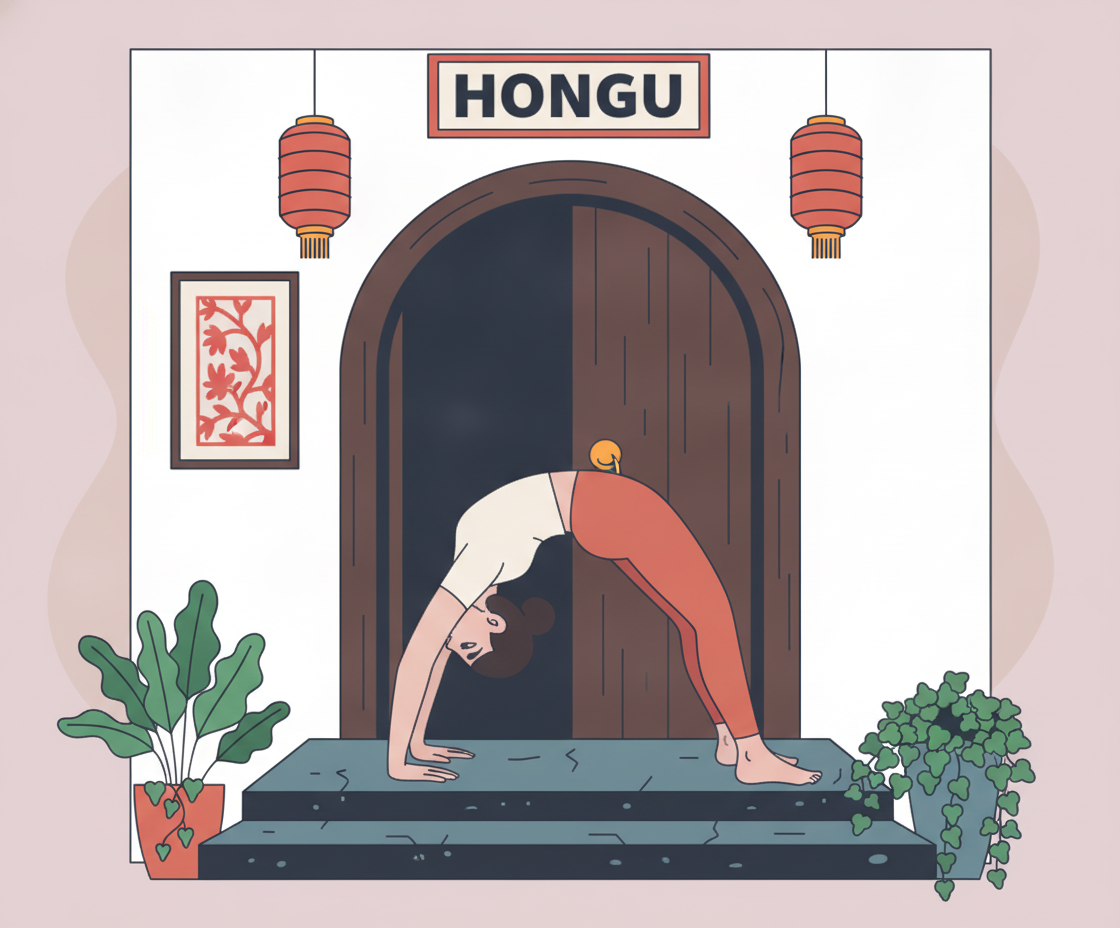
A woman performing a backbend yoga pose in front of a traditional arched doorway.
The Heart Chakra (Anahata) and the Anatomy of Love
What is Anahata and why it matters
In the yogic map of the body, Anahata is the fourth chakra, sitting right at the center of your chest. It's the hinge point of the whole system: three energy centers below it deal with survival, desire, and personal power, three above it deal with expression, insight, and something beyond the individual self. Anahata is the bridge. This isn't a scientific claim, it's a traditional framework, one that Yogawiki describes as the seat of compassion and love as core inner attitudes, not just feelings that pass through you.
Here's the part worth sitting with. Anahata is where self-love stops being self-interest and starts becoming the capacity to love beyond yourself. YogaEasy.de frames the heart chakra as the site of selfless, loving expression and compassion, which is a specific claim: not just "feel good things," but a transformation of energy from personal to universal. An open heart, in this tradition, runs on trust, generosity, and real contact with other people. A defended heart runs on walls, suspicion, and quietly avoiding anything that might hurt again. Same chest, two completely different operating systems.
How blocked heart energy shows up in your life
A blocked Anahata rarely announces itself. It shows up sideways. You struggle to actually receive love, compliments slide off, help feels like a debt. Or you swing the other way and give endlessly with no boundaries, then wonder why you feel hollowed out. Your chest carries a low, constant tightness that has nothing to do with fitness. You feel lonely at a dinner table full of people who like you. You catch yourself judging strangers harshly for things you'd forgive instantly in yourself.
None of that requires a dramatic backstory. It can happen to someone whose life looks, from the outside, completely fine. That's the point of understanding Anahata as energetic rather than purely psychological: the block isn't about your circumstances, it's about whether love is actually able to move through you, in both directions. This is the ground the rest of this guide works with, whether you arrive through herzchakra öffnen practices, metta meditation, or the simple ache of wanting to feel less walled off.
Why Your Heart Closes (and How Yoga Reverses It)
The nervous system's role in emotional armor
Here's the part most people never get told: a closed heart isn't a metaphor your therapist made up. Polyvagal theory, developed by neuroscientist Stephen Porges, describes how your autonomic nervous system constantly scans for safety or threat, a process called neuroception, and responds without asking your permission. When it senses danger, real or remembered, it doesn't just spike your heart rate. It reorganizes your entire chest.
Chronic stress and unresolved hurt can trigger what's called a dorsal vagal shutdown, a survival state where your system collapses inward to protect itself, and your chest physically caves as part of that response. This isn't the fight-or-flight sprint everyone knows. It's the older, slower system: the freeze, the numbness, the quiet withdrawal. Your ribs draw in. Your heart, anatomically, loses room to move.
How breath and posture lock the heart
Once that pattern sets in, your body starts defending it out of habit. The diaphragm tightens and stops doing its full job. The intercostal muscles between your ribs shorten, so each breath moves less air. The vagus nerve, which runs from your brainstem through your throat and chest and governs how quickly you can calm down after stress, loses tone. A low-tone vagus nerve means your body stays braced longer, even when nothing is actually threatening you anymore.
Hunched shoulders reinforce it. Shallow breathing reinforces it. Swallowing what you actually feel instead of saying it reinforces it. None of this is weakness. It's tissue and nerve memory doing exactly what it learned to do to keep you safe once, and now doing it by default, in a meeting, on a date, at dinner with your family.
Yoga reverses this mechanically, not just conceptually. Extended exhale breathing stimulates the vagus nerve directly, telling your nervous system, chemically, that it's safe to stand down. Over time this restores diaphragmatic breath and rebuilds vagal tone, loosening the grip that shutdown once had on your posture. What that groundwork makes possible in specific poses is where we go next.
Heart-Opening Asanas: The Direct Path
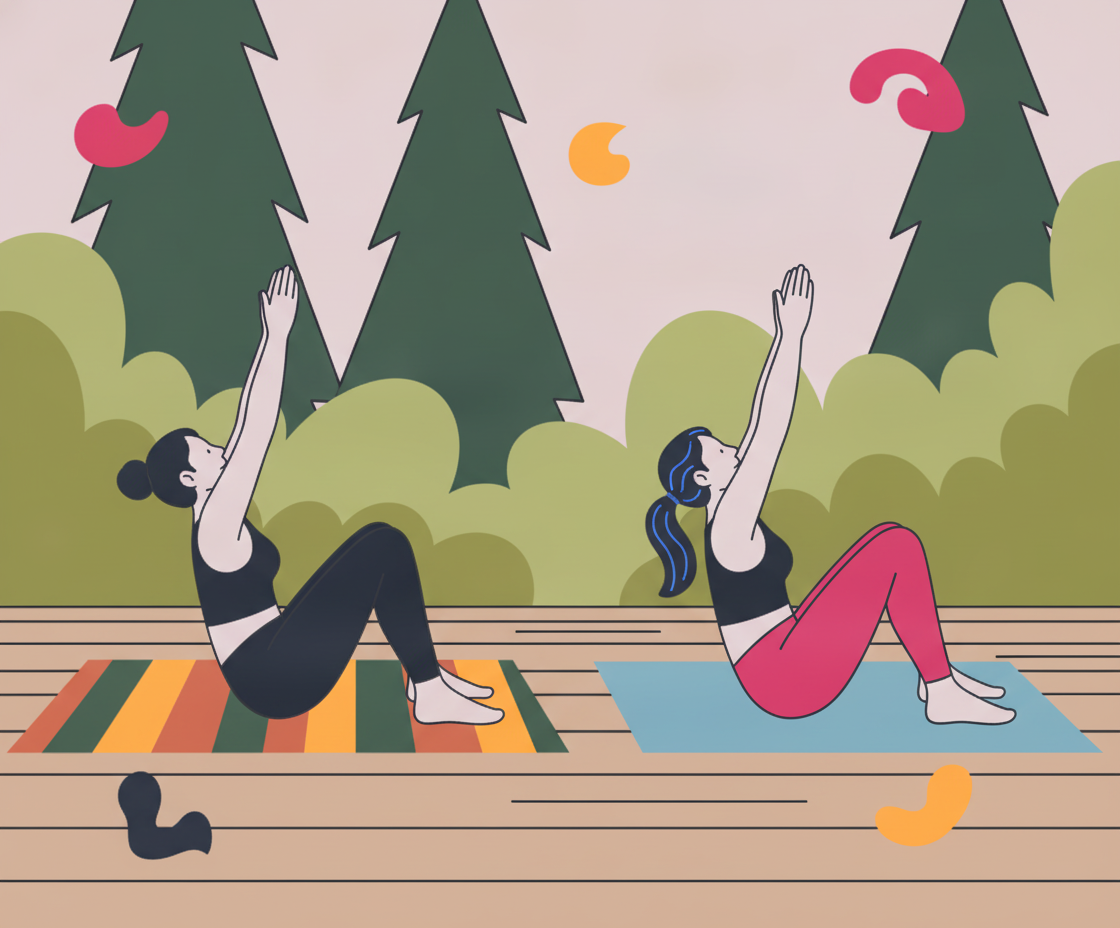
Two women doing a seated yoga pose outdoors.
Philosophy and physiology explain why the heart closes. But your body doesn't change its habits because it understood a concept. It changes because you show it, over and over on the mat, that the front body can open without anything bad happening. That's what these three asanas do: they lengthen the chest and the muscles running down your spine until your nervous system quietly reclassifies openness as safe instead of risky. No pose can hand you love. But each one gives your body a rehearsal for what receiving it might feel like.
Anahatasana (Heart-Melting Pose)
You come to hands and knees, walk your hands forward, and let your chest sink toward the floor while your hips stay stacked over your knees. The forehead or chin rests down. I've watched hundreds of students find this shape and the first thing that happens is almost always a held breath. Then, if they stay, a small release around the collarbones. This is Anahatasana, and it works because gravity is doing the opening for you. You're not reaching, you're not performing, you're just letting the chest drop into the space your arms have made.
This pose asks your body to surrender rather than reach, exactly the texture the heart needs to learn. Emotionally it often brings up something closer to grief than joy at first, a softness that feels almost too exposed. That's normal. If you catch yourself tensing your shoulders to hold the shape, that's forcing. Let them melt instead, and the pose starts doing what it's named for.
Matsyasana (Fish Pose) for chest expansion
Lying back, propped on your forearms or lowering the crown of your head to the mat, chest lifted high: Matsyasana pries the ribcage open in a way few other poses do. Students consistently tell me they can suddenly breathe into parts of their lungs they forgot existed. That's not imagination. You're physically increasing thoracic volume, and the breath follows. This pose teaches the body, in real time, that deep inhalation is available to it again.
Urdhva Dhanurasana (Wheel Pose) for deep vulnerability
Wheel Pose asks for more: strength, backbend flexibility, and a real decision to trust your own arms holding you up while your entire front body is exposed toward the ceiling. It's intense, sometimes shaky, occasionally a little frightening the first few times. That edge is the point. Urdhva Dhanurasana builds the capacity to stay open under pressure, which is exactly the skill love eventually demands of you off the mat.
Loving-Kindness Meditation: The Inner Cultivation of Love
One of my students once sat down to meditate and tried to silently say to herself, may I be happy, and started laughing. Not because it was funny, but because it felt so foreign to direct kindness at herself that her body didn't know what to do with it. That's the moment loving-kindness meditation actually begins to work. Not when it feels natural, but when it doesn't.
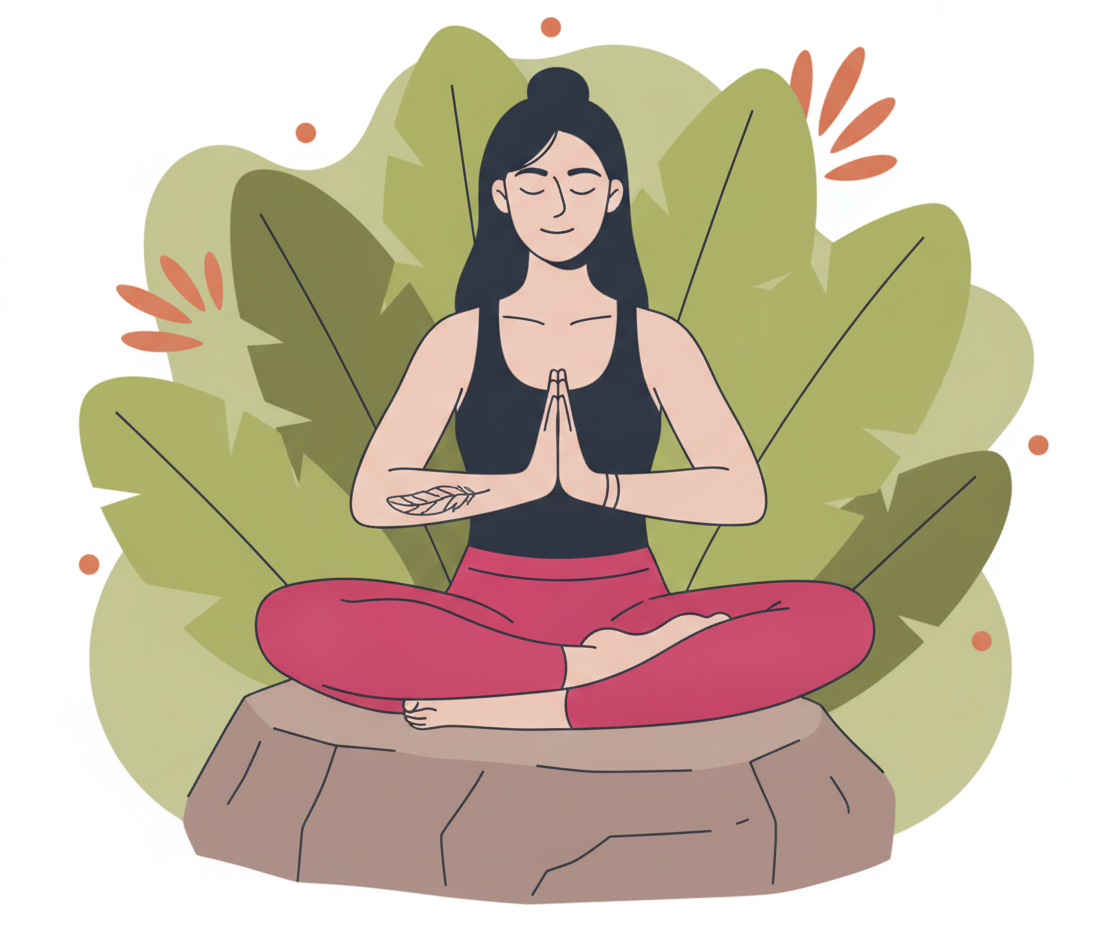
A woman meditating in a cross-legged pose on a rock with green leaves behind her.
Metta meditation as a systematic practice
Loving-kindness meditation goes by two names depending on where you learned it. In the Pali tradition it's called Metta, which means something like benevolent friendliness. In English you'll usually find it as loving-kindness meditation. Same practice, same purpose: you don't wait for love to show up on its own. You generate it, on purpose, using specific phrases, until the heart learns the route so well it stops needing the map.
The classic phrases are simple: may I be happy, may I be healthy, may I be safe, may I live with ease. You repeat them slowly, silently, letting each phrase land in the chest before moving to the next. Repetition isn't about convincing yourself of something you don't believe. It's training, the same way you'd train a muscle. Say something enough times, with attention, and the nervous system starts producing the feeling instead of just the words.
The sequence: self, loved ones, neutral person, difficult person, all beings
You start with yourself, which trips up almost everyone. Self-love as foundation gets its own space elsewhere in this practice, but here it shows up as a hard, physical fact: most people can wish a stranger well faster than they can wish it for themselves. Sit with that discomfort instead of skipping past it. Then move to someone you love easily, a parent, a partner, a dog. This part feels almost like cheating, the warmth is already there.
Next comes a neutral person, someone you don't know well, maybe the cashier you see twice a week. This is where the heart's capacity actually stretches, because you're generating warmth with no personal story attached to justify it. Then the difficult person, and this is where the real work happens. You're not required to like them. You're training your heart to offer warmth that isn't conditional on approval, which is a different skill than liking someone.
Finally, all beings, everywhere, without exception. This last stretch is the point of the whole sequence: metta practice done repeatedly appears to strengthen brain regions tied to empathy and emotional warmth, according to neuroscience research on long-term meditators. What starts as an awkward, effortful phrase eventually becomes something your nervous system does on its own, in traffic, in an argument, without you deciding to.
Self-Love as the Foundation: You Cannot Give What You Do Not Have
Here is where a lot of practitioners quietly stall out. You sit down to do a self-love meditation and some old voice in the back of your head mutters that this is indulgent, that real yoga is about service, humility, dissolving the ego, not sitting there wishing yourself well like some kind of pampered guest. That voice is wrong, and it is worth naming clearly why.
Why self-love meditation is not selfish
Anahata, the heart chakra, is described in yogic tradition as the meeting point of matter and spirit, the place where the individual self starts to reach past its own boundaries. YogaEasy's writing on Anahata connects it directly to compassion and selfless expression. But notice the order of operations: a heart cannot express what it has not first learned to hold. Yogawiki's teaching on heart-opening frames compassion and love as the central inner postures, and both begin at home, in you.
Think of the oxygen mask instruction on a flight. You put yours on first, not because your child matters less, but because an unconscious parent helps no one. Self-love meditation works the same way. You are not skipping past service to others, you are building the well you will actually serve them from. A heart closed to itself is simply closed. It doesn't have a separate, generous setting reserved for everyone except the person carrying it.
The paradox: love for others flows from love for self
This is not the same as self-obsession. Self-love isn't the endless self-improvement project, the comparison spiral, the perfectionism that measures your worth against someone else's highlight reel. That's a different animal entirely, closer to anxiety wearing a wellness costume. Genuine self-love is quieter: respect for your own struggles, acceptance of what you actually are today, not the polished future version.
When you meditate on loving yourself, silently offering yourself the same phrases you'd offer a friend, you are teaching your nervous system a new belief: I am worthy of kindness. That belief does not stay contained. It leaks outward, because a heart that trusts its own worth stops needing others to prove it. Without that foundation, love for others curdles into resentment, over-giving, or boundaries that collapse the moment someone needs too much. Self-love isn't the detour from loving others well. It's the only road that actually gets you there.
This kind of devotion, offering yourself the same warmth you'd give a friend, is exactly what the mantra Om Namo Bhagavate Vasudevaya stands for: surrender, devotion, and love as a way of moving through life. As a daily reminder, our Krishna shirt keeps that open-hearted attitude close to your chest, so you carry Krishna with you at all times.
Here's the thing nobody tells you in a workshop: heart-opening yoga doesn't live on the mat. It lives in the three seconds after your partner says something sharp and your jaw tightens. It lives in the meeting where a colleague takes credit for your work. Those ordinary, unglamorous moments are the actual practice. Anahata doesn't get trained in stillness. It gets trained under pressure, the same way a muscle gets trained under load.
Micro-practices for the workplace and difficult relationships
Next time criticism lands, before you speak, pause and drop attention into your sternum. Just one breath. That pause interrupts the ego's reflex to defend and gives the heart space a chance to weigh in instead. In a tense conversation, use the chest as your breathing anchor: inhale into the upper ribs, exhale slowly, and let that physical softening happen before you respond to anything.
Picture this: your partner says you never listen, and something in you wants to fire back with every time you've listened and they haven't noticed. Instead, you feel the heat rise in your chest, take one slow breath into the upper ribs, and just stay there a moment longer than feels natural. You say nothing yet. You just listen to the rest of the sentence. That single pause, chest first, mouth second, is the entire practice in miniature.
Genuine listening is a heart practice, not a mental one. When you're rehearsing your comeback while someone talks, you've left the chest and gone straight to the head. Real listening means staying in the body long enough to feel what the other person is actually carrying, not just what they're saying. Students who try this for a week, even badly, usually report the same thing: fewer arguments escalate the way they used to.
How to know your heart is actually opening
It's rarely dramatic. Mostly it's a small, unglamorous softening across the chest, like a fist unclenching you didn't know was clenched. There's a subtle shift in perspective too: instead of "me versus them," you suddenly see "both of us struggling right now." Sometimes there's a spontaneous urge to reach out, text an apology, or simply drop an argument you were winning. That urge is data. Honor it.
None of this means going soft on mistreatment or accepting whatever comes your way. An open heart still says no, still leaves the room, still ends the relationship if it needs to. Boundaries and emotional availability aren't opposites, they're what makes real openness sustainable instead of naive. Each time you choose compassion over defensiveness in a real moment, even imperfectly, you're not just practicing metta meditation in theory. You're rewiring your actual baseline, one ordinary Tuesday at a time.
The Path Forward: Sustaining Heart-Opening as a Lifelong Practice
Here's the thing nobody tells you at the start: there's no final pose, no last meditation session, after which your heart stays open forever. Anahata, the nervous system, the asanas, the metta practice, the daily choice to soften instead of armor up. None of these are separate projects you complete. They're one continuous motion, and the motion doesn't stop. Opening your heart for love isn't a destination you arrive at. It's a return you keep making, each time a little deeper, a little more stable, until one day you notice love isn't something you're doing anymore. It's just who you are.
That brings up a paradox worth sitting with. This whole practice asks two things of you that seem to contradict each other. One: work at it. Show up for the backbends, breathe with intention, sit with metta meditation even when your mind wanders off to your grocery list. Two: accept, without flinching, exactly how closed your heart is today. Not the heart you wish you had. The one you've actually got, guarded chest and all. Real heart-opening yoga holds both. Effort without acceptance turns into striving and self-punishment. Acceptance without effort turns into resignation. You need both hands on the wheel.
Your Next 40 Days
So don't try to do everything in this article at once. Pick one thing. Camel pose, or ten minutes of loving kindness meditation before bed, or a single daily intention like pausing before you react defensively. Then commit to that one practice for 40 days. This number isn't arbitrary. It's a classical yoga timeframe because it's roughly how long your nervous system needs to stop treating a new pattern as a threat and start recognizing it as familiar, as safe. Forty days is long enough to matter and short enough that you won't quit by week two.
A more open heart isn't a nice-to-have you get to once the rest of life is sorted. It's the foundation underneath your health, your relationships, your capacity to feel connected to anyone at all. Self-love meditation, herzchakra öffnen work, an honest breath in a hard conversation: they're all pointing at the same thing. Start with one. Let it be imperfect. Let it be enough for today.
Sources & further links
The three articles below give you the background on Anahata and the science of love that shaped this guide. But if you want to take the practice further than a page can carry you, a few real places and resources are worth knowing about. I have not tried all of them myself, but they represent the range of what is actually out there, from a weekend somewhere nearby to a ten-day silent retreat that will ask a lot more of you.
In Germany, the Anahata Yoga & Healing Center in Dusseldorf runs its retreats on a donation basis and builds its entire philosophy around the fourth chakra: heart-opening practices, sound, and stillness woven into a few days away from your usual routine. If you would rather travel further, the Anahata Transform Centre offers five-day retreats that focus specifically on opening the heart, cultivating love, peace, and a steadier kind of happiness. And if the Buddhist lens on this work speaks to you more than the chakra system, Source Yoga's Brahma Viharas retreat explores the four qualities, loving-kindness, compassion, sympathetic joy, and equanimity, as a direct path to the same open heart Anahata describes.
You do not need to book a flight to start, though. Insight Timer hosts a large library of free guided meditations specifically for the Anahata chakra, built around love, compassion, and emotional balance, which makes it a reasonable place to practice the loving-kindness work mentioned earlier in this guide without any cost or commitment.
For those who want to go deeper into the kind of inner opening that no asana alone can give you, the Vipassana Meditation Centre in Triebel runs two ten-day Vipassana courses every month. It is demanding, silent, and not a heart-chakra retreat in name. But insight meditation of this depth tends to soften exactly the defenses this guide has been talking about, the ones that keep your heart guarded long after the original hurt is gone.

 AsanaHerzöffnerAnahatasanaZur Asana →
 AsanaFischMatsyasanaZur Asana →
 AsanaRadUrdhva DhanurasanaZur Asana →