Ask any Indian classical musician before a performance and they will tell you the same thing: bow to Saraswati first. I have seen this backstage before concerts in Chennai, a quick touch of the instrument to the forehead, a silent nod toward her. Saraswati, goddess of knowledge and the arts, is not some background character in the Hindu pantheon. She is the current running underneath every insight you have ever had, every melody that moved you, every moment a blank page suddenly filled itself with words. This is not nostalgia for old mythology. It is a working philosophy of consciousness, one that treats intelligence and artistry as sacred rather than accidental. Over the next sections we will get into who she actually is, what she represents psychologically and spiritually, and how you can invite her clarity into your own thinking, learning, and creative practice, starting today.
Saraswati: Goddess of Knowledge and the Arts in Hindu Tradition
The Origins and Divine Attributes
Saraswatis heilige Symbole: Die Veena, Blüten und ritueller Schmuck
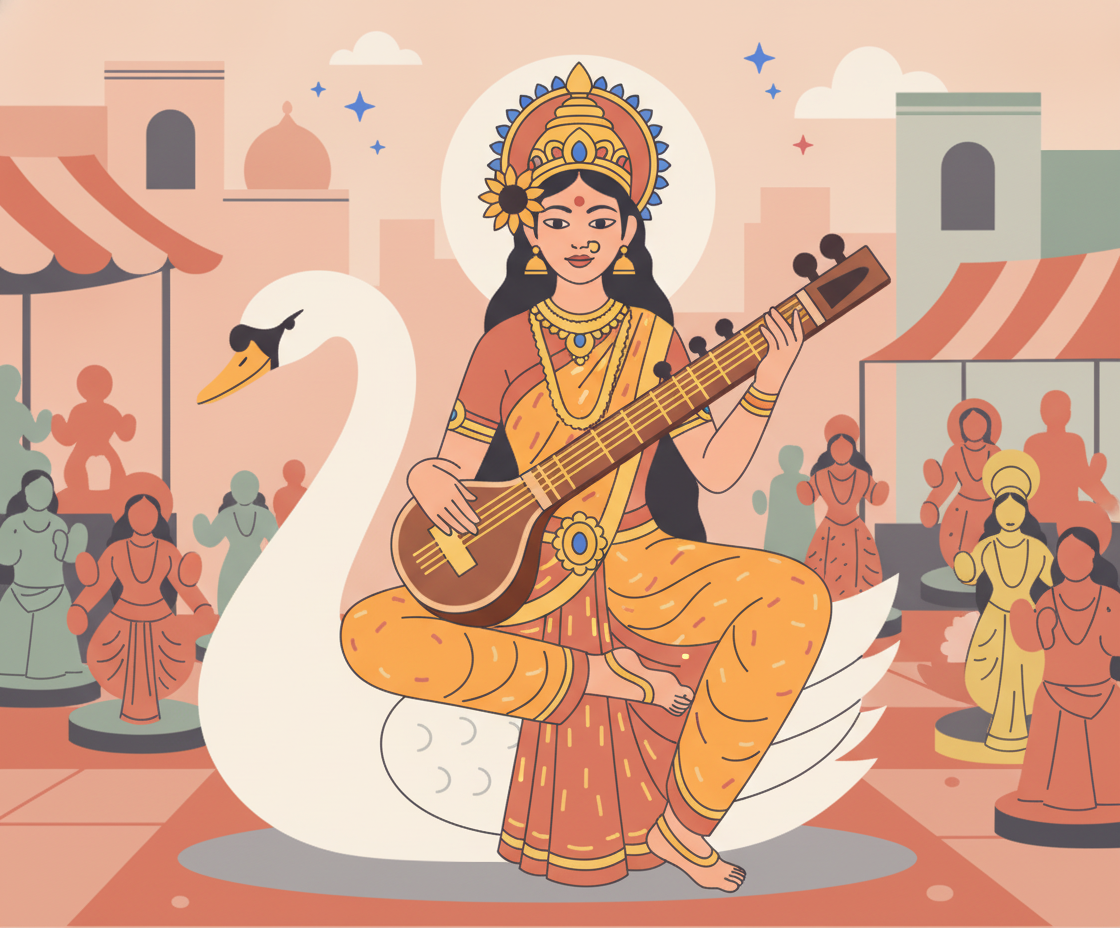
In Hindu mythology, Saraswati represents the goddess of knowledge, wisdom, and the arts, and honestly, that description barely scratches the surface. She's usually pictured sitting on a white lotus, dressed in white herself, holding a veena in her hands. The white isn't decoration. It's a symbol for purity of thought, for a mind that isn't clouded by ego or clutter. A swan often sits near her feet too, an animal that, according to legend, can separate milk from water, which is basically a metaphor for discernment: the ability to tell what's true from what's just noise.
That veena in her hands matters too. Music, art, language, all of it flows through her. She's not some distant deity of dry facts and textbooks. She's the current that turns raw perception into something expressed, something shared. When you're stuck creatively or mentally foggy, that's often described as Saraswati's energy feeling blocked, not absent, just waiting for you to clear the channel.
Saraswati's Role in Creation and Learning
Tradition credits Saraswati with creating the Sanskrit alphabet itself, giving humans the very structure needed to think in language and pass down wisdom across generations. That's a big deal. Before her, in the old stories, there was only sound without form. She gave that sound shape, syntax, meaning. It's why she's still honored in schools and universities today, invoked before exams, before new academic years, before anyone picks up a pen to actually learn something real.
Psychologically, I think this is where she gets really interesting. Saraswati isn't about hoarding information. She's the bridge between scattered data and integrated understanding, the difference between memorizing a fact and actually knowing something in your bones. Most seekers I've worked with hit a point where they've read enough, studied enough, and still feel lost. That's the gap Saraswati bridges: turning input into insight, noise into clarity, which is exactly what a proper Saraswati Puja or a quiet Saraswati mantra practice is meant to invite in.
The Spiritual Symbolism of Saraswati: Creativity, Beauty, and Inner Wisdom
Sacred Symbols and Their Meanings
Look at any depiction of this goddess of knowledge and the arts and you'll notice she's never showing off. The veena resting in her hands isn't decoration, it's the whole point. Stringed instruments need tension and space in equal measure to make music, and that's basically the operating manual for a creative mind. Too tight and you choke the sound, too loose and nothing resonates. The sacred texts she carries point to knowledge that's actually been lived and studied, not just downloaded and forgotten. Her white sari is unapologetically simple, representing a mind clear enough to perceive beauty without the usual mental static getting in the way. And the swan she rides on carries a specific skill: legend has it the bird can separate milk from water, which is basically a metaphor for discriminative wisdom, or knowing what's essential from what's just noise.
Saraswati and the Flow of Consciousness
Tiefe Meditation in Lotus-Position zur Aktivierung der inneren Weisheit
Here's where it gets interesting for your practice. Saraswati's energy is traditionally linked to the Muladhara Chakra, the root center at the base of the spine. That might seem like an odd pairing since we usually associate creativity with the throat or third eye, but her grounding at the root reminds you that inspiration needs roots before it can grow anywhere. You can't build lasting artistic expression on shaky foundations. As one overview on Saraswati puts it, she embodies inspiration, creativity, beauty, knowledge and wisdom, with a direct connection to that same root center. When you sit with a Saraswati mantra or work through a Saraswati Puja, you're essentially asking dormant capacities, the ones buried under deadlines and self-doubt, to wake up and find stable ground to stand on before they express themselves outward.
Saraswati Mantras and Spiritual Invocation Practices
Om Aim Saraswatyai Namaha: The Sacred Sound
If you learn one Saraswati mantra, make it this one: Om Aim Saraswatyai Namaha. Break it down and it makes sense fast. Aim is the seed sound, the Bija Mantra, associated with Saraswati herself, tied to speech, intellect, and creative expression. Saraswatyai Namaha simply means salutations to Saraswati. Chant it slowly and you feel the vibration sit right at the throat and soft palate, exactly where language originates in the body. That's not a coincidence. Yogawiki describes Saraswati as the goddess of knowledge, wisdom, and the arts in Indian mythology, and this mantra is essentially a direct line to that domain, a sound designed to clear static in the mind before study, writing, or performance.
Saraswati Puja and Ritual Practice
Saraswati Puja gives this invocation a structure. Books, instruments, and pens get placed near her image, a small but pointed gesture: the tools of learning are sacred too, not separate from spirit. Her birthday is marked on Vasant Panchami, which falls on Magha Shukla Panchami, the fifth day of the bright fortnight of the lunar month of Magha. Schools and art institutions across India often pause formal lessons that day so students can honor the source of what they're trying to absorb. Worth noting for anyone researching this further: the name Saraswati Jayanti is also used for the birth anniversary of Maharishi Dayanand Saraswati, observed separately in February. Different person, same name, easy to mix up if you're reading quickly.
It sounds ceremonial, but functionally it works like a reset button for the nervous system, a permission slip to approach knowledge with reverence instead of anxiety. There's real psychology underneath the ritual. Repeating a mantra narrows attention the same way a breath count does in meditation, quieting the default mode network chatter that usually drowns out focus. Some research on sound frequency and cognition suggests certain vibrational patterns can shift brainwave activity toward calmer, more alert states, the same territory artists describe when they hit flow. You don't need to take my word on the mysticism. Just sit with the mantra for five minutes before you write or paint and notice what softens.
Yogic Practices for Awakening Saraswati's Energy: Asanas and Meditation
Foundational Poses for Mental Clarity
Start simple. Sukhasana, Easy Pose, is where I put every student before we talk about Saraswati at all. You cross your shins, lengthen the spine, let the hands rest on the knees. Nothing fancy, but that stillness is exactly what the goddess of knowledge asks for. A scattered mind can't absorb anything, no matter how sharp it is. Sukhasana builds the quiet, grounded base your nervous system needs before real learning or focused study can happen. I've watched students who fidget through their first ten breaths settle into something steadier by breath thirty, and that's the whole point.
Once that base feels stable, Padmasana, Lotus Pose, takes it further. It's the classic meditation seat for a reason. The hip opening and the locked, self-supporting shape of the legs free up the breath and settle the mind in a way that Sukhasana only begins. In the Hindu tradition, this is where you stop just concentrating and start listening inward. Padmasana opens the door to intuitive wisdom and creative flow, the kind of insight that doesn't come from memorizing facts but from sitting quietly enough to let something arise on its own.
Sirsasana, Headstand, is where things get interesting philosophically. Physically it's demanding, you need shoulder strength and a teacher's eye before you attempt it alone, but energetically it flips your whole relationship to gravity and blood flow toward the crown of the head. This is the seat of higher consciousness in the subtle body, and inverting there stimulates a kind of mental clarity that sitting practices alone rarely reach. Students often tell me their best ideas show up upside down, which tracks with what the old texts say about knowledge needing to move through the body, not just the intellect, before it becomes wisdom.
That's really the throughline of any saraswati puja combined with asana practice. Information sitting in your head is just data. Saraswati's blessing, if you want to call it that, is what happens when that data drops into the body and becomes something you actually embody, whether that's a raga, a poem, or a hard-won insight. The postures aren't decoration around the devotion. They're the mechanism.
Kopfstand als fortgeschrittene Praxis für kreative Aktivierung und Bewusstseinserweiterung
Saraswati for Modern Learners and Artists: Applying Ancient Wisdom Today
Invoking Saraswati in Academic and Creative Pursuits
Here's the thing about modern education: it's built like a warehouse, subjects stacked in separate boxes, math over here, art over there, never touching. Saraswati doesn't work like that. She's the goddess of knowledge and the arts in one single form, which is a pointed philosophical statement. She's honored in schools and universities across India, and tradition even credits her with creating the Sanskrit alphabet itself. That's not a small myth detail. It tells you language, logic, and beauty were never meant to be separate departments.
So if you're a student drowning in disconnected facts, or an artist who feels like your craft has gone mechanical, invoking Saraswati isn't about lighting incense and hoping for inspiration. It's a practical reframe. Before you sit down to write, paint, or study, pause and ask what you're actually trying to understand, not just complete. I've watched students in my classes shift from anxious cramming to genuine curiosity once they treat their desk like a small altar instead of a battlefield.
The Psychology of Knowledge and Authentic Expression
There's a real gap between information and wisdom, and your nervous system knows the difference even when your brain doesn't. Information sits in your head, tense, ready to be tested. Wisdom drops lower, into the gut, the breath, the way you move through a room. Saraswati embodies inspiration, creativity, beauty, knowledge, and wisdom together, with a traditional link to the Muladhara chakra, the root center. That's telling: real understanding needs grounding, not just accumulation.
This is where a Saraswati mantra earns its keep. Chanting isn't decoration, it slows the breath, quiets the mental noise of comparison and performance anxiety, and lets whatever you've learned actually settle. Saraswati puja, done at home or in a studio, works the same way: it's a ritual pause that separates gathering knowledge from digesting it. Among Hindu goddesses, she's less about power and more about clarity, reminding you that competence without presence is just noise dressed up as skill.
The mantra Om Aim Saraswatyai Namaha stands for clarity over confusion, authentic expression over performance anxiety, and wisdom over scattered facts. As a daily reminder there is our Saraswati shirt, so you carry her flow with you every time you sit down to learn, create, or speak your truth. As a daily reminder there is our Saraswati shirt, so you carry this attitude with you in everyday life.
Conclusion: Integrating Saraswati's Wisdom into Your Spiritual and Creative Path
Here's the thing nobody tells you about Saraswati, goddess of knowledge and the arts: she was never meant to live on an altar. She's meant to live in your spine when you sit down to write, in your hands when you pick up an instrument, in the pause before you speak so what comes out actually means something. All that mythology, the swan, the veena, the white sari, it's pointing at something happening right now in your own nervous system. The river hasn't dried up. You just stopped listening for it.
So skip the part where this stays theoretical. Pick one small door and walk through it daily. Chant the Saraswati mantra, Om Aim Saraswatyai Namaha, for five minutes at your desk before work starts, letting the seed sound Aim vibrate behind your throat where clarity actually gets born. Or hold a grounding asana like Vajrasana for a few breaths, spine long, letting the fidgety mind settle before you create anything. Or just journal for ten minutes with one honest question: what do I actually know here, versus what am I just repeating? That's it. That's the whole practice.
You don't need a formal Saraswati puja or an altar full of marigolds to access this, though there's nothing wrong with either if that's your language. What matters is remembering you're not separate from her. You're a vessel she flows through when you stop clutching and start listening. Among the vast field of Hindu goddesses, she asks the least and gives the most: just make space, and let what's true move through you instead of what's merely impressive.
Sources & further links
If you want to go deeper than this article, here are a few directions worth following, both for study and for practice.
Places and practices to explore
If you ever travel through South India, the Gnana Saraswati Temple in Basar is worth knowing about. It sits on the banks of the Godavari River in Telangana and is one of the most revered and visited Saraswati temples in the country. Pilgrims come here specifically for blessings on learning, often bringing young children for their first formal introduction to letters, a small ceremony that treats knowledge itself as sacred ground.
On the sound side of practice, look into the Medha Suktam, a Vedic chant that calls on Saraswati's energy directly. It is traditionally used by students before exams and by anyone who wants to sharpen focus before demanding mental work. I have used it myself before writing sessions that needed real clarity, and there is something to the repetition that settles the mind before the reasoning even starts.
Architecture carries this devotion too. The Dilwara Jain Temple in Rajasthan honors Maha Saraswati especially during Vasant Panchami, and the marble carving there is itself a kind of tribute to her domain: the temple's artistry, precision, and craft are treated as expressions of the same creative intelligence the goddess represents.
Research worth reading
On the science side, a study published on ResearchGate titled Neurophysiological and Cognitive Benefits of Mantra Chanting found meaningful correlations between mantra chanting and improvements in cognitive and affective performance. It does not prove that Saraswati grants wisdom, that is a matter of faith and lived tradition, but it does support what practitioners have long felt: that sustained, rhythmic sound practice measurably affects how clearly and calmly the mind works.