Asanaverse

Yoga Sequence

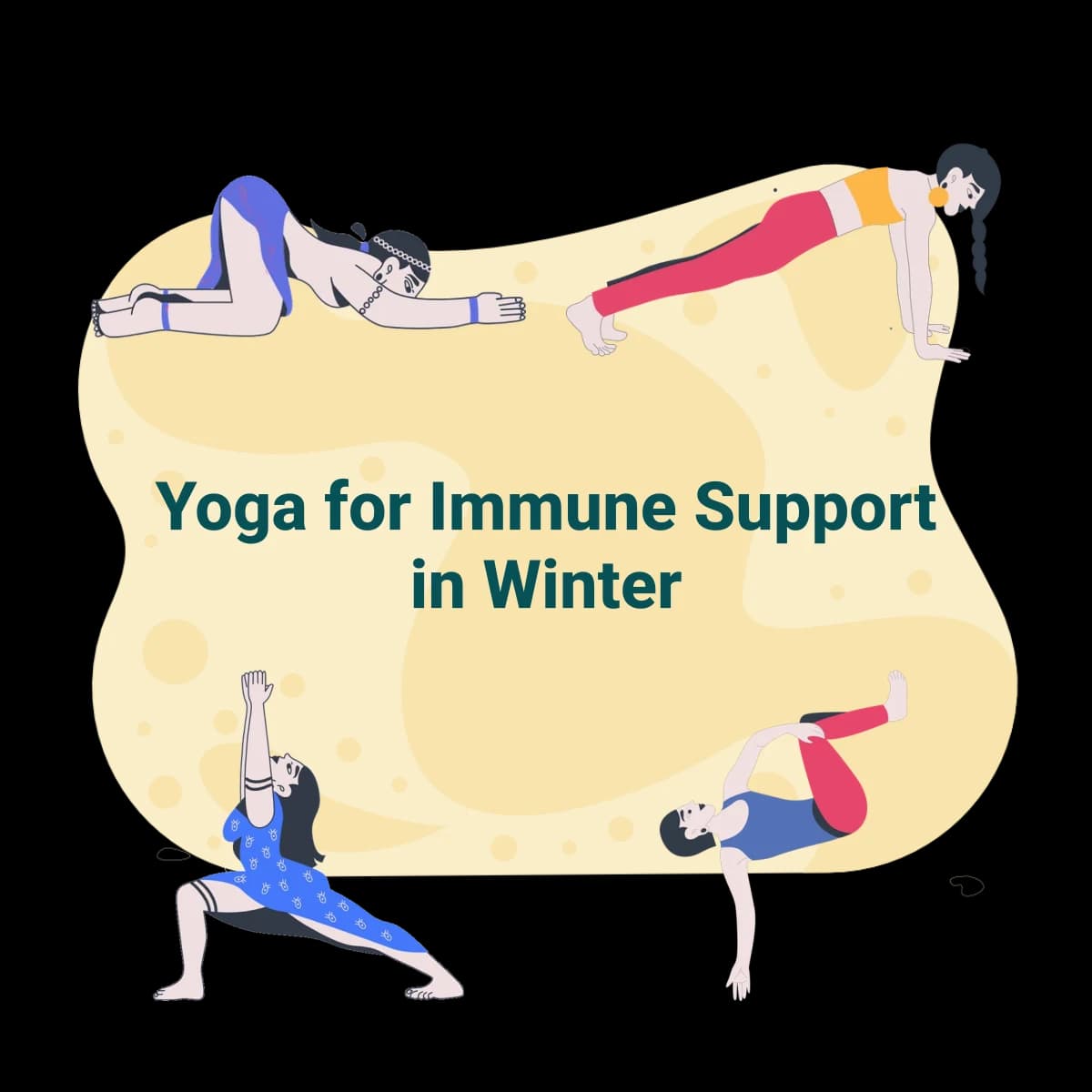
Yoga for Immune Support in Winter

Forty minutes of twists, warmth and one quiet inversion

Late nights, too much sitting, dry indoor air and a season that makes leaving the house feel optional. Nothing here will stop you catching a cold. What a regular practice does is smaller and better documented than the usual claims: it lowers the low grade inflammation that chronic stress keeps switched on, and it does that through repetition rather than through any single session. This practice is built to be repeatable. It warms you from the inside with standing poses, wrings the middle out with four twists, and ends with your legs up the wall instead of a headstand, so that doing it on a tired evening stays realistic.

40 min · Level 2
When it helps

The stretch between November and February, when you are indoors more, moving less, and everyone around you is coughing. Also useful in the week after a run of short nights, which is when most people notice they are getting run down. Forty minutes. A wall for the last pose, and a folded blanket for the seated twists if your hips are tight. No other props.

Physical effect

Four twists across the practice, two standing and two on the floor, plus the standing poses that actually make you warm. Twisting moves the ribcage and the diaphragm through their full range, which is the part of breathing most people lose by January.

What the research supports

Reviews of randomised trials find that regular yoga lowers pro inflammatory markers, most consistently interleukin 1 beta, with signals for interleukin 6 and TNF alpha (Falkenberg 2018). The effect tracks total practice time rather than intensity: above roughly 1,000 minutes accumulated, results improve (Djalilova 2019). That is around twenty five sessions of this length.

Mental effect

The inversion at the end is not the dramatic kind. Five minutes with your legs up a wall is the part people skip and the part that makes the practice worth repeating on an evening when you nearly did not bother.

Wake the spine up

On hands and knees, moving with the breath. The spine has not gone anywhere overnight, it has just stopped being asked.

Cat PoseMarjaryasana
01
6 breaths

Cat Pose

Round the back on the exhale, look towards your navel.

Cat and Cow are the cheapest way to find out what kind of back you have today.

Learn more about Marjaryasana
Cow PoseBitilasana
02
6 breaths

Cow Pose

Chest forward on the inhale, throat long, no crunching in the lower back.

The counter shape. Together the two of them move every segment of the spine before anything is asked of it.

Learn more about Bitilasana
Heart-Melting PoseAnahatasana
03
1 min

Heart-Melting Pose

Hips stay above the knees. Chest and forehead melt towards the floor, arms long in front.

Melting Heart opens the front of the chest and the armpits, which is where a winter of hunching collects.

Learn more about Anahatasana
Thunderbolt PoseVajrasana
04
3 breaths

Thunderbolt Pose

Just sit back on your heels and breathe.

A neutral spine between the backbend and the fold. Three breaths, and the two shapes stop cancelling each other out.

Learn more about Vajrasana
Child's PoseBalasana
05
1 min

Child's Pose

Knees wide or together, whichever lets the belly soften.

Child's Pose is the first inversion of the practice. Your heart is above your head and nothing is being asked of you.

Learn more about Balasana
Downward-Facing DogAdhomukha Shvanasana
06
8 breaths

Downward-Facing Dog

Bend the knees generously. A long spine matters more than straight legs.

Downward Dog is the transition from floor to standing. It also gets the blood moving in the direction the rest of the practice will use.

Learn more about Adhomukha Shvanasana

Build heat, then wring it out

This is where you get warm. Chair into a twist is the fastest honest way to raise your temperature without jumping around.

Chair PoseUtkatasana
07
8 breaths

Chair Pose

Weight in the heels, knees together, arms up beside the ears.

Chair Pose is the largest muscles in the body under load. Warmth comes from working, not from a heated room.

Learn more about Utkatasana
Revolved Chair PoseParivrtta Utkatasana
08
5 breaths per side

Revolved Chair Pose

Hands at the heart, one elbow outside the opposite thigh. Keep the knees level with each other.

The first twist, and it arrives while you are already warm. Twisting a cold spine is how people hurt themselves.

Learn more about Parivrtta Utkatasana
Plank PoseUtthita Chaturanga Dandasana
09
5 breaths

Plank Pose

Shoulders over wrists, ribs drawn in, one long line from heel to head.

The hardest pose in the practice sits here on purpose, at the top of the curve, with everything after it going gently down.

Learn more about Utthita Chaturanga Dandasana

Standing, open and warm

Five standing poses in a row. This is the block that makes the difference between feeling stretched and feeling warm.

Warrior IVirabhadrasana 1
10
6 breaths per side

Warrior I

Back heel down and turned in, hips facing forward, arms up.

Warrior 1 keeps the hips square and lifts the chest. It is the standing version of what Melting Heart did on the floor.

Learn more about Virabhadrasana 1
Warrior IIVirabhadrasana II
11
6 breaths per side

Warrior II

Open the hips to the side, front knee tracking over the middle toes, arms level.

The hips turn out here, which takes a moment. Do not rush the change, it is the one transition in this practice that deserves a breath of its own.

Learn more about Virabhadrasana II
Peaceful WarriorShanti Virabhadrasana
12
4 breaths per side

Peaceful Warrior

Back hand slides down the rear leg, front arm reaches up and back. Keep the front knee bent.

A side bend between two open hip poses. It lengthens the ribs on one side, which is exactly the part of the ribcage that stops moving when you are cold and braced.

Learn more about Shanti Virabhadrasana
Triangle PoseTrikonasana
13
6 breaths per side

Triangle Pose

Both legs straight, reach out before you go down, hand to the shin rather than forcing the floor.

Triangle is a twist wearing a side bend, and it asks less of the lower back than a seated twist does.

Learn more about Trikonasana
Wide-Legged Standing Forward BendPrasarita Padottanasana
14
1 min

Wide-Legged Standing Forward Bend

Feet parallel and wide, hands under the shoulders, head heavy.

The second real inversion. Head below the heart, hamstrings long, and no drama about it.

Learn more about Prasarita Padottanasana

Down to the floor and turn

Two more twists, both on the floor, where the legs are not holding you up and the spine can do the work.

Downward-Facing DogAdhomukha Shvanasana
15
5 breaths

Downward-Facing Dog

Pedal the heels, then hold still.

The way down. Standing straight to sitting is a bigger jump than it looks after fourteen poses.

Learn more about Adhomukha Shvanasana
Child's PoseBalasana
16
5 breaths

Child's Pose

Forehead down, arms wherever they are comfortable.

A pause between the standing work and the floor work, and a chance for the wrists to stop carrying you.

Learn more about Balasana
Half Lord of the FishesArdha Matsyendrasana
17
8 breaths per side

Half Lord of the Fishes

Sit up tall first, then turn. Lift out of the waist on the inhale, turn a little further on the exhale.

The classic seated twist. Turning from a tall spine rather than cranking with the arm is what makes it useful rather than just uncomfortable.

Learn more about Ardha Matsyendrasana
Cow Face PoseGomukhasana
18
6 breaths per side

Cow Face Pose

Arms only is enough. One elbow up, one hand up the back, a strap between them if they do not meet.

Cow Face arms open the shoulders and the side of the ribcage. If your breathing feels shallow in winter, this is often the reason.

Learn more about Gomukhasana
Reclining Belly TwistJathara Parivartanasana
19
1 min per side

Reclining Belly Twist

On your back, knees over to one side, both shoulders staying down.

The last twist, and the one that costs nothing. This is the shape people mean when they say a twist wrings you out.

Learn more about Jathara Parivartanasana
Knees to Chest PoseApanasana
20
1 min

Knees to Chest Pose

Both knees in, hands behind the thighs, lower back long on the floor.

Back to the middle after turning both ways. It resets the spine before you stop moving altogether.

Learn more about Apanasana

Upside down, then still

The inversion at the end is the quiet kind. Do not skip it because it looks like nothing is happening.

Legs Up the WallViparita Karani
21
5 min

Legs Up the Wall

Sit sideways to a wall, swing the legs up, shuffle your seat close. A folded blanket under the hips if it helps.

Every effect an inversion is credited with, this one has too. It is also the only inversion you will still do in week ten, which is the point.

Learn more about Viparita Karani
Corpse PoseSavasana
22
5 min

Corpse Pose

Slide the legs down, palms up, and stay longer than feels necessary.

Five minutes, not two. The stress response you are trying to interrupt does not switch off on a shorter timer.

Learn more about Savasana

Integration

Three times a week beats one long session. The dose that shows up in the research is cumulative, so a short practice you actually keep doing is worth more than a strong one you abandon in week two. If you only have fifteen minutes, take the first six poses and the last three, and leave the standing sequence out.

Go deeper into the poses

Every asana in this practice has a page of its own. You will find alignment cues, what the shape actually works on, and the energetics behind it.

Open the Asana Lab

Make it yours

Keep this practice in your library, print it for the mat, or build your own sequence from all 108 asanas.

Create a free account