Asanaverse

12 week program

12 Week Yoga Program for Lower Back Pain That Keeps Coming Back

Your back has hurt for months. It settles for a few weeks, then returns, and somewhere along the way you started moving carefully without ever deciding to. Lifting, bending and sitting through a long afternoon all cost more than they used to.

Twelve weeks to move your spine through its full range again, carry load without bracing, and know what to do on your own when the pain comes back.

Most yoga for back pain is a single gentle session, repeated forever. It feels good and it changes very little, because a body only adapts to something that gets slightly harder over time.

This program is built the way the research built it. Three phases of four weeks. The first four weeks are about movement being available again. The middle four add strength, standing work and actual load. The last four put the pieces together into the movements daily life asks for.

Three practices a week, two longer and one short. Six sequences in total, each of them repeated for a whole phase. The repetition is the point and not a shortage of ideas.

Length

12 weeks

Practices

36 sessions

Rhythm

Three practices a week

Made for

Adults with back pain lasting longer than three months

Who this is for

  • ·Your lower back has been sore for longer than three months, and no single injury or accident started it.
  • ·You have been told it is nonspecific back pain, or nobody has found a structural cause worth treating.
  • ·You can get down to the floor and back up, even if it is slow and you would rather not.
  • ·You can find about half an hour twice a week and fifteen minutes once more.
  • ·You want to understand why a pose is in the plan rather than be told to hold it.

This is not rehabilitation after surgery, and it is not a treatment for a diagnosed condition. If your pain started with a fall or an accident, travels down a leg, or comes with numbness, weakness or any change in bladder or bowel control, the first step is a doctor and not a mat. The full list is in the practice guide.

What the research says

Yoga for chronic low back pain is one of the better studied areas in the whole field, and the honest summary is narrower than most websites suggest. A Cochrane review of 21 trials with 2,223 people found small improvements in pain and back function after about three months compared with no exercise. Compared with other back specific exercise programs, there was probably little or no difference.

So the claim worth making is not that yoga is better than other movement. It is that yoga is a plausible, well studied form of structured exercise for this problem, and structured exercise is what the WHO and NICE guidelines actually recommend for chronic primary low back pain.

The twelve week length is not a marketing number. The large trials used exactly twelve weekly sessions, including a 2024 trial that ran entirely online and still found improvements in pain and function that were still there at 24 weeks. A dose study found that once a week worked about as well as twice, which is why this program asks for less than you might expect.

See every study and guideline behind this program →

Before you start

Increased back pain was the most common side effect in the trials, and no serious harms were found. That said, some kinds of back pain need a doctor before they need a movement program. The practice guide has the full list of what to look out for and how to adjust when a flare comes.

Read the full safety notes in the practice guide →

How it works

Each phase has one longer practice and one short one, and you stay with them for the whole four weeks. Open a practice below to see every pose, its timing and the reason it sits where it does, or go to the full sequence when you are on the mat. Nothing here needs props, though a folded blanket under the head and one under the knees make the first phase considerably kinder. Two sessions a week is the dose the research supports. A third short one is what keeps the gap between them from undoing the work.

12 Week Yoga Program for Chronic Lower Back Pain

12 weeks, 36 practices, every session with its poses, its timings and the reason it sits where it does. Nothing to sign up for.

Start the program →

The plan, week by week

Three phases of four weeks. Each phase has one longer practice and one short one, and you repeat them for the whole phase. That repetition is not a shortcut, it is the mechanism. A back changes because the same ask came back often enough, not because every week brought something new.

Phase 1 · Weeks 1 to 4

Reconnect and Tolerance

Get movement back without paying for it the next day.

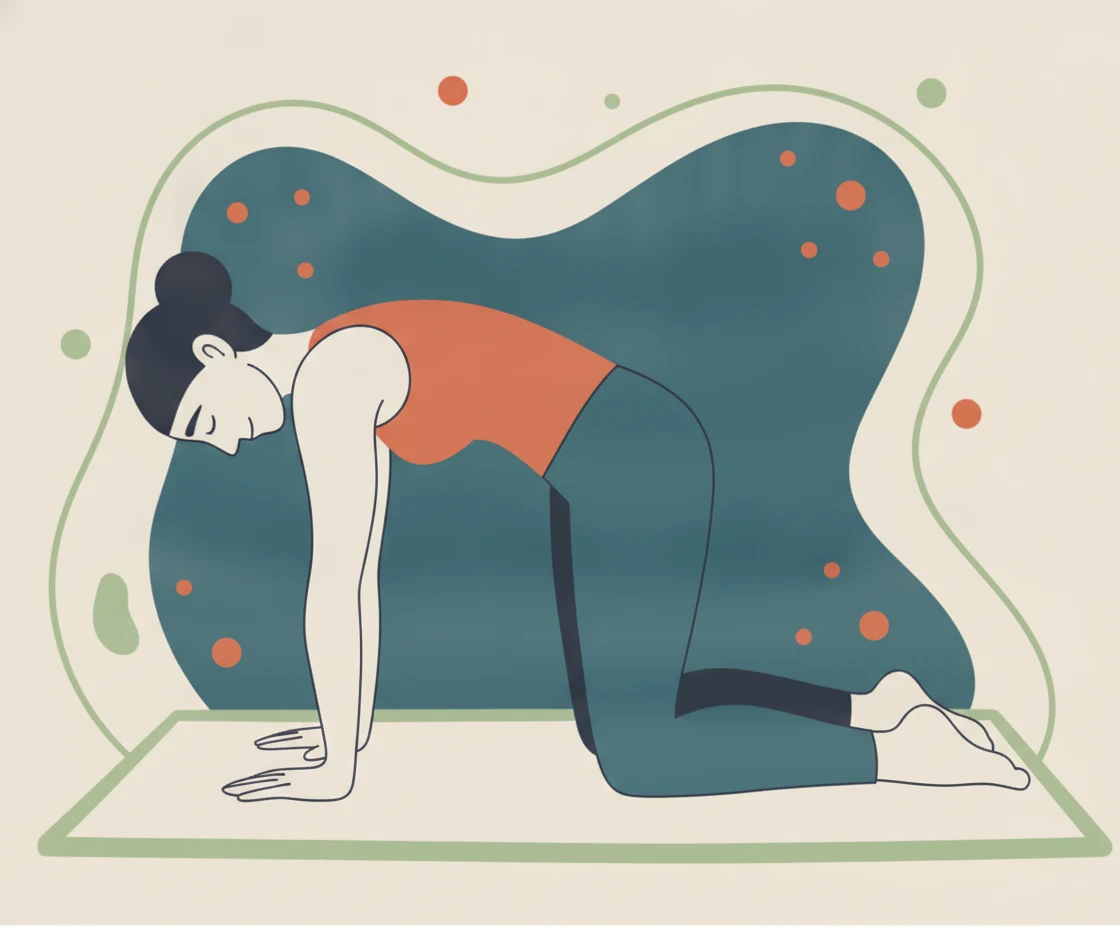
A back that has hurt for months moves less than it can, because guarding is what a nervous system does when it expects trouble. These four weeks are almost entirely on the floor, where the spine does not have to hold you up while it moves. Nothing is a stretch you have to earn. Every session is one more piece of evidence that a movement can happen and nothing bad follows.

  1. 1.Corpse Pose2 min
  2. 2.Knees to Chest Pose1 min
  3. 3.Happy Baby Pose1 min
  4. 4.Cat Pose1 min
  5. 5.Cow Pose1 min
  6. 6.Child's Pose1 min 30 sec
  7. 7.Baby Cobra1 min
  8. 8.Downward-Facing Dog1 min
  9. 9.Reclining Hand-to-Big-Toe Pose1 min 30 sec per side
  10. 10.Bridge Pose5 lifts, 5 breaths each
  11. 11.Reclining Pigeon Pose1 min 30 sec per side
  12. 12.Reclining Belly Twist2 min per side
  13. 13.Knees to Chest Pose1 min
  14. 14.Corpse Pose5 min
Open the full sequence →

Week by week

Week 1Find out what today actually isDo the gentle sequence twice and take the smallest version of every pose. The point of week one is not progress. It is a baseline you can compare against in week four.
Week 2Same practice, less hesitationNothing changes in the plan. What usually changes is how long it takes before the first pose stops feeling like a negotiation.
Week 3Let the range grow on its ownStay with the same timings and let the movements get a little larger where they want to. Bridge is the one place to add: lift a touch higher, and take longer coming down.
Week 4Check the morning, not the matJudge this phase by how the first twenty minutes of the day go compared with week one. If getting out of bed has changed at all, phase two is where the real work starts.

Phase 2 · Weeks 5 to 8

Build Capacity

Make the back and hips strong enough that daily load stops being a problem.

This is the phase most back programs never reach. Stretching and resting leave a back exactly as strong as it was, and what makes life hard is rarely stiffness. It is that lifting, carrying and standing for an hour cost more than they used to. So standing poses come in, and Bridge, Locust and Chair are done in sets. That is closer to training than to yoga as most people picture it, and it is deliberate.

Week by week

Week 5Learn the shapes before loading themDo two sets instead of three in every strengthening pose this week, and spend the time you save on the standing poses. Getting Warrior I and Chair to feel organised matters more than the number of repetitions.
Week 6Three sets everywhereFull sets in Bridge, Locust and Chair. Expect to feel this in the muscles the day after. Muscle soreness is not the pain you came here about.
Week 7Slow the second half of every repetitionSame sets, but take twice as long lowering out of Bridge and coming up from Chair. Controlling the way down is where most of the strength is built.
Week 8Hold the standing poses longerAdd fifteen seconds to each standing pose and leave the sets where they are. By the end of this week the standing block should feel like work rather than like a test.

Phase 3 · Weeks 9 to 12

Return to Function

Put it together, and be able to run the practice without the plan.

Real life never asks you to hold a shape for a minute. It asks you to get up, turn, reach, carry something and set it down. So this phase moves between poses instead of parking in them, adds balance and a deep squat, and keeps the strength work that built the capacity. By week twelve the aim is not that nothing ever aches again. It is that you know exactly what to do about it on your own.

Week by week

Week 9Stop setting up between posesMove from Warrior II into Triangle into Side Angle without resetting the feet. It will feel less tidy than phase two did, and that is the skill being trained.
Week 10Take the wall awayTry Tree Pose without a hand nearby, and get in and out of the squat without using your hands. If either is not there yet, keep the support and try again next week.
Week 11Run one session from memoryDo one of the two core practices without reading along. Not remembering the exact order matters far less than finding out that you can run a practice on your own.
Week 12Decide what staysCompare this week with week one honestly, in what you can do rather than in how much it hurts. Then pick the practice you will keep. For most people it is the fifteen minute standing one, once or twice a week, and that is enough to hold what you built.

The guide behind this program

Why these poses and not others

The chronic lower back pain practice guide explains what each pose does and why it belongs to this goal. It also carries the safety notes and every study this program is built on. Read it if you want the reasoning rather than the plan.

Read the chronic lower back pain guide →

Frequently Asked Questions

Will this get rid of my back pain?

Probably not entirely, and anyone promising that is selling something. The trials found small improvements in pain and clearer improvements in back function, which means what you can do changes more reliably than how much it hurts. For a lot of people that is the change that actually matters.

Why twelve weeks and not four?

Because that is the length the research used. The large trials all ran twelve weekly sessions, and the improvements they measured were still there six and twelve months later. A four week program would be easier to sell and would not be based on anything.

What if I miss a week?

Pick up where you left off rather than starting over. The phases are four weeks long because that is roughly how long a body needs with one set of movements, not because the calendar is sacred. Missing a week costs you a week, nothing more.

My back is sore the day after. Should I stop?

Muscle soreness in the days after a session that asked more is normal and settles. Increased back pain was the most common side effect in the Cochrane review and no serious harms were found. Sharp pain, pain travelling down a leg, or numbness and weakness are different, and those belong with a doctor.

Can I do this instead of physiotherapy?

It is not meant to replace treatment. One large trial found yoga was not inferior to physical therapy for pain and function over twelve weeks, which makes it a reasonable form of structured exercise, not a substitute for care you are already receiving. If you are working with someone, show them the plan.

Do I need props?

No. A folded blanket under the head and a second one under the knees make the first phase kinder, and a block is useful in Triangle and Side Angle later on. A stack of books does the same job.