Asanaverse

Chronic Neck and Upper Back Tension

9 Week Yoga Program for Neck and Upper Back Tension That Keeps Coming Back

Your neck and the top of your back have been tight for months. It builds through the afternoon, it settles overnight, and it is back by Wednesday. Checking a blind spot has become a whole-body movement, and by now you notice your shoulders are up near your ears only when something reminds you.

Nine weeks to get the movement back into your upper back, build a shoulder girdle that holds you up all day, and stop handing the job to your neck.

Almost every neck routine goes straight at the neck. Ear towards the shoulder, chin to the chest, hold, repeat. It feels like something is happening, and it is mostly not the thing that changed the numbers in the trials.

The studies that found the clearest improvements worked through the ribcage, the shoulder blades and the way the spine stacks under the head. Neck last, if at all. That is what this program does, and it is why the first three weeks contain almost no direct neck work.

Four practices a week: two longer sessions and two short ones. Six sequences in total, each repeated for a whole phase. Nine weeks, because that is the length both of the trials that measured this exact problem actually used.

Length

9 weeks

Practices

36 sessions

Rhythm

Four practices a week

Made for

Adults with neck tension that keeps coming back

Who this is for

  • ·Your neck or upper back has been tight or sore for longer than three months, and it comes back rather than staying gone.
  • ·No single accident or injury started it, and nobody has found a structural cause that needs treating.
  • ·You have no numbness, tingling or weakness in an arm or hand.
  • ·You can sit on the floor, or on a chair with room to move your arms.
  • ·You can find about forty minutes twice a week and fifteen minutes twice more.

What the research says

This program is based on the two trials that studied exactly this: nine weeks of yoga for adults with chronic nonspecific neck pain. Michalsen and colleagues randomised 77 people to nine weeks of Iyengar yoga and found reductions in pain at rest, pain on movement and functional disability against a self-care exercise control. Cramer and colleagues compared the same nine week format directly against a home exercise programme in 51 people and found less pain, less disability, better cervical range of motion and better proprioceptive accuracy.

The wider picture is consistent but not overwhelming. A meta-analysis of 10 trials with 686 people found improvements in neck pain, disability, cervical mobility, quality of life and mood, while warning that the interventions varied a lot and the methods had limits. A 2024 network meta-analysis of 18 studies put yoga among the more effective mind-body options for pain, disability and cervical mobility, and asked for larger and longer trials.

One finding shapes this program more than any other. The strongest evidence in chronic neck pain overall is not for stretching, it is for resistance and motor control exercise, across 68 studies. That is why phases two and three load the shoulder girdle rather than only opening it, and why this is not a relaxation routine with a neck label on it.

See every study and guideline behind this program →

Before you start

The trials reported good tolerance overall, with temporary soreness, and in the Iyengar studies occasional migraine or vertigo. What matters more is the short list of situations where a neck needs a doctor before it needs a movement program: anything numb or weak in an arm or hand, dizziness triggered by moving your head, or pain that shoots down into the hand. The practice guide has the full list.

Read the full safety notes in the practice guide →

How it works

Each phase has one longer practice and one short one, and you stay with them for the whole three weeks. Open a practice below to see every pose, its timing and the reason it sits where it does, or go to the full sequence when you are on the mat. A folded blanket to sit on and a strap for Cow Face arms make the first phase considerably easier, and a block helps in Triangle later. The rule that runs through all nine weeks: the ribcage turns first and the head follows. If your head is leading a movement, the movement is going to the wrong place.

The plan, week by week

3 phases of 3 weeks. Each phase has one longer practice and one short one, and you repeat them for the whole phase. That repetition is not a shortcut, it is the mechanism. A body changes because the same ask came back often enough, not because every week brought something new.

Phase 1 · Weeks 1 to 3

Awareness and Mobility

Get the upper back and shoulders moving again, without provoking the neck.

Almost all of this phase is seated and kneeling, and almost none of it touches the neck directly. That is deliberate. A neck that has been guarding for months does not need to be pulled on, it needs the joints above and below it to start contributing again. Three weeks is enough for the mid back to stop being the stiffest part of you.

  1. 1.Easy Pose3 min
  2. 2.Seated Side Bend1 min 30 sec per side
  3. 3.Revolved Easy Pose1 min 30 sec per side
  4. 4.Bharadvaja's Twist1 min 30 sec per side
  5. 5.Cow Face Pose1 min 30 sec per side
  6. 6.Cat Pose1 min 30 sec
  7. 7.Cow Pose1 min 30 sec
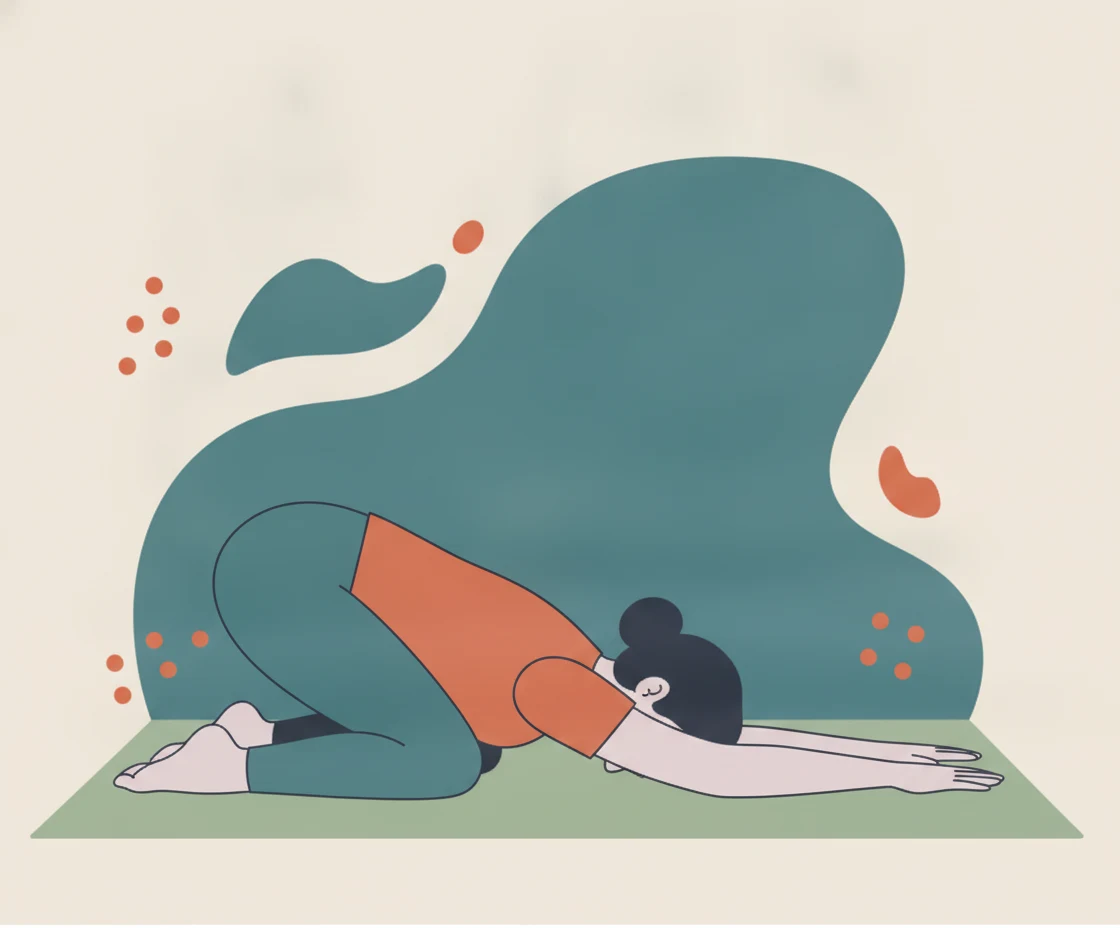
  8. 8.Child's Pose2 min
  9. 9.Heart-Melting Pose2 min
  10. 10.Baby Cobra1 min 30 sec
  11. 11.Bridge Pose5 lifts, 5 breaths each
  12. 12.Knees to Chest Pose1 min 30 sec
  13. 13.Corpse Pose6 min
Open the full sequence →

Week by week

Week 1Find out where your shoulders actually areDo the gentle sequence twice and take the smallest version of everything. Most people discover in week one that their shoulders sit higher than they thought and that the mid back barely rotates.
Week 2Let the head come last, every timeNothing changes in the plan. The one thing to work on is the order: ribs turn, head follows. If you catch yourself leading with the chin, start the turn again from the middle of your back.
Week 3Stay longer in the two that matterAdd thirty seconds to Cow Face arms and to Heart-Melting Pose and leave everything else as it is. Those two do most of the work in this phase, and they need time rather than force.

Phase 2 · Weeks 4 to 6

Alignment, Strength and Control

Build a shoulder girdle that can hold you up for a whole day.

This is the phase most neck routines never reach. Stretching and resting leave the shoulder girdle exactly as strong as it was, and by four in the afternoon it hands the work back to the neck. So the standing poses come in and the arms stay away from the body: overhead, out at shoulder height, held long enough to count. It will feel less soothing than phase one and that is the point.

Week by week

Week 4Learn the shapes before holding themTake the standing poses for thirty seconds each this week instead of a full minute, and spend what you save on getting the arms right. Shoulders down while the arms go up is the skill.
Week 5Full holdsA minute in Warrior II with the arms out is longer than it sounds. Expect to feel this the next day between the shoulder blades. That soreness is muscle, not your neck problem.
Week 6Stop shrugging under loadSame practice, one thing to watch: whether the shoulders creep up towards the ears when the pose gets hard. Catching that on the mat is how you catch it at a desk.

Phase 3 · Weeks 7 to 9

Functional Capacity

Put it together, and be able to run the practice without the plan.

A tight neck does not fail in a yoga pose. It fails when you reverse the car, carry a bag on one shoulder, or work through an afternoon without noticing your position. So this phase rotates under load, balances, moves between shapes without resetting, and asks the shoulder girdle to hold up at the end of a session rather than the start. By week nine the aim is not that nothing ever tightens, but that you know exactly what to do about it.

Week by week

Week 7Stop setting up between posesMove from Warrior II into Triangle into Side Angle without resetting the feet. It will feel less tidy than phase two did, and that untidiness is the skill being trained.
Week 8Take the rotation seriouslyRevolved Pyramid is the strongest twist in the program. Keep the hips square and turn from the ribs. Go to a block rather than to the floor, for as long as that is what it takes.
Week 9Run one session from memory, then decide what staysDo one core practice without reading along. Then compare this week with week one in what you can do, not in how much it aches. Then pick the practice you will keep. For most people it is the fifteen minute standing one, once a week.

The guide behind this program

Why these poses and not others

The Chronic Neck and Upper Back Tension practice guide explains what each pose does and why it belongs to this goal. It also carries the safety notes and every study this program is built on. Read it if you want the reasoning rather than the plan.

Read the guide →

Frequently Asked Questions

Why does the first phase barely touch my neck?

Because that is how the trials worked. The Iyengar protocols that produced the clearest improvements went through the ribcage, the shoulder blades and the way the spine stacks under the head. Pulling the ear towards the shoulder feels like something is happening, but it is not the part that moved the numbers.

Will this fix my posture?

It will make holding yourself up cheaper, which is a different claim. There is no evidence that a nine week program permanently changes the shape of a spine, and anyone promising that is selling something. What does change is how long the shoulder girdle can do its job before it gets tired and hands the work to your neck.

Why nine weeks and not eight or twelve?

Because both trials that measured this exact problem used nine weeks with one weekly session. A twelve week protocol exists, but it was a back pain programme adapted for neck pain, and the participants with neck pain showed smaller improvements. Nine is the evidence-based number here, not a round one.

My arm tingles sometimes. Can I still do this?

Not yet. Numbness, tingling or weakness in an arm or hand means something is involving a nerve, and that needs looking at before you start any movement program. This is on the exclusion list for a reason. Once it has been checked and cleared, come back.

Is this enough on its own, or do I need physiotherapy too?

The strongest evidence in chronic neck pain overall is for resistance and motor control exercise, and yoga performed comparably to other movement in the trials rather than better. If you are already working with someone, show them the plan. This is a reasonable form of structured exercise, not a replacement for care you are receiving.

Can I do this at a desk instead of on a mat?

The ten minute practice, largely yes. Sit on the front edge of the chair with both feet down and you can do the side bend, the twist and the arm work. Cat and Cow and Heart-Melting Pose need the floor, and the standing poses in the later phases need room.