Do you know that feeling of living in your head all day while your body lags somewhere behind? I see it in almost every student: shallow breath, cold feet, shoulders pulled up to the ears. This is not a character weakness, but a clear reaction of the nervous system. When the sympathetic nervous system, our activation mode for fight or flight, runs at full speed permanently, the body draws blood out of the extremities and concentrates it for the head and trunk. The feet get cold, the breath stays stuck in the upper chest, because a deep belly breath would signal relaxation, and that is precisely not intended in stress mode. We like to call this being uprooted, and this is exactly where a grounding meditation with the 5 elements of nature comes in. Earth, water, fire, air and space, in yoga called Prithvi, Apas, Agni, Vayu and Akasha, are not esoteric concepts, but a millennia-old system of order for body and mind that fits astonishingly well with what we know today about nervous-system regulation. Each element corresponds to a chakra, an energy center along the spine, and brings its very own quality: stability, flow, transformation, expanse, connection. Grounding therefore does not mean incense sticks and wishful thinking, but tangible anchoring in your own nervous system, palpable in feet, breath and posture.
The 5 elements in grounding meditation: A system of connection
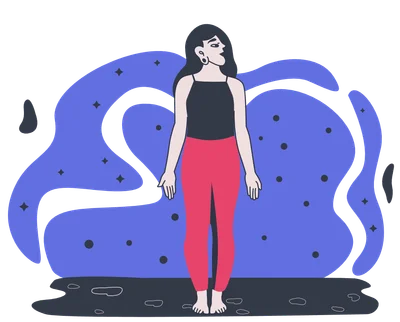
Mountain Pose Tadasana embodies the element Earth and forms the foundation of grounding meditation
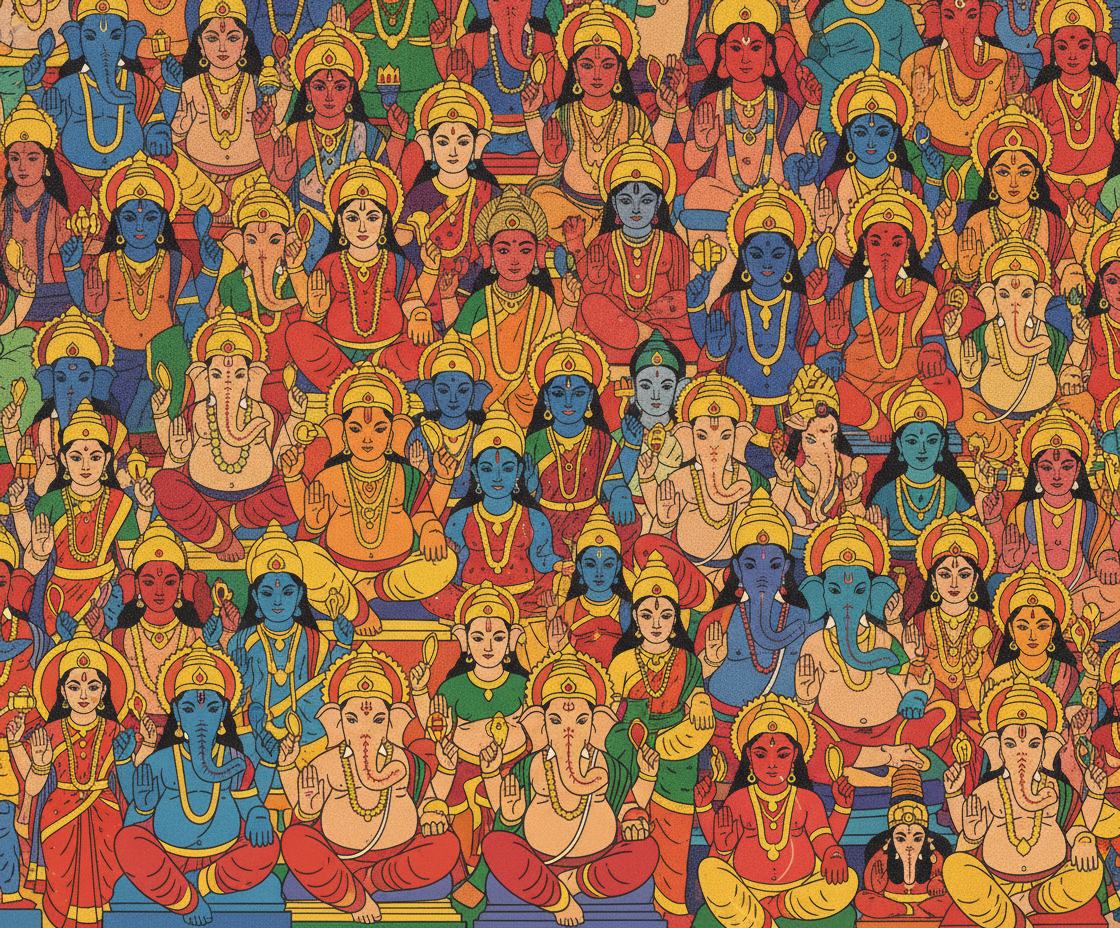
In the Vedic scriptures the five elements, earth, water, fire, air and ether, are not romantic images of nature. They are building blocks of your own energy structure. Each element corresponds to a chakra and a level of your astral sheath, that subtle layer that your gross body carries outward. This meditation uses precisely this map to reassemble you, level by level.
Earth, Water, Fire, Air and Ether
Earth is weight, bones, the feeling of ground beneath the feet. It gives stability when everything wobbles in the head. Water flows through your emotions, through tears, through the softness in the pelvis. Where water is blocked, feeling becomes rigid. Fire sits in the belly, it is willpower, digestion, the heat of change. Without fire you stay stuck in old patterns. Air moves thoughts and words, it sits in the chest and regulates how light or heavy communication feels. Ether, finally, is space itself, the expanse behind everything, the feeling of unity that no longer needs words.
Chakra correspondences and the astral sheath
Earth belongs to Muladhara, the root chakra at the pelvic floor. Water lives in Svadhisthana, the sacral chakra, seat of sensuality and emotion. Fire radiates from Manipura in the solar plexus. Air vibrates in Anahata, the heart chakra, and ether opens in Vishuddha, the throat chakra, before it passes into the higher centers. This assignment stems from the idea that the five elements correspond to five different chakras and levels of the astral sheath, so they act not only physically, but also energetically. A practice with the five elements therefore deliberately wanders through these levels. It is thus considerably more than a mere technique for calming down, it is a system that Ayurveda has long used to strengthen the connection to the natural energy forces within yourself, layer by layer, until everything holds together again.
Preparation: Bringing the body into the grounding pose
Mountain Pose as the foundation
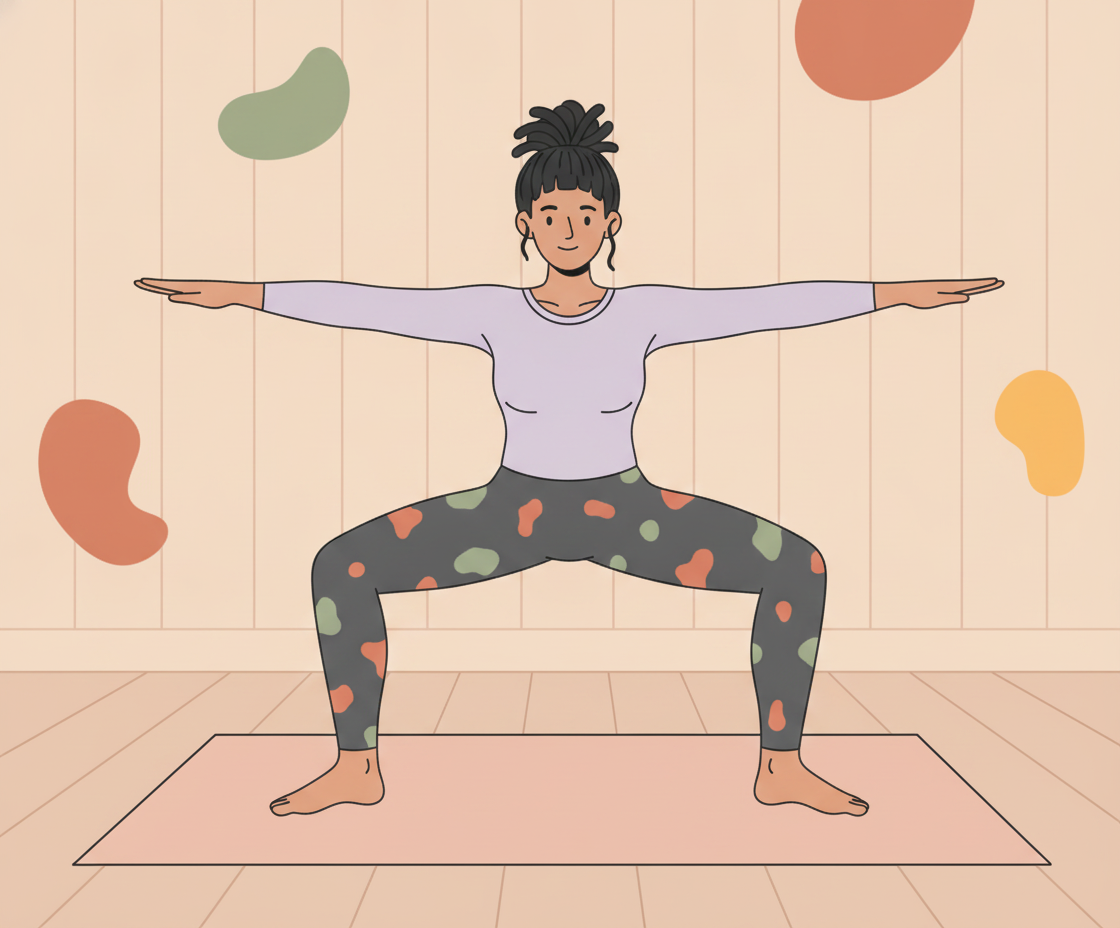
Before you even think about elements or visualizations, simply stand up. Feet hip-width apart, weight evenly distributed on both soles, knees slightly released instead of locked. This is Mountain Pose, Tadasana, and it is not a warm-up exercise, but already half the battle of every grounding meditation.
Tadasana literally embodies the element Earth: firm, upright, immovable like a mountain that has stood in the same spot for millennia and yet stays alive. Consciously feel how the four corners of your feet touch the floor. It is precisely this foot-to-earth contact that activates something in your nervous system that pure head work never achieves. Many of my students want to approach the exercise mentally right away and completely forget the feet in doing so, yet exactly there lies the key to every good grounding meditation.
Physical stability and emotional stability are more closely connected than one thinks. When your body has a clear, secure stance, the nervous system reports to the brain: all in the green. This proprioceptive feedback, i.e. the perception of your own body position in space, is one of the simplest techniques of a grounding meditation at all. It is no coincidence that anxiety often feels like wobbly ground under the feet, and safety like a firm stance.
Developing breath awareness
As soon as the stance feels stable, attention wanders to the breath. Don't control, at first just observe: how the air streams in, lingers briefly, goes again. This meditation with elements begins right here, at the threshold between conscious body posture and inner perception. Your breath becomes the bridge that carries you from pure muscle work into the meditative state.
The guided grounding meditation: Step by step through the 5 elements
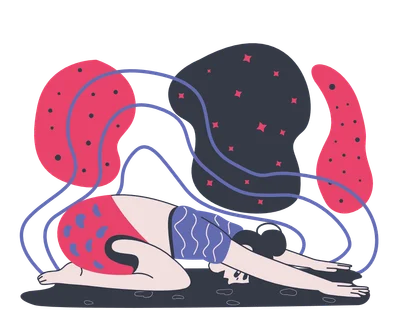
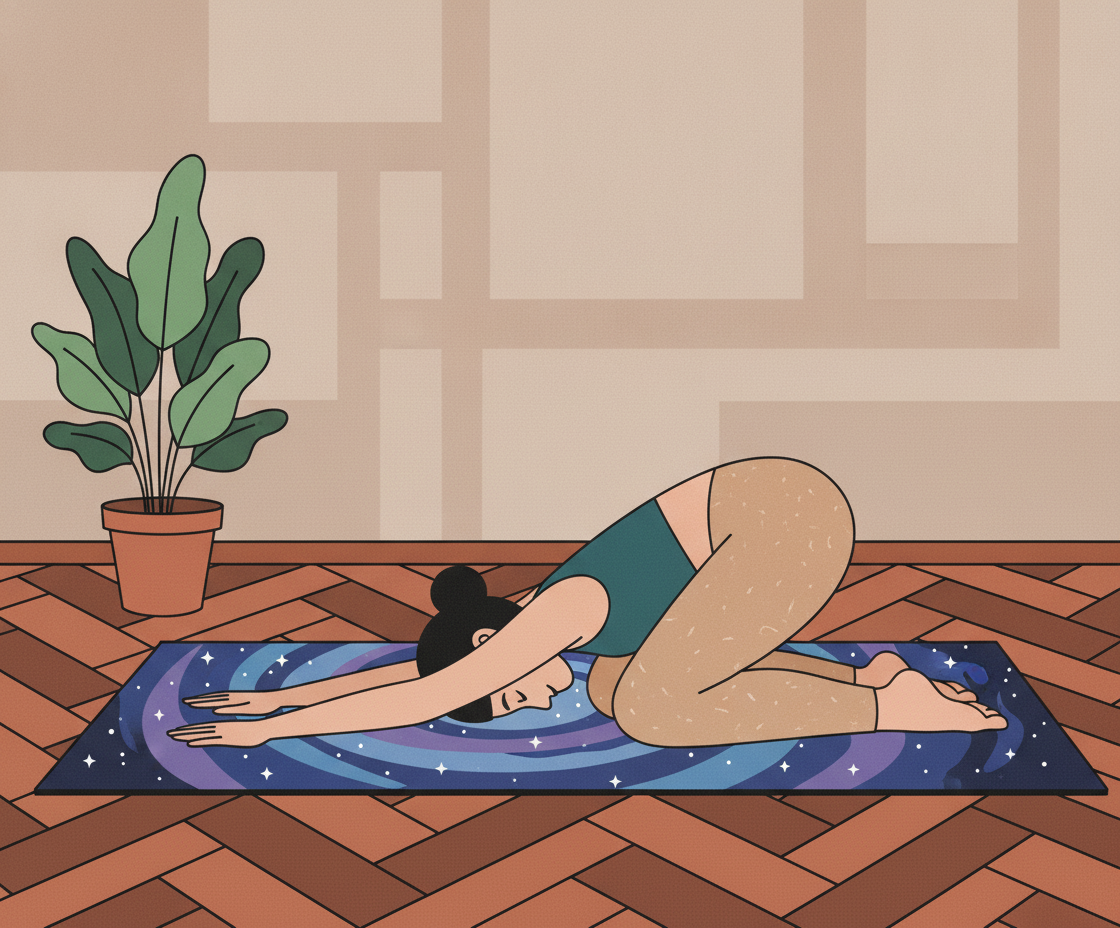
Sit down or lie in Child's Pose, Balasana. This posture creates a protected, introspective space in which you can fully engage with the elements, without the outside world breaking in. It is right here that the actual grounding meditation begins, guided through the body, not through the head.
First feel the earth. Your soles, your tailbone, everything that has contact with the floor becomes heavy and stable. This stability in the legs is more than a bodily feeling: it signals safety to your nervous system, and that often dissolves anxiousness faster than any carousel of thoughts.
Move on to the water in the abdominal space. Imagine a liquid warmth flowing through your pelvis. Where there was rigidity, movement arises. Emotional fluidity does not mean that you dissolve, but that you may flow again, instead of freezing in rigidity. Meditation with the elements makes this difference physically palpable.
Then comes the fire, a light in the solar plexus that transforms apathy into clarity. From there air rises into the heart and throat, lightness, expanse, a space that opens instead of narrowing. At the very top the ether waits: infinite space above the head, in which you simply are. A guided meditation with the five elements based on Ayurvedic practices strengthens precisely this connection to the natural energy forces within you.
Chakra activation during the meditation
Each element corresponds to an energy center, from Muladhara at the base to Sahasrara at the crown. Verena Leuze describes in her work on Yin Yoga how the five elements help to strengthen our connection to nature and to ourselves. This grounding meditation uses exactly this technique: the physical and psychological levels remain inseparably connected, a gentle grounding-meditation approach for everyday life.
Integration and conclusion: Savasana as an incubator of the elemental energies
After the work with earth, water, fire, air and space comes the part that most people underestimate. Savasana is not a breather after the actual exercise, but the place where integration happens in the first place. What you actively built up in the grounding meditation must now settle, sink in, inscribe itself into your system. Without this phase, much stays on the surface, a nice feeling that quickly evaporates again.
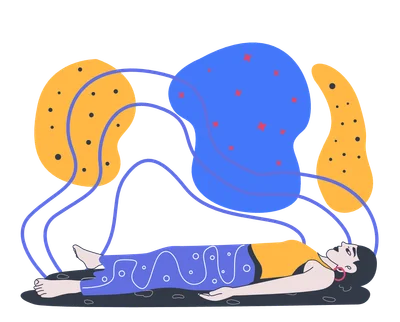
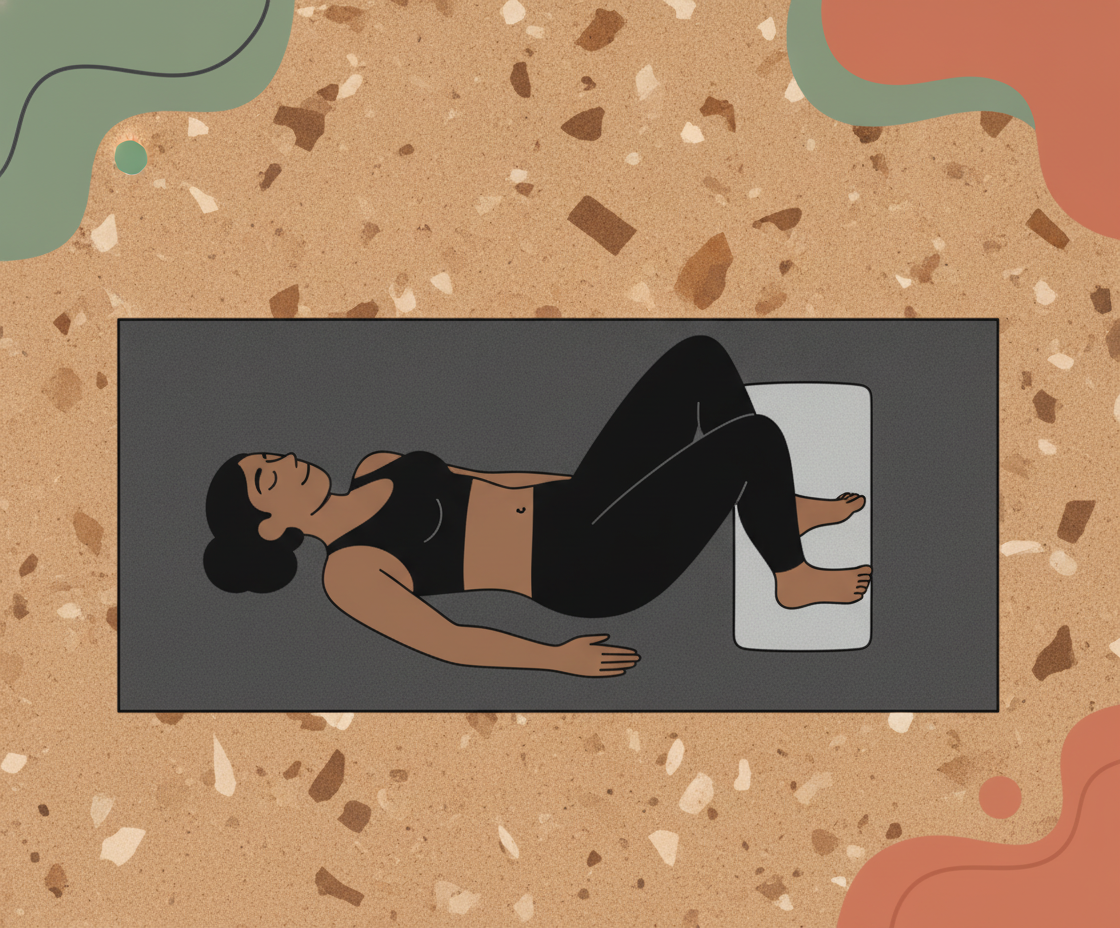
Savasana is the integrative conclusion of the grounding meditation and enables deep inner anchoring
Corpse Pose, Savasana, is the most demanding asana of all, because it demands nothing of the body except complete surrender. That is exactly what makes it so effective for anchoring the elemental energies in your subtle sheath, in the yogic tradition also called the astral body. As long as you actively steer, your nervous system stays in doing mode. Only when you really let go, let arms and legs become heavy, open the jaw, can your system switch from the sympathetic to the parasympathetic. There, in this state of active receptivity, grounding is no longer thought, but internalized. Psychologically this is an exciting point: deep transformation rarely happens through more effort, but through the ability to give oneself over receptively. That is exactly what you practice here, lying still, without control.
This very surrender in Savasana, the letting go of everything that no longer serves, is the core of Om Namah Shivaya: transformation instead of holding on, truth instead of mask, stillness instead of resistance. As a daily reminder of this, there is our Shiva shirt, so you carry this anchoring on your body even off the mat.
After opening your eyes, keep lying there a moment longer and consciously scan: Where do you feel heaviness? Where a new calm that wasn't there before? These qualities are no coincidence, they are the palpable result of the grounding meditation. Perceive them without immediately naming or judging them. This inner stability, experienced physically as heaviness, mentally as clarity, is exactly what you take with you into everyday life, into conversations, into decisions, into stressful moments.
Grounding meditation in everyday life: From the mat into the world
Here comes the honest truth about a grounding meditation with the 5 elements of nature: the 20 minutes on the cushion are only the beginning. This practice does not mean grounding once a day and then floating in the head again for the rest of the day. It is a practice of presence that repeats in seconds. Your nervous system learns through repetition, not through intensity. Short, conscious body contacts with the earth build up over the weeks a psychological basic security that sits deeper than any one-off session.
Short element anchors between tasks
Between two meetings: walk barefoot across the floor and feel Muladhara, the root chakra, as the soles make contact. When drinking water, pause briefly, feel how the liquid flows through the body. This activates Svadhisthana, your flow and feeling center. Before a challenge, a difficult phone call for example, inwardly imagine a small fire in the solar plexus that ignites Manipura and gives you determination. These micro-techniques need no mat, no silence, no 45 minutes. You practice them in elevators, kitchens and waiting rooms, in the middle of everyday life, without anyone noticing anything of it.
Preserving the grounding quality
The actual point of this exercise is not the single moment, but continuity. Every short anchor is like a stitch in sewing, individually inconspicuous, in series it holds everything together. Ask yourself in the evening: where did I ground today? Not as a performance check, but as a reminder that presence is trainable. Over time the earth is no longer something you seek, but something you already carry within you, physically palpable, retrievable at any time.
Conclusion: Grounding as an act of self-empowerment
A grounding meditation with the 5 elements is not a trick for the one stressful day. It is a path on which body, emotion and mind begin again to breathe in the same rhythm. Earth gives you support, water lets you flow, fire brings clarity, air widens the space, ether connects everything into a coherent whole. Anyone who practices this meditation with the elements regularly notices: grounding is not a goal that you reach at some point and tick off. It is a movement of return, again and again, to the present, to the strength that already dwells within you.
So, quite concretely: take ten minutes tomorrow and try the guide through once completely. Afterward keep a small journal in which you note what has changed, in body feeling, in mood, in thinking. This one week is often already enough to recognize the first grounding techniques as your own inner language. I've experienced this with many students: the recording itself becomes an anchor. You read back and see in black and white how something has shifted, entirely without big words.
What happens with repeated grounding meditation is quite clear: your nervous system learns that the ground is there even when the storm rages. Not because life becomes calmer, but because you become calmer, no matter what comes. The vagus nerve, that long wanderer between brain and belly, is trained like a muscle through slow breath and repeated grounding impulses. Over time your body reacts faster to safety instead of to alarm. That is exactly what self-empowerment is: not control over external circumstances, but the knowledge that you can find your way back at any time, to yourself, to the earth, to your own unshakable center.

 AsanaMountain PoseTadasanaTo the asana →