You just walked out of a room where you crushed the presentation. People nodded, someone even took notes. And your brain, instead of letting you enjoy it for five seconds, is already whispering that you got lucky, that they'll figure out you don't actually know what you're doing. Your chest tightens. Your breath goes shallow and quick, like you're back on stage instead of standing safely in the hallway. Your palms are damp, your stomach has that hollow drop you get right before bad news. Sound familiar? That gap between what you've clearly achieved and what you feel you deserve is impostor syndrome, and it lives in the body just as much as in the mind. If you're reading this, you're probably tired of white-knuckling your way through it.
Here's where I want to start, because it matters: this article is about how to overcome impostor syndrome with meditation, and I don't mean repeating affirmations in the mirror until you sort of believe them. That's willpower, and willpower runs out around 3pm on a Tuesday, right around the time your palms get sweaty again before a call you're fully qualified to be on.
Meditation works differently. It doesn't argue with the self-doubt, it changes the actual neural circuitry that keeps generating it in the first place. We're talking about measurable shifts in brain structure and nervous-system regulation, not mindset tricks.
So stick around. I'll walk you through what's actually happening in your body and brain when that fraud feeling hits, why eight weeks of practice seems to be a real turning point, and a few techniques you can use the next time your breath shortens and that inner critic starts talking, starting today, not someday.
Die Neurobiologie der Impostor Syndrome: Wie Meditation die Gehirnstruktur verändert
What Is Impostor Syndrome and Why Meditation Targets It
The psychological mechanics of self-doubt
Impostor syndrome, in plain psychology terms, is the persistent belief that your success is undeserved, accidental, or about to be discovered as fake, despite real evidence you're competent. Notice what that definition doesn't include: a skills gap. You're not actually underqualified. Your nervous system just hasn't gotten the memo. That's the core piece most people miss when they try to think their way out of it, and it's exactly where impostor syndrome psychology diverges from a simple confidence problem.
Here's the mechanism. Your amygdala, the almond-shaped structure deep in your brain that scans for threat, has learned somewhere along the way to flag being seen, evaluated, or praised as dangerous. Maybe it was a harsh teacher, a competitive household, a culture that tied your worth to constant proving. Doesn't matter which. What matters is that your amygdala now fires a threat response every time you're in the spotlight, the same circuitry that would fire if you were being chased.
Why traditional confidence-building fails for impostor feelings
This is why telling yourself "you're good enough" almost never sticks. You're trying to argue with a part of your brain that doesn't process arguments. The amygdala doesn't read your resume or listen to logic from your prefrontal cortex, the region responsible for reasoning and self-assessment. It just registers a threat signal and hijacks the show. That mismatch, rational evidence on one side, an alarmed nervous system on the other, is the entire engine behind impostor syndrome symptoms like racing thoughts before a presentation or the urge to over-prepare for a meeting you're fully qualified to run.
This is exactly why meditation earns its place here instead of another pep talk. It doesn't argue with the thought, it works underneath it, subcortically, right where the threat response actually lives. If you're serious about overcoming impostor syndrome with meditation, this is the piece to understand first: you're not managing a mindset, you're addressing a nervous system that mislabels visibility as danger. Scientific studies confirm that meditation triggers measurable changes in brain structure after eight weeks of consistent practice, altering the amygdala and strengthening the prefrontal cortex's ability to regulate it. This kind of confidence-building through meditation isn't metaphorical, it's literally retraining tissue.
How Meditation Rewires the Brain: The Eight-Week Threshold
Here's the part I want to be careful with, because I've told this story to students myself and I want to get it right: the research is not a clean, single headline. It's messier than that, and the mess is actually useful. Some eight-week MBSR programs, the Mindfulness-Based Stress Reduction protocol developed at the University of Massachusetts, have shown changes in gray matter concentration and reduced amygdala activity. But at least one PubMed-indexed study looking at eight weeks of meditation found no measurable change in brain structure at all. Other research suggests that unless you're meditating more than 22 minutes a day for several months, you likely won't see structural change in the amygdala specifically. So the honest answer is: it depends on dose, consistency, and probably on things researchers haven't fully mapped yet. That uncertainty doesn't undercut the practice. It just means we should talk about it the way scientists actually do, in probabilities and ranges, not guarantees.
Measurable changes in gray matter and neural pathways
When structural change does show up in the research, three things tend to move together. Amygdala density and reactivity can decrease. The prefrontal cortex, the part responsible for reasoning and perspective, can thicken its connections. And the default mode network can quiet down. None of this happens after one good meditation session, and none of it is guaranteed on any fixed calendar. It happens, when it happens, because the brain adapts to what you repeat, and the studies that find it usually involve meditators who've kept a steady daily practice for weeks or months, not once a week for twenty minutes. This is part of why impostor syndrome psychologie research increasingly treats self-doubt as a trainable neural pattern rather than a fixed personality trait, even while acknowledging that not every practitioner's brain will show up the same way on a scan.
The role of the default mode network in self-doubt loops
The default mode network is the part of your brain that activates when you're not focused on a task, the mental background hum that narrates your life. It's also the machinery behind the 3am spiral where you replay a comment your manager made and conclude, again, that you don't belong. This network runs on autopilot. It doesn't ask for permission before generating I am a fraud, it just fires the thought and hands it to you as fact.
Meditation interrupts this, when it works, by strengthening the prefrontal cortex's ability to step in before the loop completes. Instead of the default mode network running unchecked, you build a few seconds of awareness where you notice the thought forming rather than fusing with it. That gap is small at first, barely noticeable. But it's the same gap that later lets mindfulness gegen impostor syndrom work at all: you can't observe a thought you're completely inside of.
None of this promises instant relief, and I'd be lying if I said otherwise, or if I told you a scan would confirm your progress on schedule. Week one usually feels like nothing changed. Week five is where students start telling me the spiral catches itself faster, and that shift in lived experience often arrives well before any structural change would even be detectable. Consistency beats intensity here every time. Twenty minutes once a week isn't the dose the research points to for physical change, but five honest minutes daily, kept up for months, builds the direction this research keeps circling back to, even when the exact mechanism is still being worked out.
The Stop-Breathe-Observe Technique: Breaking the Impostor Thought Loop
Here's a tool you can use standing in a hallway thirty seconds before you walk into a room. I teach it to students constantly, and it works precisely because it doesn't ask you to believe anything different about yourself. You're not arguing with the impostor thought. You're interrupting the body state that's feeding it. Research referenced by calm.com on breathwork and mindfulness backs up what I see in class: a structured Stop, Breathe, Observe sequence calms the mind and breaks the negative thought loop before it gathers speed.
Picture this. You're backstage, laptop open, slides loaded, and the thought arrives: they're going to realize I don't actually know what I'm talking about. Your chest tightens. Your breath goes shallow and high, up in the collarbones. This is the moment to Stop, literally freeze the spiral by naming it: "this is the impostor loop, right now." Then Breathe: four counts in, six or eight counts out, exhale longer than the inhale, three or four rounds. Then Observe: watch the thought sitting there without arguing with it or agreeing with it.
How breathing interrupts the amygdala response
The extended exhale is doing real physiological work, not just giving you something to focus on. A longer out-breath activates your vagus nerve and shifts you toward parasympathetic dominance, the body's rest-and-digest gear. Your heart rate drops. The amygdala, which was driving that threat response, gets less fuel. That's the neurological interrupt happening in real time, not denial, not talking yourself into confidence. You're changing the chemistry the thought is riding on, which opens a small window for your prefrontal cortex to actually respond instead of react defensively.
Practical steps for using this technique in high-stakes moments
In practice, students almost always catch themselves holding their breath before they notice the racing thoughts. So the cue is physical first: shoulders creeping up, jaw tight, breath stuck high in the chest. That's your Stop signal. From there the sequence takes under a minute, which is exactly why it works in a hallway, an elevator, or sitting at your desk right before you unmute. Do it daily during ordinary moments too, not just crises, so the pathway is already worn smooth when you need it under pressure.
Körperliche Stabilität als Fundament für inneres Vertrauen
All the neuroscience in the world won't help you if your body is buzzing with restlessness the moment you sit down to meditate. This is the part most articles skip. Before your brain can rewire anything, your body needs to know what stable actually feels like. I've taught hundreds of students who could recite the theory of mindfulness perfectly and still sat down fidgeting, shoulders creeping to their ears, jaw tight. The nervous system doesn't take notes. It takes posture.
Easy Pose (Sukhasana) for grounded meditation
Sit cross-legged, spine long, hands resting on your knees. That's it. Sukhasana, or Easy Pose, creates a safe, settled base for mindfulness meditation precisely because there's nothing to figure out. No balance to chase, no stretch to fight. Your sit bones ground into the floor, and that steady contact sends a quiet signal upward: you're supported, you're not falling. For someone whose impostor syndrome symptoms include a racing pulse before a presentation, that grounded base matters more than any mantra.
I've watched beginners drop their shoulders within the first minute of settling into this pose, often without noticing. That's the body doing the work language can't. It's a small, physical rehearsal of what building self-confidence through meditation actually requires: a felt sense of ground beneath you before you ask your mind to do anything harder.
Lotus Pose (Padmasana) for deepening your practice
Once Easy Pose feels unremarkable, boring even, Lotus Pose invites something sharper. Each foot rests on the opposite thigh, the spine stacks with unusual precision, and the whole shape becomes self-contained. Padmasana fosters inner stability and centeredness, which makes it particularly suited to meditation practice aimed at overcoming self-doubt. You're not leaning on anything. You're holding your own structure.
Students often describe a specific sensation here: the legs lock into place and something in the mind follows suit, attention narrows, chatter quiets. That's not mysticism, it's proprioception, your body's sense of its own position, feeding directly into a calmer state. This is where the strengthening of self-compassion and inner confidence, the mechanism at the heart of overcoming impostor syndrome, becomes something you can physically feel rather than just something you read about.
Corpse Pose (Savasana) for integrating self-compassion
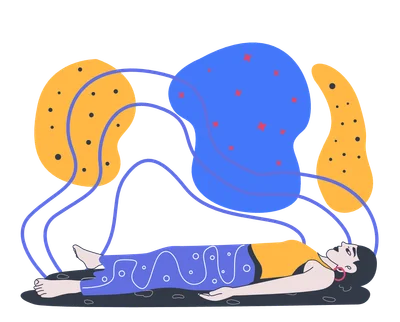
Lie flat, arms loose, palms up, legs falling open. Savasana looks like doing nothing, and that's exactly its power. With no muscular effort required anywhere, the nervous system finally gets the message it's been waiting for: no threat here. This is where the harsh inner critic loses its grip long enough for real self-compassion to surface, not as an idea, but as a bodily state of ease you can actually feel.
This progression, from grounded, to centered, to fully released, mirrors the arc of working through impostor feelings themselves: first safety, then depth, then integration.
Self-Compassion Meditation: Rewiring Your Inner Dialogue
Why impostor syndrome feeds on inner criticism
Here's something worth sitting with: no promotion, no glowing review, no round of applause has ever permanently quieted the voice that says you don't belong. That's because impostor syndrome isn't a logic problem you can argue your way out of. It's a relationship, specifically, the relationship you have with yourself. In yoga philosophy, this harsh inner narrator has a name: the vritti, a mental fluctuation or pattern the mind keeps spinning whether or not it's asked to. Left unchecked, it doesn't just comment on your life. It starts narrating as if it were the truth.
The inner critic isn't protecting you from failure, it's just familiar, and familiarity gets mistaken for accuracy. This is where self-compassion meditation, rooted in the ancient metta or loving-kindness practice, does something different from ordinary mindfulness against impostor syndrome. Mindfulness teaches you to observe the thought. Metta goes a layer deeper: it changes the emotional tone you bring to that observation. Same doubt, same moment of shaky confidence, but met with warmth instead of a verdict.
Loving-kindness practice for silencing the inner fraudster
A basic metta practice is simple, almost embarrassingly so: sit, breathe, and silently offer yourself phrases like "may I be at ease, may I trust what I know." The tradition doesn't claim this erases self-doubt. It claims something more precise, that repeated exposure to kindness, directed inward, retrains the emotional response your mind defaults to. This is not the same as overcoming impostor syndrome through affirmations or forced positivity. It's slower and more honest than that.
One source on yoga and self-compassion makes the point clearly: sustained practice reduces self-doubt by strengthening self-compassion alongside inner self-trust, not by suppressing doubt but by removing the hostility around it. That distinction matters. Self-compassion isn't self-pity, and it isn't lowered standards. It's the difference between a teacher who berates a student for a wrong answer and one who simply says, try again. Learning happens in the second room, never the first. Building confidence through meditation, in this sense, isn't about feeling flawless. It's about becoming someone your own inner dialogue stops treating as the enemy.
The Role of Mindfulness in Separating Thought from Identity
Here's something the yogis figured out long before anyone had an MRI machine: you are not your thoughts. In the Yoga Sutras, Patanjali calls the mind's raw material chitta, and the fluctuations that pass through it, vrittis. A thought is a vritti. It rises, it moves, it passes. That's it. Impostor syndrome convinces you otherwise. It tells you that the thought 'I am a fraud' isn't a passing ripple, it's the water itself. That collapse, thought becomes identity, is the actual mechanism keeping you stuck, more than any specific insecurity you're carrying.
The observer versus the thought: building metacognitive distance
Yoga philosophy calls the part of you that notices the mind's activity the Sakshi, the witness. Not the thinker. The watcher of the thinker. This isn't mystical fluff, it's a practical shift you can feel. Try this instruction next time the fraud-thought shows up: sit still, notice the thought as if it were a cloud passing through the sky of your mind. Don't grab it, don't argue with it, don't chase it away. Just watch it drift. Say internally: 'I am having the thought that I am a fraud,' not 'I am a fraud.' That one grammatical shift rebuilds the observer distance impostor syndrome had erased.
Why impostor syndrome persists when you believe your thoughts are facts
This is the deepest layer of impostor syndrome psychologie, and it rarely gets named directly. It's not that you have the thought. Everyone does. It's that you treat the thought as testimony, as evidence admissible in the trial of who you are. A thought is a neural event, a flicker of electrical activity, not a verdict. When you can observe it, question it, and let it pass without fusing your identity to it, the thought loses its authority over you. This metacognitive shift is the ground everything else stands on. The eight-week rewiring, the breathwork, the grounding poses, none of it lands if you're still mistaking mental weather for permanent climate.
Building a Practice: From Eight Weeks to Lasting Change
Konsistente Praxis über acht Wochen: Das Fundament für nachhaltige Veränderung
Here's the honest math. Everything you've read so far, the amygdala shrinking, the prefrontal cortex strengthening, the shift from harsh self-judgment to self-compassion, none of it happens from reading about it. It happens from repetition. Eight weeks sounds like a long commitment until you realize it's just fifty-six ordinary days, most of which you were going to live through anyway, imposter feelings and all. The question isn't whether you have time. It's whether you build a rhythm your nervous system can actually learn from.
Starting small: why five minutes daily beats occasional long sessions
A forty-five-minute meditation on a random Sunday teaches your nervous system almost nothing, because there's no pattern for it to recognize. Five minutes every morning, same time, same chair, is a completely different signal. Consistency is what tells your brain this matters enough to change for. Think of it less like exercise and more like brushing your teeth: the value isn't in one long session, it's in the fact that it happens daily, without negotiation, until your body stops treating it as optional.
Tracking subtle shifts in confidence and self-doubt
You won't wake up on day twenty feeling transformed. The shifts are quieter than that: a meeting where the fraud thought showed up and left faster, a presentation where your hands didn't shake quite as much. Keep a short note, a single line most days, about how self-doubt showed up and how long it stuck around. This isn't about proving your progress to anyone. It's data for you, because impostor syndrome relies on you forgetting how far you've already come.
Integrating meditation into high-pressure moments (presentations, meetings, imposter spikes)
This is where the daily practice actually gets tested. The Stop-Breathe-Observe technique you learned earlier isn't a separate skill from your five minutes of morning meditation, it's the same nervous system pathway, just deployed under fire. Sitting quietly at home builds the circuit. Using it thirty seconds before you unmute yourself in a meeting is where the circuit proves it was worth building. That's the real target: not calm mornings, but a steadier body in the exact moments that used to spiral.
So drop the idea that you're trying to become a different person. You're not rebuilding your personality, you're gradually changing how your nervous system responds to the same triggering moments it already knows well. The meeting doesn't get easier because you've changed who you are. It gets easier because your body has practiced a different response enough times that it's now the default one.
This is exactly what Hanuman embodies: the courage to act not from ego or the need for validation, but from devotion to something larger than the fear itself. The mantra Om Hanumate Namaha stands for surrendered doubt, quiet courage, and trust in your own strength, and wearing our Hanuman shirt means you carry that reminder with you all day, right when the fraud thought tries to speak up.
Here's your next step, concretely. Pick one recurring trigger, team meetings, pitching an idea, whatever reliably brings the fraud feeling up. For the next two weeks, use Stop-Breathe-Observe every single time that situation happens, while keeping your five minutes of daily meditation running underneath it. Two weeks, one situation, one technique. That's a plan small enough to actually finish, and specific enough to notice when it's working.
Sources & further links
If you want to go deeper into the research and practices mentioned throughout this article, these sources are a good place to start. Some are peer-reviewed studies, some are practical teaching tools. We think it matters to know which is which.
Research on impostor syndrome
Bravata et al. (2020) published a systematic review on impostor syndrome that is often cited for good reason. It pulls together decades of research and finds that impostor feelings are especially widespread among doctoral students and early-career professionals, affecting a striking share of people in academic and high-performance settings. If you have ever sat in a PhD seminar feeling like the only one who does not belong, this review is essentially a map of that room.
A separate line of research looked specifically at mindfulness and impostor syndrome using the Mindful Attention Awareness Scale, or MAAS, a standard tool for measuring how present someone stays in daily life. The finding is worth sitting with: higher MAAS scores were linked to a 64 percent lower likelihood of impostor syndrome, with an odds ratio of 0.36. That is not a small effect. It suggests that the simple, unglamorous act of paying attention on purpose does real work against self-doubt.
The National Institutes of Health, through PMC, has also published peer-reviewed work on the prevalence, predictors, and treatment of impostor syndrome. One consistent thread in this research is that impostor feelings correlate significantly with minority stress and track closely with lower psychological well-being. This matters because it reframes impostor syndrome as something shaped by social context, not just personal insecurity.
Where the cycle gets studied and where you can practice breaking it
Stanford's Center for Teaching and Learning has documented what many of us recognize instantly once we see it named: the impostor syndrome cycle. A new task arrives, anxiety spikes, procrastination follows, and the whole loop reinforces itself, making it harder to break without a structured intervention. Their analysis is a useful reference if you want to understand why willpower alone rarely solves this.
On the practice side, Insight Timer offers a course called How To Overcome Impostor Syndrome, which explores the root causes behind the pattern and pairs reflective writing with guided meditation to reduce self-doubt. It is not a substitute for therapy or for the deeper nervous system work we describe elsewhere in this article, but it is a solid, accessible starting point if you want structured guidance rather than figuring it out alone.