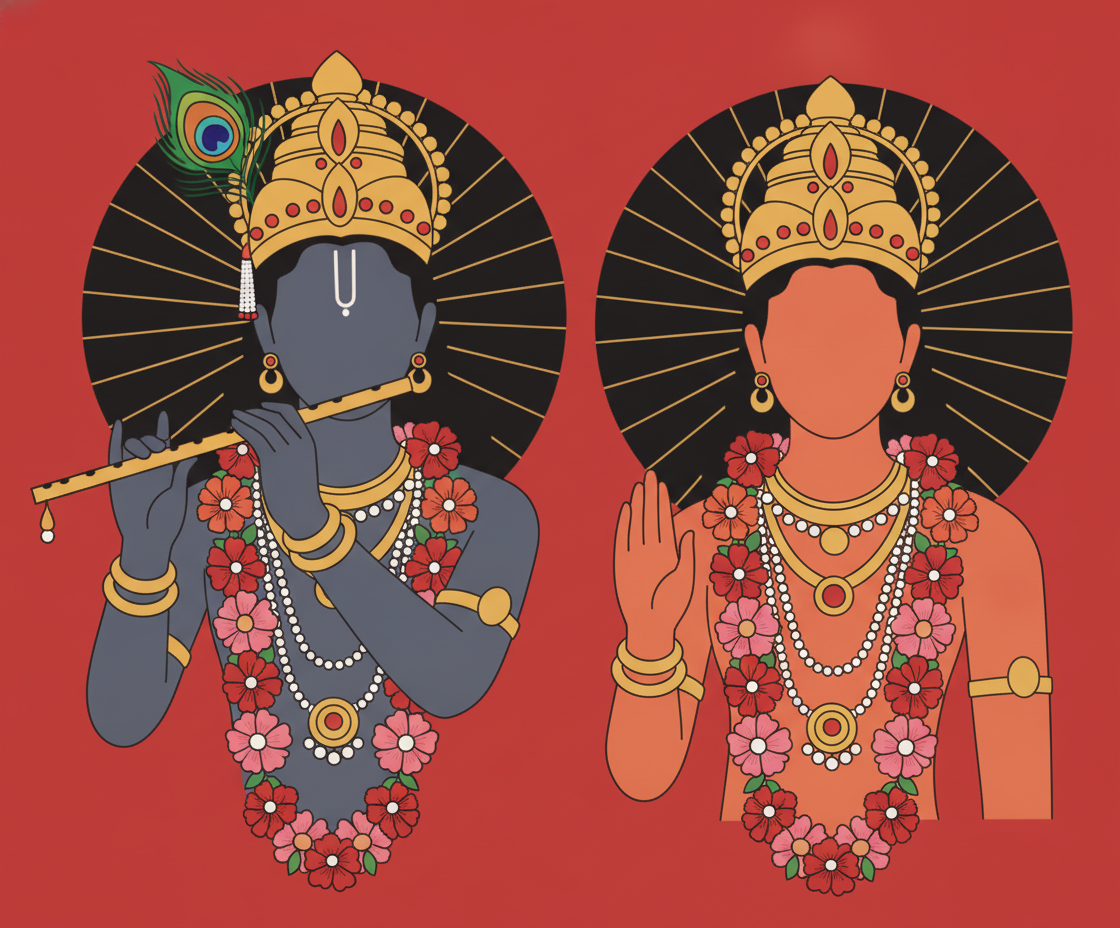
Krishna is the eighth incarnation of Vishnu in Hindu tradition, and he represents something that no single label quite covers: Krishna, god of universal love, embodies joy, devotion, and divine wisdom in a form that speaks past doctrine straight to the heart. He's not a distant rule-giver. He's the one who dances, teases, plays the flute, and still delivers the sharpest spiritual philosophy in the Bhagavad Gita, the Sanskrit teaching poem where he counsels the warrior Arjuna on the battlefield.
Maybe you've come across Krishna's image in a yoga studio, blue-skinned, flute in hand, half smiling, and felt a small disconnect. He looks like a myth from somewhere far away, wrapped in a tradition that isn't yours. Or you've heard the word Bhakti, devotion, and briefly wondered if it fits a practice you built on self-inquiry and discipline.
Here's the thing worth sitting with before anything else: Krishna's love was never meant to stay inside a temple or a scripture. It's personal enough to feel like it's just for you, and vast enough to hold everyone else too, both at once, no contradiction. That flute, that playfulness, that steady voice in the middle of a war, they're not relics. They're an invitation into how you breathe, how you open your chest in a backbend, how you show up for your own life without armor. That's what we're actually going to unpack.
Krishna and the Divine Incarnation: Why Love Takes Form
Vishnu's Eighth Avatar and Historical Context
In the tradition, Krishna arrives as the eighth avatar, or incarnation, of Vishnu, the preserving force in the Hindu trinity. The scriptures describe this descent as happening whenever dharma, the cosmic order that keeps existence in balance, gets buried under greed, cruelty, and forgetting. Yogawiki names Krishna directly as the god of joy, love, and wisdom, the eighth of Vishnu's forms. That detail matters more than it first appears. This isn't a random cameo appearance. It's a pattern, a promise that gets repeated whenever the world loses its way.
But here's what's easy to skim past. Krishna doesn't show up as a king issuing decrees or a warrior enforcing law. He shows up as a cowherd, a friend, a lover, a charioteer, someone who gets his hands dirty in the actual mess of human relationships. Compare that to deities across traditions who rule from thrones or hand down commandments from a distance. Krishna's avatar is a deliberate refusal of that model. The infinite, rather than staying untouchable, chooses skin, breath, friendship, heartbreak.
The Essence of Krishna Beyond the Myth
This is where the real teaching lives, and it's easy to miss if you treat Krishna hindu mythology as just colorful stories for children or temple murals. The incarnation itself is the lesson. Universal love, in this framework, cannot stay an idea. It has to enter a body, get hungry, fall in love, make mistakes, grieve, laugh. Yoga World's description of Krishna guarding the heart chakra with his flute, playful, light, unforced, points at exactly this: love that stays abstract never actually reaches anyone.
I think about this every time a student tells me they feel love for humanity in general but struggle to feel it for the person sitting across from them at dinner. Picture something smaller than a battlefield: you're texting a friend who just lost their job, and the easy move is a quick line, thinking of you, sending you strength. It costs nothing and lands nowhere. Then you put the phone down, call instead, and just listen to them cry for ten minutes without trying to fix it. That shift, from gesture to presence, is the whole point of Krishna's story. Divine love that never takes personal form is just a concept you nod along to. Krishna's mythology insists otherwise: love has to become specific, has to show up for one friend, one afternoon, one phone call, before it can mean anything universal at all.
This is also why Krishna spiritual teachings never separate the sacred from the ordinary. He steals butter, teases the milkmaids, dances in the moonlight, and somehow none of that undercuts his divinity. It deepens it. If you're wondering what any of this has to do with your own practice, hold that thought. It's a thread that runs straight into your own chest, long before it ever needs a scripture to explain it.
Krishna and the Heart Chakra: The Geography of Universal Love
Here's something worth sitting with: love isn't just a feeling you have. It's a frequency you can locate in your body. In the yogic map of energy centers, Krishna isn't loosely connected to love in some poetic, greeting-card sense. He's specifically the guardian of Anahata, the heart chakra, and that's a precise placement, not a vague one. The Yoga World tradition names this directly: Krishna's flute and his heart-chakra association aren't separate ideas. They're the same teaching told twice.
Anahata and the Seat of Devotion
Anahata sits at the midpoint of the seven chakras, and that position matters. It's the bridge between the three lower centers, which govern survival, desire, and personal power, and the three upper ones, which govern expression, intuition, and transcendence. Your nervous system actually mirrors this geography. The vagus nerve, the body's main channel for calm and connection, runs directly through the chest and heart region, linking gut-level instinct to higher brain function. When you're anxious or defended, that connection tightens. When you feel safe, it opens.
This is what devotion to Krishna is really pointing at on a physiological level. Bhakti isn't sentimentality, it's a deliberate softening of a specific bodily region until the chest stops guarding and starts transmitting. I've watched students hold their arms crossed, shoulders rounded, breath shallow, for years without noticing. Then something in a practice cracks that pattern open, and they describe it exactly the way the old texts describe Krishna's presence: lighter, unguarded, strangely joyful for no logical reason.
The Flute as a Symbol of Inner Resonance
Sound is vibration, and vibration is measurable. Krishna's flute isn't a prop in a myth, it's a symbol for something your own body already does. A relaxed exhale, a hummed mantra, even the resonance of a deep laugh, these create oscillations you can actually feel in your chest and throat. The flute's music is a metaphor for that internal frequency, the one available to you the moment fear stops occupying the space in your chest.
Krishna never plays the flute to conquer or persuade. He plays it, and the world simply turns toward him. That's the whole teaching about universal love hidden in one image: it doesn't push, it resonates. You don't need to convince your heart chakra to open any more than you need to convince a tuning fork to hum next to another one already vibrating. You place yourself near the frequency, in a practice, a piece of music, a moment of honest connection, and something in your chest answers on its own.
Bhakti Yoga: Krishna's Path of Devotional Love as a Practice
Here's what surprises most people when they actually try Bhakti Yoga instead of just reading about it: it works faster than the disciplines that demand more of you. I've watched students spend years wrestling with meditation postures, trying to force the mind still through sheer willpower, and get nowhere. Then they sit down, place a hand on the chest, and simply remember someone or something they love without reservation. The shift is almost immediate. Bhakti works because it doesn't fight your nature, it uses it. You already know how to love. You've just never pointed that capacity at the divine before.
You can see this scale up from a single cushion to a global movement. ISKCON, the International Society for Krishna Consciousness, was built entirely on this premise: that devotion, not doctrine, is the fastest road to the divine. It now runs temples on nearly every continent, and none of them require visitors to master Sanskrit grammar or years of philosophy before they're welcome to chant. You show up, you sing, you feel something. That's the whole entry requirement, and it's exactly what makes Bhakti the path Krishna offers to everyone, not just the scholars.
Why Bhakti Is Called the Easiest Path
A teaching associated with Yogalehrerausbildung Köln puts it almost bluntly: when the big, unguarded love wakes up in you, that itself is the practice. Bhakti Yoga, Krishna's path, is considered the easiest route in the yogic tradition precisely because it demands Gottvertrauen, trust in the divine, rather than years of technical mastery. You don't need flexible hips or a disciplined breath count. You need a willingness to feel something and let it grow. I've taught complete beginners who could barely hold a seated position for five minutes, yet they wept during a Krishna mantra on their first try. That's not weakness. That's the heart finding a door it already knew how to open.
Physically, this shows up as warmth spreading through the sternum, shoulders dropping without being told to, breath slowing on its own. No one taught them that. Love does it. This is the part intellectual traditions can't shortcut: you can study Krishna's philosophy for a decade and still feel nothing until you actually practice devotion, the same way reading about swimming never gets you wet. Walk into the Krishna Balaram Mandir in Vrindavan during evening arati and you'll see the same thing happening at scale: hundreds of people, none of them philosophers, all of them moved to tears or laughter by the same simple act of remembering and offering love.