Asanaverse
yogasphere

Krishna: The Hindu God of Universal Love and Divine Wisdom

von Jonas Weber25. August 2026 17 Min.
Krishna: The Hindu God of Universal Love and Divine Wisdom

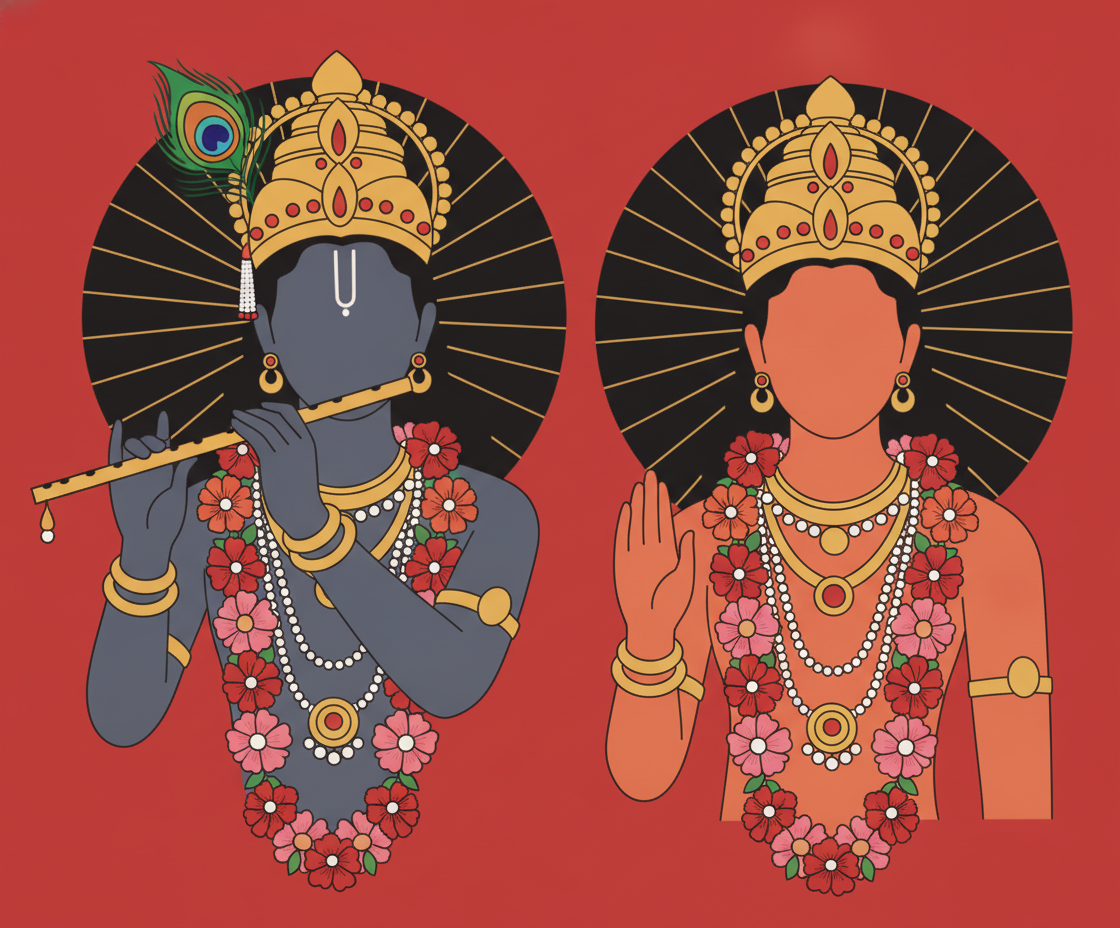
Krishna is the eighth incarnation of Vishnu in Hindu tradition, and he represents something that no single label quite covers: Krishna, god of universal love, embodies joy, devotion, and divine wisdom in a form that speaks past doctrine straight to the heart. He's not a distant rule-giver. He's the one who dances, teases, plays the flute, and still delivers the sharpest spiritual philosophy in the Bhagavad Gita, the Sanskrit teaching poem where he counsels the warrior Arjuna on the battlefield.

Maybe you've come across Krishna's image in a yoga studio, blue-skinned, flute in hand, half smiling, and felt a small disconnect. He looks like a myth from somewhere far away, wrapped in a tradition that isn't yours. Or you've heard the word Bhakti, devotion, and briefly wondered if it fits a practice you built on self-inquiry and discipline.

Here's the thing worth sitting with before anything else: Krishna's love was never meant to stay inside a temple or a scripture. It's personal enough to feel like it's just for you, and vast enough to hold everyone else too, both at once, no contradiction. That flute, that playfulness, that steady voice in the middle of a war, they're not relics. They're an invitation into how you breathe, how you open your chest in a backbend, how you show up for your own life without armor. That's what we're actually going to unpack.
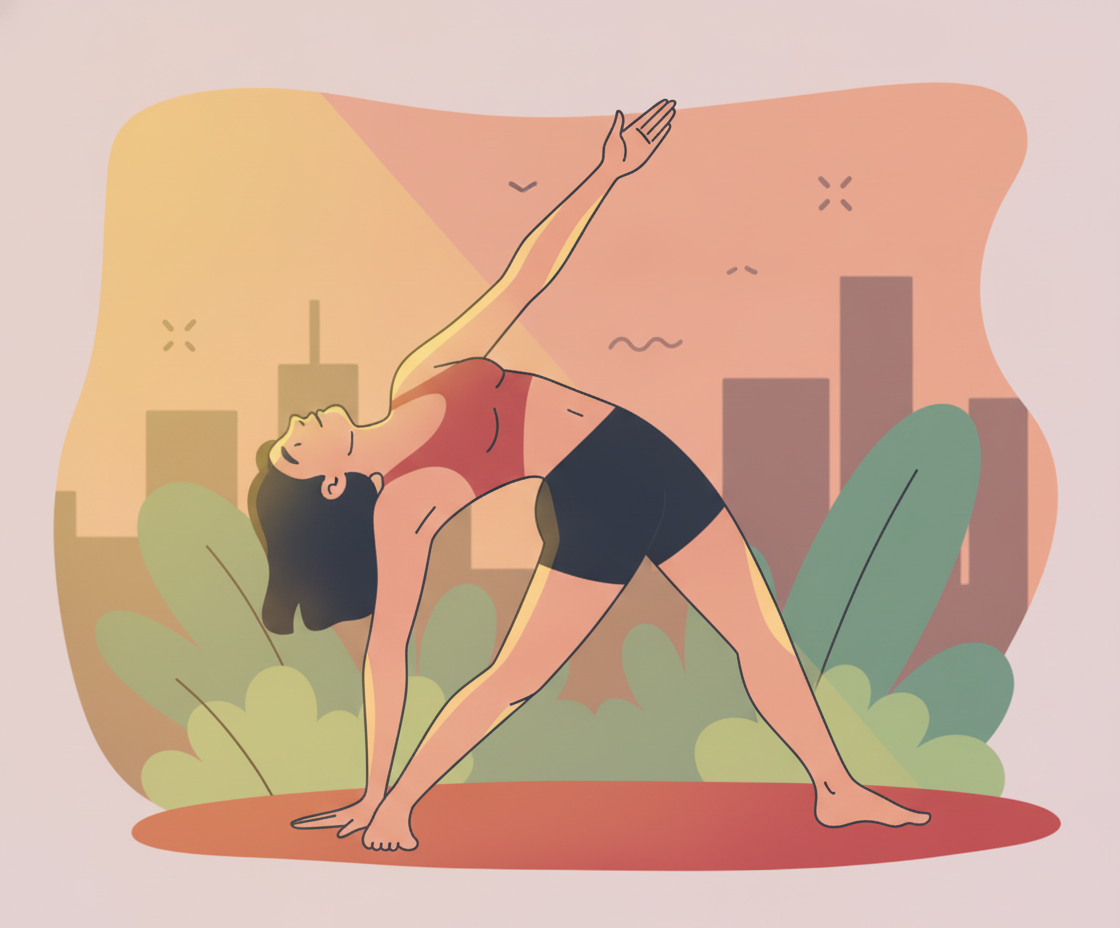
Illustration of a person in a heart-opening backbend pose on a yoga mat, chest lifted toward the sky, arms extended beside the body, in a peaceful indoor space
A practitioner in a heart-opening backbend, embodying divine love through the body

Krishna and the Divine Incarnation: Why Love Takes Form

Vishnu's Eighth Avatar and Historical Context

In the tradition, Krishna arrives as the eighth avatar, or incarnation, of Vishnu, the preserving force in the Hindu trinity. The scriptures describe this descent as happening whenever dharma, the cosmic order that keeps existence in balance, gets buried under greed, cruelty, and forgetting. Yogawiki names Krishna directly as the god of joy, love, and wisdom, the eighth of Vishnu's forms. That detail matters more than it first appears. This isn't a random cameo appearance. It's a pattern, a promise that gets repeated whenever the world loses its way.

But here's what's easy to skim past. Krishna doesn't show up as a king issuing decrees or a warrior enforcing law. He shows up as a cowherd, a friend, a lover, a charioteer, someone who gets his hands dirty in the actual mess of human relationships. Compare that to deities across traditions who rule from thrones or hand down commandments from a distance. Krishna's avatar is a deliberate refusal of that model. The infinite, rather than staying untouchable, chooses skin, breath, friendship, heartbreak.

The Essence of Krishna Beyond the Myth

This is where the real teaching lives, and it's easy to miss if you treat Krishna hindu mythology as just colorful stories for children or temple murals. The incarnation itself is the lesson. Universal love, in this framework, cannot stay an idea. It has to enter a body, get hungry, fall in love, make mistakes, grieve, laugh. Yoga World's description of Krishna guarding the heart chakra with his flute, playful, light, unforced, points at exactly this: love that stays abstract never actually reaches anyone.

I think about this every time a student tells me they feel love for humanity in general but struggle to feel it for the person sitting across from them at dinner. Picture something smaller than a battlefield: you're texting a friend who just lost their job, and the easy move is a quick line, thinking of you, sending you strength. It costs nothing and lands nowhere. Then you put the phone down, call instead, and just listen to them cry for ten minutes without trying to fix it. That shift, from gesture to presence, is the whole point of Krishna's story. Divine love that never takes personal form is just a concept you nod along to. Krishna's mythology insists otherwise: love has to become specific, has to show up for one friend, one afternoon, one phone call, before it can mean anything universal at all.

This is also why Krishna spiritual teachings never separate the sacred from the ordinary. He steals butter, teases the milkmaids, dances in the moonlight, and somehow none of that undercuts his divinity. It deepens it. If you're wondering what any of this has to do with your own practice, hold that thought. It's a thread that runs straight into your own chest, long before it ever needs a scripture to explain it.

Krishna and the Heart Chakra: The Geography of Universal Love

Here's something worth sitting with: love isn't just a feeling you have. It's a frequency you can locate in your body. In the yogic map of energy centers, Krishna isn't loosely connected to love in some poetic, greeting-card sense. He's specifically the guardian of Anahata, the heart chakra, and that's a precise placement, not a vague one. The Yoga World tradition names this directly: Krishna's flute and his heart-chakra association aren't separate ideas. They're the same teaching told twice.

Anahata and the Seat of Devotion

Anahata sits at the midpoint of the seven chakras, and that position matters. It's the bridge between the three lower centers, which govern survival, desire, and personal power, and the three upper ones, which govern expression, intuition, and transcendence. Your nervous system actually mirrors this geography. The vagus nerve, the body's main channel for calm and connection, runs directly through the chest and heart region, linking gut-level instinct to higher brain function. When you're anxious or defended, that connection tightens. When you feel safe, it opens.

This is what devotion to Krishna is really pointing at on a physiological level. Bhakti isn't sentimentality, it's a deliberate softening of a specific bodily region until the chest stops guarding and starts transmitting. I've watched students hold their arms crossed, shoulders rounded, breath shallow, for years without noticing. Then something in a practice cracks that pattern open, and they describe it exactly the way the old texts describe Krishna's presence: lighter, unguarded, strangely joyful for no logical reason.

The Flute as a Symbol of Inner Resonance

Sound is vibration, and vibration is measurable. Krishna's flute isn't a prop in a myth, it's a symbol for something your own body already does. A relaxed exhale, a hummed mantra, even the resonance of a deep laugh, these create oscillations you can actually feel in your chest and throat. The flute's music is a metaphor for that internal frequency, the one available to you the moment fear stops occupying the space in your chest.

Krishna never plays the flute to conquer or persuade. He plays it, and the world simply turns toward him. That's the whole teaching about universal love hidden in one image: it doesn't push, it resonates. You don't need to convince your heart chakra to open any more than you need to convince a tuning fork to hum next to another one already vibrating. You place yourself near the frequency, in a practice, a piece of music, a moment of honest connection, and something in your chest answers on its own.
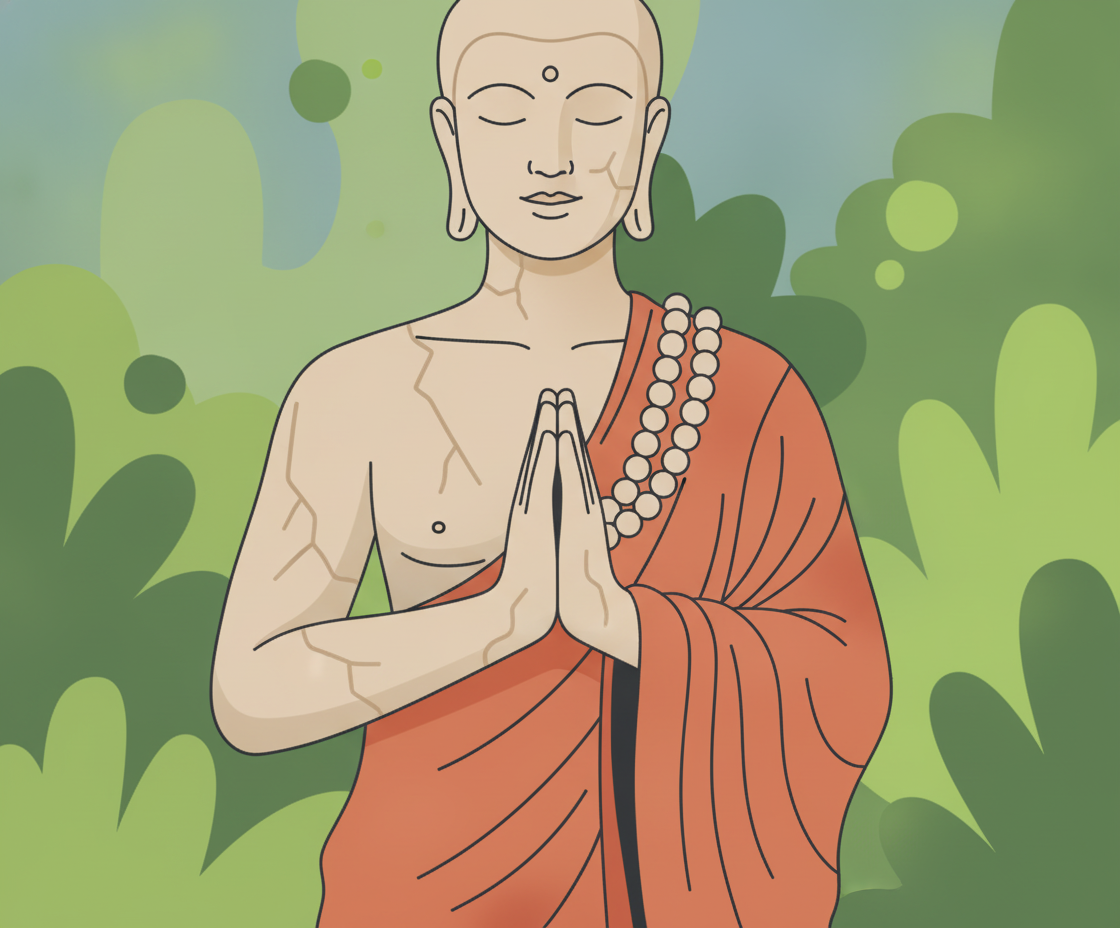
Illustration of hands in a devotional mudra position, palms pressed together at the heart center with gentle fingers, warm golden light illuminating the gesture
Hands pressed together in a devotional gesture at the heart center

Bhakti Yoga: Krishna's Path of Devotional Love as a Practice

Here's what surprises most people when they actually try Bhakti Yoga instead of just reading about it: it works faster than the disciplines that demand more of you. I've watched students spend years wrestling with meditation postures, trying to force the mind still through sheer willpower, and get nowhere. Then they sit down, place a hand on the chest, and simply remember someone or something they love without reservation. The shift is almost immediate. Bhakti works because it doesn't fight your nature, it uses it. You already know how to love. You've just never pointed that capacity at the divine before.

You can see this scale up from a single cushion to a global movement. ISKCON, the International Society for Krishna Consciousness, was built entirely on this premise: that devotion, not doctrine, is the fastest road to the divine. It now runs temples on nearly every continent, and none of them require visitors to master Sanskrit grammar or years of philosophy before they're welcome to chant. You show up, you sing, you feel something. That's the whole entry requirement, and it's exactly what makes Bhakti the path Krishna offers to everyone, not just the scholars.

Why Bhakti Is Called the Easiest Path

A teaching associated with Yogalehrerausbildung Köln puts it almost bluntly: when the big, unguarded love wakes up in you, that itself is the practice. Bhakti Yoga, Krishna's path, is considered the easiest route in the yogic tradition precisely because it demands Gottvertrauen, trust in the divine, rather than years of technical mastery. You don't need flexible hips or a disciplined breath count. You need a willingness to feel something and let it grow. I've taught complete beginners who could barely hold a seated position for five minutes, yet they wept during a Krishna mantra on their first try. That's not weakness. That's the heart finding a door it already knew how to open.

Physically, this shows up as warmth spreading through the sternum, shoulders dropping without being told to, breath slowing on its own. No one taught them that. Love does it. This is the part intellectual traditions can't shortcut: you can study Krishna's philosophy for a decade and still feel nothing until you actually practice devotion, the same way reading about swimming never gets you wet. Walk into the Krishna Balaram Mandir in Vrindavan during evening arati and you'll see the same thing happening at scale: hundreds of people, none of them philosophers, all of them moved to tears or laughter by the same simple act of remembering and offering love.

Lotuscrafts Meditationsmatte

Lotuscrafts Meditationsmatte

Auf Amazon shoppenPreis: 70

Surrender as Strength, Not Passivity

Students often flinch at the word surrender. It sounds like giving up, like weakness dressed in spiritual language. But sit in Padmasana, Lotus Pose, the classic meditation seat for Bhakti practice, and notice what surrender actually requires: your spine stays lifted, your hips stay grounded, your attention stays present. Nothing collapses. Real surrender takes more strength than control does, because you're staying open instead of bracing. That's Krishna's gift, love as active engagement, not withdrawal.

LotussitzAsanaLotussitzPadmasanaZur Asana →

Krishna Janmashtami makes this visible on a massive scale. It's the largest Hindu festival celebrating Krishna's birth, and at temples like Sri Krishna Janmabhoomi in Mathura, devotees don't just sit quietly. They dance the Raslila, they climb human pyramids for Dahi Handi, they stay up through the night in active, physical devotion. Nobody there is passive. That's the paradox surrender actually resolves: total emotional openness paired with full-bodied engagement, not either one at the expense of the other. The same dynamic shows up at the Banke Bihari Temple, listed among the thirty most significant Krishna shrines in India, where crowds move, sing, and offer themselves for hours without a trace of resignation in it.

This is where Krishna's spiritual teachings become something you can actually practice rather than just admire. Sitting quietly with his name, his image, or simply the memory of loving someone fully carries the same transformative weight as advanced asana. Your body already rehearsed this openness in the postures. Now the heart just has to keep choosing it.

The Bhagavad Gita: Krishna's Wisdom Teaching in Dialogue

The Crisis That Demands Wisdom

Picture a guy sitting in his car in a parking lot before a meeting he cannot bring himself to walk into. Hands on the wheel, engine off, mind racing between what he owes his family and what he actually believes is right. That is Arjuna, minus the chariot and the battlefield. He is not calm. He is not seeking a lecture on metaphysics. He drops his bow, sits down, and admits to Krishna that he cannot move. The Bhagavad Gita opens right there, in collapse, not contemplation.

What makes this scene so enduring is that Krishna does not scold him for doubting. He does not tell Arjuna to toughen up or suppress the feeling. He sits with him in it, then starts talking, patiently, through chapter after chapter, because a crisis this real needs more than a slogan. That intimacy is easy to miss if you only know Krishna hindu god of universal love through temple paintings and flute imagery. Here he is closer to a friend staying on the phone with you at 2am than a distant deity.

Krishna's Central Message: Love Over Duty Alone

Krishna bhagavad gita teachings move through several paths: disciplined action, knowledge, meditation. But none of them stand alone as the point. Krishna keeps circling back to something warmer and less systematic: surrender rooted in love. Not surrender as giving up, but as loosening your grip on the outcome because you trust something bigger than your own anxious calculations. Dharma, your sense of purpose or right action, only becomes livable when it is carried by that trust instead of gritted teeth.

This is the part people miss when they read the Gita as a manual on duty. Krishna is not asking Arjuna to fight because rules say so. He is showing him that action done from a place of love and connection stops being a burden you carry alone. You act, fully, and then release your white-knuckle hold on how it turns out. That is not detachment in the cold sense. It is closer to what happens when you help someone you love without keeping score.

Read this way, the dialogue format is not decoration. It is the whole method. Doubt speaks, wisdom answers, doubt speaks again. That back and forth is happening in your own head right now, probably about something far less dramatic than a war. Krishna spiritual teachings do not resolve that inner argument by shutting it down. They keep talking to it until love becomes the more convincing voice.

Opening the Heart Through Asana: Embodying Krishna's Teachings

You can talk about Krishna's teachings on divine love for years without ever feeling what they point to. I have watched students nod through an entire philosophy discussion, then get onto their mats and physically flinch when asked to open the chest. The body keeps score in a way the mind cannot argue with. This is why the mat, not the book, is often where Krishna actually arrives.

Fish Pose and the Vulnerable Heart

In Matsyasana, Fish Pose, you arch the upper back, drop the crown of the head toward the floor, and let the chest lift wide open toward the ceiling. The throat stretches. The ribs spread. There is nothing guarding the front of the body anymore. I have taught this pose hundreds of times, and the same thing happens over and over: people who are composed and articulate off the mat suddenly go quiet, or their breath catches, the moment the chest is that exposed.

FischAsanaFischMatsyasanaZur Asana →

That bracing is worth noticing rather than fighting. Many students tense the shoulders toward the ears the instant the chest lifts. It is an old, sensible reflex: an exposed throat and heart used to mean danger. Consciously letting the shoulders melt down the back, even slightly, is already the practice. You are not stretching a muscle. You are telling an old alarm system that this particular openness is not a threat.

Stay in the pose a little longer than feels comfortable and something shifts. The first ten seconds are often about managing the stretch. Past that, most students stop adjusting and simply breathe, and the chest keeps lifting on its own, not because they are trying harder but because they have stopped resisting. That difference, between forcing an opening and allowing one, is the entire teaching Krishna offers about love: it cannot be willed into place, only permitted.

Heart-Melting Pose as a Gesture of Surrender

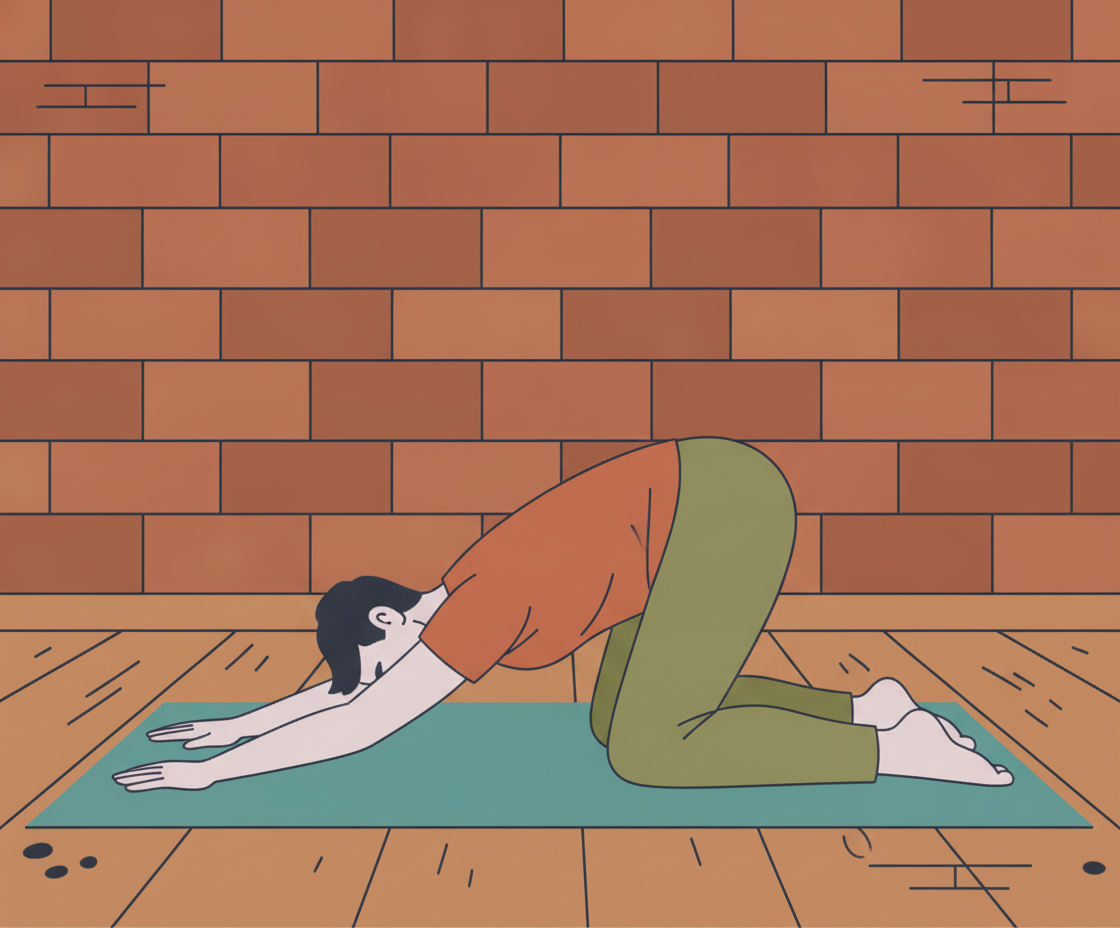
Anahatasana, the Heart-Melting Pose, asks for something even more direct: hips stacked over the knees, arms walked forward, chest sinking toward the earth. Students often describe an odd sensation there, part ache, part relief, right in the center of the chest, as if the body were rehearsing surrender before the mind has agreed to it.

HerzöffnerAsanaHerzöffnerAnahatasanaZur Asana →
Illustration of a person lying on their back in heart-melting pose with hips elevated on a bolster, chest open and vulnerable, in a dimly lit room with soft candlelight
A practitioner in heart-melting pose, surrendering through a supported backbend

This is where Krishna's universal love stops being a concept and becomes something felt. His flute, his playfulness, his devotion to those he loved, none of that needs explaining while your chest is pressed into the earth. The pose does the teaching. You are not becoming more flexible so much as your nervous system is learning, one held breath at a time, that love is safer than defense, and that lesson lands in the body long before it ever reaches the mind.

Lotuscrafts Yoga Block

Lotuscrafts Yoga Block

Auf Amazon shoppen

From Krishna to You: Universal Love as a Living Practice

Here's the thing nobody tells you about all of this: the incarnation, the heart chakra, the Gita, the asanas. None of it works as information. You can know that Krishna is the eighth incarnation of Vishnu, know exactly where Anahata sits in the body, quote entire chapters of the Gita from memory, and still feel nothing when you close your eyes. Universal love isn't a fact you learn, it's a muscle you build through repetition, the same way trust in a person is built through a hundred small moments rather than one grand declaration. That's the shift this whole article has been pointing toward.

Translating Myth Into Daily Devotion

Bhakti Yoga, the devotional path Krishna represents, has a reputation for being the easiest road in yoga philosophy. Easy doesn't mean passive though. It asks for something specific: consistent, unglamorous acts of remembrance. Not a single breakthrough moment, but showing up again and again until the walls soften on their own schedule, not yours.

So make it small enough that you'll actually do it. Sit in Padmasana, hand resting over your heart, and repeat the mantra Om Namo Bhagavate Vasudevaya, I bow to Krishna, the source of all. You're not asking anything of a distant being. You're naming what's already inside your own chest. Five minutes. Same time each day if you can manage it. The repetition is the practice, not a warm-up for it.

This mantra, Om Namo Bhagavate Vasudevaya, stands for trust in life, playful devotion, and the heart as your compass, the very essence of Bhakti Yoga. As a daily reminder there is our Krishna shirt (https://asanaverse-shop.com/en-eur/collections/krishna), so you carry Krishna with you at all times, even on the days the flute feels far away.

Om Namo Bhagavate Vāsudevāya (BLACK)

Om Namo Bhagavate Vāsudevāya (BLACK)

T-Shirt aus der Krishna-Kollektion. Mantra: Om Namo Bhagavate Vasudevaya. Hingabe, Liebe und Vertrauen ins Leben — das Herz als Kompass.

Jetzt ansehenPreis: 35

Some days you'll feel the flute-like lightness Krishna is known for. Other days you'll feel bored, distracted, convinced nothing is happening. Keep going anyway. That's not failure, that's just what devotion looks like before it becomes felt experience instead of an idea you're testing out.

Building a Personal Relationship With the Divine

Krishna was always painted as a friend before he was painted as a god, a playmate, a lover, a charioteer who argued with Arjuna like an equal. That detail matters more than it seems. It means your own relationship with this consciousness doesn't need formality. Talk to it. Argue with it, the way Arjuna did. Read one verse from the Gita and just sit with whatever it stirs, without rushing to interpret it correctly.

Pair that with a heart opener, Fish Pose or Heart-Melting Pose, not for flexibility but as a physical yes to whatever softens. Over weeks, these gestures stop being separate techniques and start being one continuous conversation. The sense of a distant god fades. What replaces it is quieter and stranger: the recognition that the love you were reaching for was never outside you to begin with.

Sources & further links

Community

Deine Erfahrungen

Teile deine Erfahrungen mit der Community.

Kommentare werden vor der Veröffentlichung geprüft.