Asanaverse

Menopause Sleep and Stress

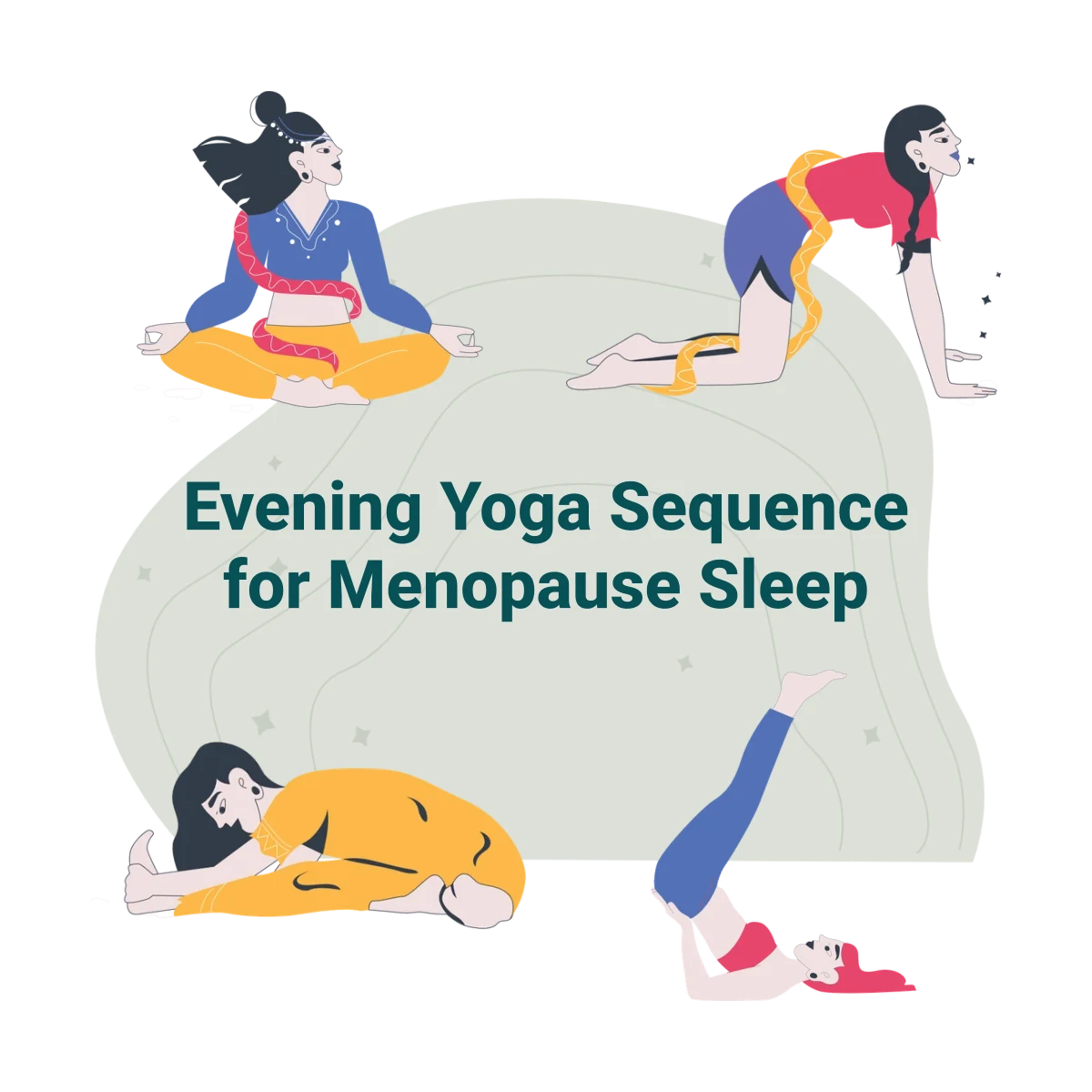
Yoga for Sleep and Steadiness Through Menopause

You wake at three and lie there. The temper you did not use to have arrives over nothing. Everything is one degree too warm and one notch too loud, and the tiredness after a bad night has started to feel like the baseline.

This guide leads with sleep and mood rather than hot flushes, because that is where the evidence is. What the strongest trial found and what it did not, why two meta-analyses by the same author disagree, what to change if your bones are thinning, and an eight week program.

Who this guide is for

Signs this guide was written for you

This is for perimenopause and after, when sleep and mood are the main problem, alongside whatever else you are doing about it.

  • ·You are in perimenopause or past it.
  • ·Sleep is broken, or the days are shorter tempered than they used to be.
  • ·You want something honest about what a practice can and cannot change here.
  • ·If osteoporosis is a possibility, you have had a bone density check or will get one.
  • ·You can find thirty minutes twice a week and twenty minutes one evening.

What causes Menopause Sleep and Stress

The largest trial here found no effect on hot flushes, and sixty-eight percent of the yoga group said it had helped their symptoms anyway.

That combination is the most interesting thing in this literature. 249 women, twelve weeks, hot flush frequency counted daily as the primary outcome. Yoga fell by 2.9 a day, ordinary activity by 2.6, and the difference between the groups was nothing. Meanwhile insomnia severity improved significantly in the yoga group, and most participants reported that their menopause symptoms were better.

There are two ways to read that. One is that people fool themselves. The other is that they were measuring something the study was not: sleeping through more of the night, and minding the flushes less when they came. The second reading fits the rest of the evidence better, because sleep and mood are exactly where the effects hold up across trials. So this program aims there, and treats hot flushes as something you get a tool for rather than a promise about.

  • ·In the strongest single trial, hot flush frequency fell by a similar amount in the yoga group and in the ordinary activity group.
  • ·In the same trial, insomnia severity improved significantly more in the yoga group.
  • ·A 2012 meta-analysis found moderate evidence for psychological symptoms and none for vasomotor symptoms. A larger 2018 one found effects on both.
  • ·In postmenopausal women with diagnosed insomnia, yoga beat both a control group and a passive stretching group on insomnia severity, while sleep laboratory measures showed no group difference.
  • ·A meta-analysis of eleven studies found no significant effect of Pilates or yoga on bone density. Standing work here is for strength and balance, not for bone.

Safety

When to practise and when to get it looked at

Three things that shape how this program is built, and two lines where a doctor comes before a practice.

How to practise so it works

  • ·Twists stay at half range for the whole program and do not get deeper in week eight. Deep backbends stay out, and forward bends come from the hip crease with a long spine.
  • ·That is because vertebral compression fractures following forced flexion and rotation are documented in people with osteopenia and osteoporosis, and bone loss accelerates after menopause.
  • ·If you have risk factors for osteoporosis and have never had a bone density check, get one before starting rather than after.
  • ·Any vaginal bleeding after the menopause needs a doctor, regardless of anything on this page.
  • ·Sudden or severe hot flushes with other new symptoms are worth checking: thyroid problems and some medications produce the same picture.

For yoga teachers

Teaching a class for Menopause Sleep and Stress

Aim at sleep and mood and say so. The largest trial in this area counted hot flushes daily for twelve weeks and found no difference against ordinary activity, while insomnia severity improved significantly. Most participants still said their symptoms were better. A class sold on hot flushes will disappoint people; a class sold on sleeping through the night will not.

The cooling breath is worth teaching and worth framing honestly. It belongs in the same protocol that found no change in hot flush frequency. What it gives someone is something to do in the ninety seconds they are in, and that is a real thing to offer as long as nobody leaves thinking it prevents the next one.

Ask about bone density before the first twist. Vertebral compression fractures following forced flexion and rotation in people with osteopenia or osteoporosis are documented in the literature. In practice that means twists stay at half range for the whole room, forward bends come from the hip crease with a long spine, and deep backbends stay out. None of that costs a healthy student anything.

Two practical points:

  • ·Give the ending real time. Four minutes with the legs supported and a proper final rest is what the sleep results actually rest on, and it is the first thing that gets squeezed when a class overruns.
  • ·An active evening class can leave someone too warm to sleep. Offer the strong sessions earlier in the day and keep the evening one restorative.

And do not promise bone density. A meta-analysis of eleven studies in mostly postmenopausal women found no significant effect. Standing weight bearing work is worth doing for strength and balance, which is a good enough reason on its own.

Build your own

Put together your own class for Menopause Sleep and Stress

The sequence builder gives you all 108 asanas and lets you arrange them yourself. While you build, it watches the shape of the class: whether the intensity rises and falls the way a practice should, whether every strong pose gets its counterpose, and whether the order makes anatomical sense.

Save what you build, come back to it, and teach it. It is the fastest way to turn what you just read into a class of your own.

The research

What the studies actually found

This is a field where the answer depends on which symptom you ask about, and the honest version is more useful than the flattering one. Sleep and mood improve across independent trials. Hot flushes are genuinely contested: the largest and best controlled trial found no difference against ordinary daily activity, an older meta-analysis found nothing, and a newer larger one found an effect its own authors flag as not robust to bias. Bone density does not improve. This program is built on the first of those three and honest about the other two.

Menopause2014

Efficacy of yoga for vasomotor symptoms: a randomized controlled trial

249 women randomised to twelve weeks of yoga or to ordinary daily activity, with hot flushes counted daily. Baseline frequency was 7.4 a day in the yoga group and 8.0 in the control group, and there was no difference between groups in the change at either six or twelve weeks. Insomnia severity did improve significantly in the yoga group. It is the strongest single trial here and the reason this program is named after sleep.

Read the source →
Menopause2012

Yoga decreases insomnia in postmenopausal women: a randomized clinical trial

Postmenopausal women with diagnosed insomnia randomised to yoga, passive stretching, or a control group, followed for four months. The yoga group had significantly lower climacteric symptom and insomnia severity scores and higher quality of life, and the reduction in insomnia severity was significantly greater than in both the control and the stretching groups. Polysomnography showed no significant differences, which sets the honest limit on the claim.

Read the source →
Complementary Therapies in Medicine2016

Hatha Yoga practice decreases menopause symptoms and improves quality of life: A randomized controlled trial

88 postmenopausal women randomised to hatha yoga twice a week for twelve weeks, to an exercise group, or to no intervention. The yoga group had significantly lower menopause symptom, stress and depression scores and higher quality of life than both the exercise group and the control group. It is the clearest evidence that this does something an ordinary exercise class does not.

Read the source →
Maturitas2018

Yoga for menopausal symptoms: A systematic review and meta-analysis

13 randomised trials with 1,306 participants. Against no treatment, yoga reduced total, psychological, somatic, vasomotor and urogenital symptoms. Against exercise controls, only the vasomotor effect remained. The authors note the effects were robust against selection bias but not against detection and attrition bias, and no serious adverse events were reported.

Read the source →
Evidence-Based Complementary and Alternative Medicine2012

Effectiveness of yoga for menopausal symptoms: a systematic review and meta-analysis of randomized controlled trials

Five trials with 582 participants reviewed and four with 545 pooled. Moderate evidence for a short-term effect on psychological symptoms, and no evidence for total menopausal symptoms, somatic symptoms, vasomotor symptoms or urogenital symptoms. Read alongside the 2018 analysis by the same lead author, it is the clearest picture of how unsettled the hot flush question actually is.

Read the source →
PLOS ONE2021

Effectiveness of Pilates and Yoga to improve bone density in adult women: A systematic review and meta-analysis

Eleven studies with 591 participants aged 45 to 78, interventions running from twelve to thirty-two weeks and two for at least a year. The pooled effect against control groups was 0.07 and not significant. It is why this program describes its standing work as strength and balance rather than as anything to do with bone.

Read the source →

Frequently Asked Questions

Do hot flushes get better with yoga?

The best evidence says probably not by much. In a trial of 249 women, twelve weeks of yoga and twelve weeks of ordinary activity reduced hot flushes by a similar amount, with no significant difference between the groups. A 2012 meta-analysis found no evidence for vasomotor symptoms; a larger 2018 one did find an effect, and its authors note it was not robust against detection and attrition bias.

Does yoga help menopause sleep problems?

This is the most consistent finding in the area. Insomnia severity improved significantly in the trial above, and in a separate trial of postmenopausal women with diagnosed insomnia, yoga beat both a control group and a passive stretching group. Sleep laboratory measurements in that trial showed no difference, so what improves is how you sleep rather than what a machine records.

What about mood and irritability?

Well supported. The 2012 meta-analysis found moderate evidence specifically for psychological symptoms when it found nothing for the physical ones. In a trial of 88 postmenopausal women, yoga improved menopause symptom scores, stress and depression more than an exercise group did.

Can yoga improve bone density?

No, on current evidence. A meta-analysis of eleven studies with 591 participants, mostly postmenopausal, found no significant effect for Pilates or yoga. Weight bearing standing work is worth doing for strength and balance, and it is not the reason to be here.

What should I change if I have osteoporosis?

Keep twists gentle and never forced, leave out deep backbends, and fold from the hip crease with a long spine rather than rounding the back. Vertebral compression fractures following forced flexion and rotation are documented in people with low bone density. Get a bone density check first if you have risk factors and have not had one.

Is eight weeks long enough?

It is the length of the one trial that tested a full programme in perimenopausal women, so it is a defensible number. The trials with the clearest sleep and mood results ran twelve weeks or four months, so continuing after week eight is where the rest of it comes from.

Where to next

All programs

See the other programs

Every program here was built around one complaint and around the trials that studied it. Back, neck, knees, hips, sleep and stress, each one running for as long as the research says it takes.

Browse programs →