Modern yoga and mindfulness have been quietly stripped of their political teeth. What started as ethical systems built around collective liberation now gets sold as a private coping mechanism, teaching you to breathe through injustice instead of naming what's producing it. That's the whole trick hiding in plain sight: an ideology that turns structural pain into a personal wellness project. This essay traces how that depoliticization happened and what it would actually take to reclaim yoga as something more than a coping mechanism.
You know the feeling. You're on your mat, dropping into stillness, and somewhere underneath the calm there's a low hum of guilt. People are getting evicted, deported, underpaid, unheard, and you're here doing child's pose. Is this self care or is this checking out? That tension isn't a personal failing. It's a signal that something in the practice has been rerouted.
Then there's the teacher side of it. Maybe you've built a business on "finding your peace," candles lit, playlist curated, and you've never once mentioned that the poses you're teaching carry a much longer, messier history than the studio wall art suggests, one shaped by colonial power, nationalist reform movements, and a very specific erasure of who yoga was originally for. Selling inner stillness while skipping that history isn't neutral. It's a choice, even when it doesn't feel like one.
So where does that leave you? If your practice is tangled up in the very systems it claims to rise above, is there any ground left to stand on? That question isn't rhetorical despair, it's actually the opening. Because the answer isn't to abandon the mat. It's to look at what yoga was actually built to do, before it got repackaged, and ask what it might still be capable of.
A woman sitting at a desk with binders and potted plants behind her.
Yoga and Mindfulness: The Ideology of Depoliticization
Here's what actually happens in your nervous system when a corporate wellness program hands you a meditation app instead of a raise. Your body registers chronic stress the same way whether it comes from an unpayable rent bill or a screaming manager: cortisol spikes, the amygdala stays on alert, your baseline shifts toward hypervigilance. Mindfulness training can genuinely lower that reactivity in the moment. But the source of the threat never moves. You've been taught to regulate your response to harm, not to question why the harm keeps happening.
This is what researchers describe as depoliticization through internalization: structural suffering gets rebranded as a personal attention deficit, something you failed to breathe your way out of. Poverty becomes a mindset. Discrimination becomes a trigger to be observed non-judgmentally. Overwork becomes a resilience gap. The German outlet WELT documents this shift directly in its coverage of Achtsamkeit (mindfulness) culture, describing how the practice functions as ideology: workers meditate to survive burnout instead of organizing to change the conditions producing it.
The cognitive mechanism is almost elegant in its cruelty. Mindfulness asks you to observe thoughts and sensations without judgment, which is a genuinely useful skill for panic or intrusive rumination. But applied to systemic conditions, that same skill teaches you to observe your exploitation without judgment too. You watch the anger arise, you watch it pass, you return to the breath. Nothing outside your skull has to change for you to feel, temporarily, okay again.
That's the neoliberal logic underneath mindfulness washing: your suffering is reframed as your project to optimize, on your own time, with your own labor. The institution doesn't need to touch wages, staffing, or hierarchy. It just needs you calm enough to keep showing up. A nervous system trained only toward self-soothing, never toward collective response, is a nervous system that has been quietly recruited against its own interests.
None of this means the breath work is fake or the calm you feel is an illusion. It means the calm has been aimed in one direction only: inward, alone, permanently. What gets lost is the second half of what these practices were ever meant to do, connect insight to action, not substitute for it.
The Colonial Genealogy of Modern Yoga: How Western Power Reshaped Practice
Here's what gets erased when yoga becomes a stretching routine with candles: the version of yoga sold in most studios today is not an ancient survivor, it's a colonial-era edit. The Yoga Sutras of Patanjali, the closest thing yoga has to a foundational text, spend almost no time on posture. They spend their time on the mind, on ethical conduct, on the eight-limbed path called Ashtanga, where asana is just one limb among eight, and arguably not the most important one.
Yoga Before the West: Philosophy, Ethics, and Community
The Yamas and Niyamas, the ethical restraints and observances that open that eight-limbed path, weren't optional add-ons for the spiritually ambitious. Ahimsa (non-harm) and Satya (truthfulness) came first, before any posture, because the tradition assumed you couldn't get anywhere real on the mat while still lying to your community or profiting from harm elsewhere. Yoga was dharma, duty toward collective wellbeing, practiced inside a web of teacher, student, and community obligation. It was never a private wellness hour.
During the British Raj, colonizers and Indian reformers alike had reasons to reshape this. As a Deutschlandfunk Kultur feature on yoga's history puts it, there is no such thing as an authentic, unchanging yoga to return to: what we call yoga was substantially reworked through colonialism and through European gymnastic movements that reformers borrowed to make the practice legible, and palatable, to a Western gaze. Asana and Pranayama, breath control, got lifted out and rebranded as neutral, secular, scientific technique. The ethical scaffolding around them was quietly dropped. That wasn't translation. It was amputation with a purpose.
Patriarchal Rebranding: From Spiritual Discipline to Body Commodification
Research coming out of FU Berlin on modern yoga's structural history makes a sharper claim still: this restructuring didn't just remove philosophy, it embedded patriarchal and capitalist logic directly into yoga's new form. The practice became individualized instead of community-rooted, body-focused instead of philosophy-centered, sellable instead of sacred. The language of accessibility, making yoga simple, universal, open to anyone, did real good in one sense. It also did a quieter kind of work: it made yoga safe for Western consumption by making it compliant with Western power.
None of this is presented here as settled historical fact, it's the interpretation these sources offer, and it's worth sitting with rather than swallowing whole. But it reframes the question people ask about yoga and politics. The practice was never neutral to begin with. It was made to look neutral. And that manufactured neutrality is exactly what let depoliticization walk in the front door, unquestioned, wearing yoga's own clothes.
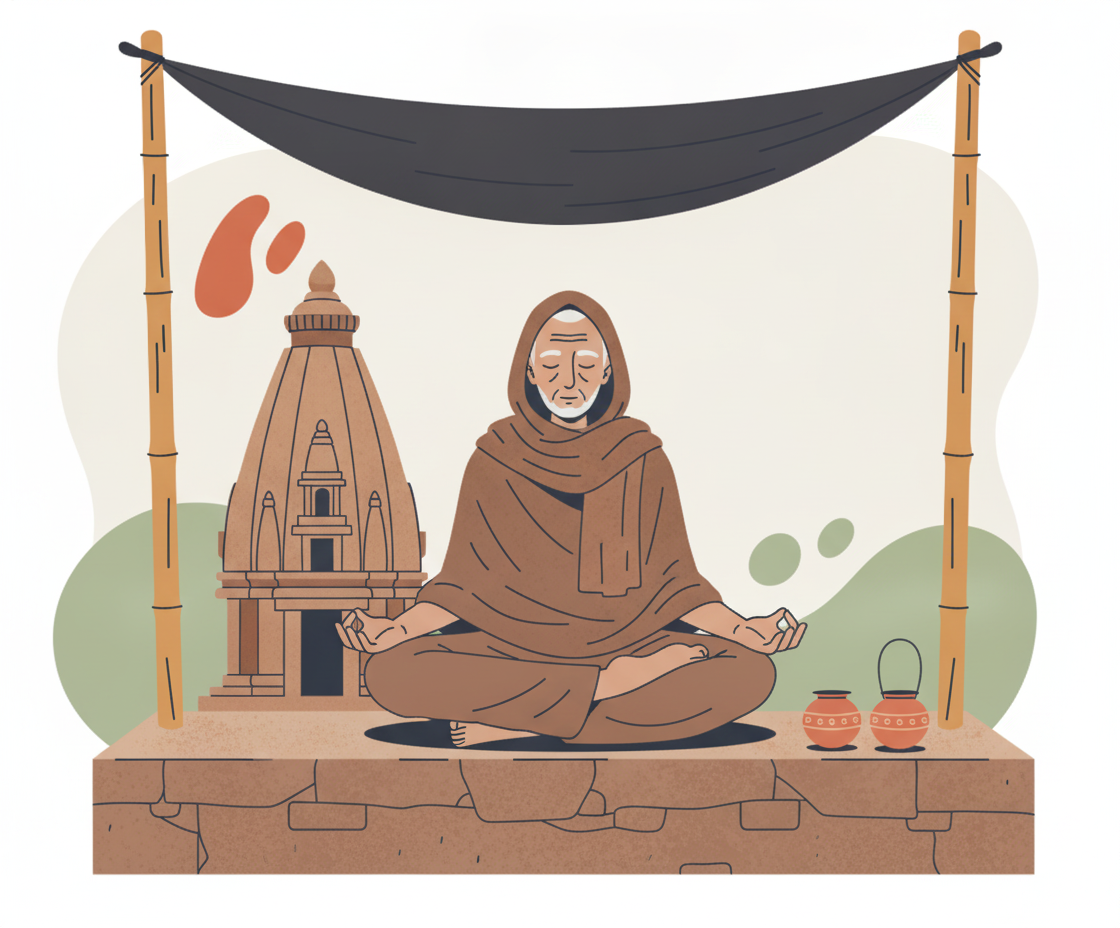
A person meditating on a stone platform with a temple in the background.
Ahimsa as Structural Critique: Beyond Individual Compassion
I've taught Ahimsa a hundred times as "be gentle with your body, don't force the pose." It's not wrong, it's just tiny. Ahimsa, the first Yama, was never meant to be a personal virtue you cultivate quietly on your mat. It's a mandate to stop participating in systems that harm people at scale. When you shrink it down to "don't push your hamstrings too hard," you've made a structural ethic into a stretching tip. That's not translation. That's amputation.
Ahimsa Beyond the Self: Collective Non-Harm
Watch a room during Bharadvajasana, Bharadvaja's Twist. Spines rotate, ribs compress on one side, the gaze shifts over the shoulder to a point the body couldn't see a second ago. That's the whole teaching in one shape: you cannot examine a structure while facing it head on, you have to turn. I ask students, mid-twist, what they're avoiding looking at in their own life. Most laugh nervously. Some go quiet. The body already knows this is uncomfortable work, not relaxation.
That discomfort is the point. Ahimsa asks you to turn toward your consumption patterns, your silence at work, your career choices, and ask whose suffering funds your comfort. A hundred classes in, I've noticed the same pattern: students accept the twist in their spine far more easily than the twist in their assumptions. The body yields before the ego does.
The Limits of Personal Purity: When Yoga Becomes Complicity
I've watched teachers, mostly women, underpaid, teach five classes a day to sustain a studio's spiritual branding, while the studio sells retreats extracting from Indian communities under the banner of ahimsa sozialverantwortung. Nobody in the room is being physically harmed. Everyone feels ethically accomplished. That gap between feeling and fact is where depoliticized Ahimsa lives.
Personal kindness doesn't cancel structural harm, it just makes it easier to tolerate. A student once told me meditation made her calm enough to stay in a job exploiting people she managed. She wasn't lying about the calm. She was describing complicity with good posture. Reclaiming Bharadvajasana as more than a hip opener means treating that unsettled feeling in the twist as instruction, not inconvenience: a disciplined refusal to stay comfortable inside systems built on someone else's harm.
Mindfulness-Washing: How Institutions Co-opt Yoga for Control
Picture a nurse on her fifteen minute break, sitting in a supply closet with an app on her phone, following a soothing voice through four counts of inhale, four counts of hold. She's been on her feet for nine hours, short staffed since her hospital cut two positions last year and never replaced them. The breathing helps, a little, for about six minutes. Then the call bell rings and she's back on the floor, carrying the same load with a slightly calmer nervous system. Nothing about the floor has changed. Only she has, and only for six minutes.
That closet is where mindfulness washing actually happens. Not in a boardroom, but in a small, quiet transaction. The hospital gets to call itself progressive for offering the app. The staffing spreadsheet never has to change. One party gets a wellness metric to report. The other gets four counts of breath and the same patient load.
This scales up cleanly. Companies roll out meditation apps as a benefit, universities require a wellness credit, prisons introduce breathing programs, and in each case the pitch sounds identical: we care about your mind. But institutions don't discover compassion on a schedule that happens to coincide with rising burnout complaints or unionization chatter. They discover something more useful: a person practicing nonjudgmental awareness of their own suffering is far less likely to organize with the person next to them about its cause.
Management literature is unusually candid about this once you go looking. Mindfulness gets framed there as a way to build employee resilience, a word that sounds like strength but functions as an instruction: absorb the harm, keep producing, don't make it the company's problem. It's not a conspiracy so much as a convenience. Regulated, introspective workers are simply easier to manage than angry, collective ones.
What gets lost in this transaction is the collective impulse itself. The version of the nurse who might have compared notes with three coworkers after a shift, who might have named the understaffing out loud, who might have walked toward a union meeting instead of a meditation app, that version gets quietly rerouted. She's alone with her breath instead of in a room with her coworkers. That rerouting is the entire function, not a side effect.
This is the real cost of mindfulness sold as neoliberal wellness. It doesn't just fail to fix the system, it actively converts the energy that might have confronted the system into something private, calm, and safely unthreatening. Rage becomes regulated breath. Grievance becomes a personal project. The institution stays exactly as it was, just with fewer people angry enough, at the same time, to say so.
Reclaiming Yoga as Sociopolitical Practice: Savasana and Refusal
So where does that leave the practitioner still lying on their mat, still showing up to class? I've taught Savasana hundreds of times, and I've watched the same discomfort ripple through a room the moment I say stay still, do nothing. Reclaiming yoga starts in the body, not in a manifesto. It starts with what happens when you actually stop.
Savasana as Political Act: The Power of Withdrawal
Watch a room during Savasana (Corpse Pose) and you'll see the fidgeting before the stillness. Fingers check for phones. Eyes crack open. Savasana (Corpse Pose) asks the body to do the one thing our culture treats as failure: nothing at all. That twitchiness isn't weak willpower. It's a nervous system trained to justify its existence through output, struggling to believe that lying still could possibly be enough, even in a studio that's supposedly a break from all that.
When a student finally sinks into that stillness, something shifts that has nothing to do with relaxation. The breath slows without being told to. The jaw unclenches on its own. Notice what actually happens in those few minutes: the shoulders drop half an inch further than you expected, the grip in the belly you didn't know you were holding just lets go. That release is not a reward for good practice. It's what a body does when, for once, nobody is asking anything of it, and for most people that's the closest they come all week to simply being allowed to exist without producing something.
Padmasana and Grounded Critique: Returning to Philosophy
Padmasana (Lotus Pose) was never designed for photographs. It's a seat built for staying, for the long, unglamorous work of sitting with the Yamas and Niyamas until they stop being vocabulary and start being questions about your own life. Ahimsa gets its own reckoning elsewhere in this piece, but Padmasana is where that reckoning actually happens in the body: hips grounded, spine long, nowhere to run.
This is where meditation-as-escape and meditation-as-preparation-for-action split apart, and most students have felt both without naming them. Escape feels like relief, a clean exit from a hard day. Preparation feels heavier: sitting with the fact that your practice, your teacher training, your studio's marketing, might be tangled up in exactly the harm you meant to transcend. A meditation that only soothes you has failed at half its job. The other half is asking, cross legged and uncomfortable, what you're going to do about what you now see clearly.
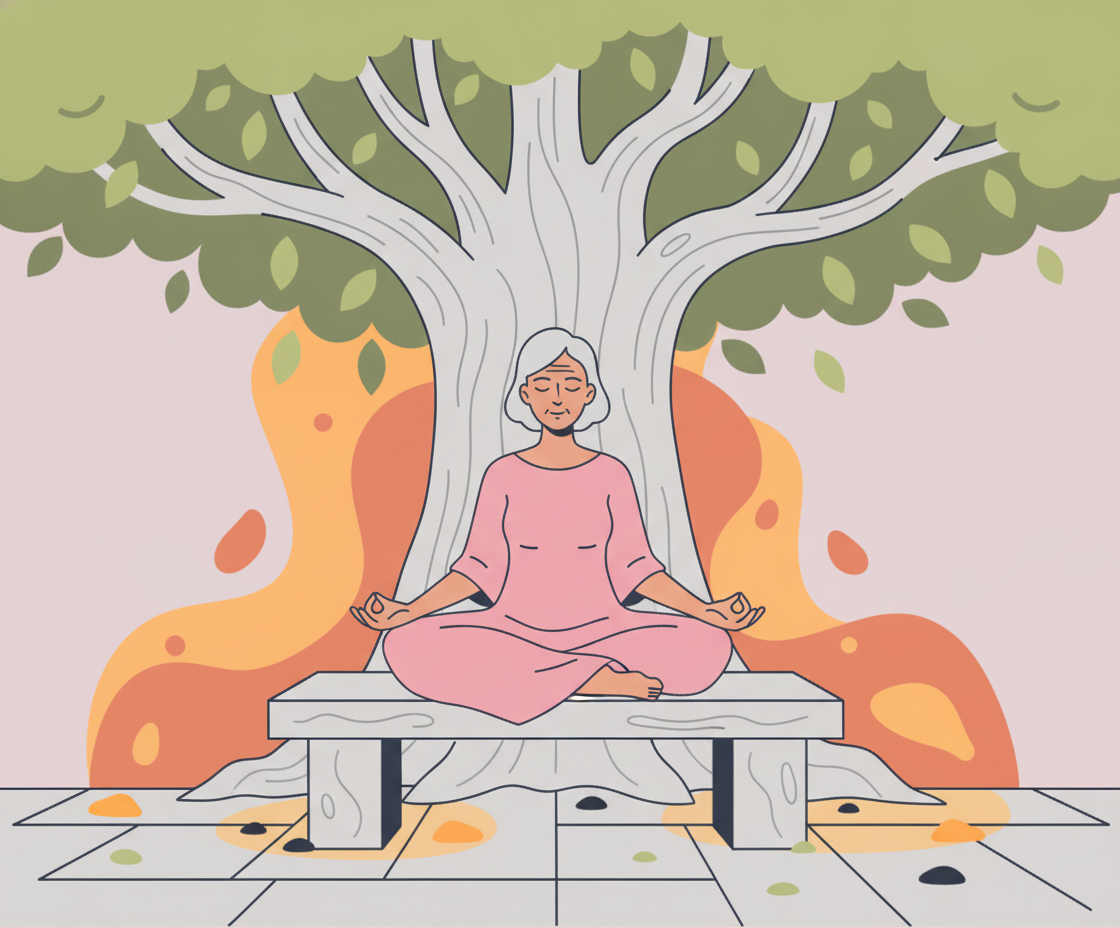
An elderly woman meditating under a tree.
Toward a Decolonized Yoga: Ethics, Accountability, and Real Community
Here's a thing I say to teacher trainees that lands like a brick every time: you cannot decolonize a practice by learning to pronounce Sanskrit correctly. Reciting a lineage, thanking India in your bio, adding a bindi to your Instagram grid, none of that touches power. It's performative antiracism dressed up as spiritual growth, and it changes nothing about who's in the room or who's getting paid. Decolonization was never about restoring some pure ancient version of yoga. There is no pure version to return to. It means building something new that actually names who holds power now.
What Decolonization Actually Requires
Start with the guru model itself. The teacher-student hierarchy in yoga philosophy, the guru-shishya relationship, was built inside a patriarchal, caste-stratified society, and Western studios imported the authority structure without the accountability that traditionally came with it. A teacher standing at the front of a room, uncorrectable, worshipped, is not a neutral inheritance. It is a power arrangement, and it deserves the same scrutiny you'd give any other.
Then look at the room. Most yoga classes remain overwhelmingly white and financially comfortable spaces. That is not an accident of marketing, it's the direct result of pricing, location, and culture excluding the very communities most harmed by the systems yoga claims to help people transcend. And look at who teaches: women and teachers of color disproportionately carry this labor while earning less than the industry built on their expertise. Equitable pay is not a footnote to decolonization. It is the test of whether you mean it.
The Saraswati collection carries the mantra Om Aim Saraswatyai Namaha, invoking Saraswati, the goddess of wisdom and truth-speaking. Tradition holds her up as the one who cuts through illusion, not the one who softens it. Decolonized yoga asks for exactly that kind of unflattering clarity: whose liberation is this practice actually serving? If the honest answer is only mine, what you're doing isn't yoga. It's consumption wearing yoga's clothes.
A justice-rooted yoga community looks different in practice. It roots itself in accountability to neighbors, not to an abstract, private inner peace. A class becomes a place to study how systems work together, not just how your hips work. That's slower, less comfortable, and it doesn't photograph as well as a sunset backbend. But it's the only version of this practice that keeps its promise instead of just performing it.
The mantra Om Aim Saraswatyai Namaha stands for clear seeing, honest speech, and the courage to question rather than settle for comfortable answers. As a daily reminder there is our Saraswati shirt, so you carry that clarity with you, on the mat and in every uncomfortable question you ask afterward.
Here's the thing nobody wants to hear: none of this gets solved by one person doing everything right. You can study the Yamas, name the power in your own studio, refuse the corporate mindfulness contract, and still walk out into a world running exactly the same systems it ran before your practice. A single practitioner reciting Ahimsa correctly does not dismantle the machinery that profits from harm. That machinery was built for exactly this: it absorbs individual virtue without changing at all.
This is where the essay's threads actually meet. The colonial stripping of ethics, the corporate repackaging of breath as productivity tool, the guilt of meditating through injustice: these aren't separate problems with separate fixes. They're one depoliticizing machine wearing different uniforms depending on the room you're in. It survives because it only ever asks something of you as an individual. Manage your stress. Find your peace. Never once does it ask what your studio, your teacher training, your wellness brand actually owes anyone.
So the refusal has to be collective, or it's just another wellness trend with better vocabulary. That means teachers comparing notes on who their trainings exclude and why. It means students asking, out loud, in class, whether the studio's labor practices match the philosophy on the wall. It means building teacher collectives, sliding scale spaces, community classes that treat accountability as curriculum, not an elective. Spirituality vs. activism is a false choice here: the practice only becomes real when it walks into a room and asks who isn't in it.
Concretely: this week, ask one person in your yoga community one uncomfortable question. Where does our money go. Who trained you and what did they leave out. Why is everyone here the same. That's the whole first step, and it's small on purpose, because collective refusal starts as a conversation before it becomes a structure.
Yoga was never just a personal technology for feeling better. It was, in its own textual roots, a discipline of seeing clearly and acting accordingly. Give it back that function, together, and the sunset backbend stops being the point. The refusal becomes the practice.
Sources & further links
The critiques in this article do not come from nowhere. If you want to keep digging, here are the voices and projects worth following, teachers, scholars, and organizations who are doing the actual work of reclaiming yoga as something more than a stretching class with incense.
Michelle C. Johnson is a yoga teacher and social justice activist whose book Skill in Action makes the case that yoga practice is never neutral. She argues, with the kind of clarity that comes from years on the mat and years in organizing rooms, that yoga can be a tool for structural change rather than a private escape hatch. If the depoliticization argument in this article feels abstract, her work is where it becomes practical.
adrienne maree brown approaches the same terrain from a different angle. Her 2017 book Emergent Strategy: Shaping Change, Changing Worlds theorizes how loving, embodied practice connects to liberation and to resistance against capitalist structures. She is not writing a yoga book in the traditional sense, but anyone doing asana or pranayama while also caring about collective change will recognize the questions she is asking.
For a more academic lens, look at Critical Yoga Studies, a project housed at UC Berkeley's Center for Race and Gender. It examines, with real rigor, how yoga in the West carries the weight of cultural appropriation and unresolved questions of decolonization. Their journal Race and Yoga, particularly Volume 3, Issue 1, is a good starting point if you want the historical and political argument laid out in full.
And if you want to see what a non-abstract version of this looks like, Yoga Behind Bars has been offering trauma-informed yoga and meditation to incarcerated people since 2008. It is one thing to write about yoga and liberation. It is another to bring breath practice into a prison cell and mean it. That gap between theory and practice is, in a sense, the whole argument of this article.