Yoga for healthy aging works by retraining proprioception, your nervous system's built-in sense of where your body is in space, which is exactly what starts to blur after 60. Specific standing poses and breathwork rebuild the neuromuscular pathways that keep you upright, cutting fracture risk and protecting the independence most people are quietly terrified of losing.
I've taught enough sixty and seventy year olds to know the pattern by heart. Someone stumbles on a curb, or grabs a railing a half second too late, and something shifts. They start taking the elevator instead of stairs. They hover near the wall on uneven ground. Nobody says the word out loud, but the fear underneath is always the same: what if I fall and everything changes.
Here's the part almost nobody tells you: that caution, the thing that feels like protecting yourself, is often what makes the fall more likely. Less movement means your joints and inner ear get less practice reading balance signals. Your muscles forget how to react fast. Confidence drops further. The fear that started the whole thing gets proven right, again and again, until it feels like fate instead of a habit.
Here's the hopeful part. Give this practice twelve weeks, three short sessions a week, and you notice it in the most ordinary moment possible: climbing a flight of stairs without your hand darting for the railing. Not because you got braver. Because your foot, your ankle, your inner ear relearned what to do a tenth of a second before you'd even have to think about it.
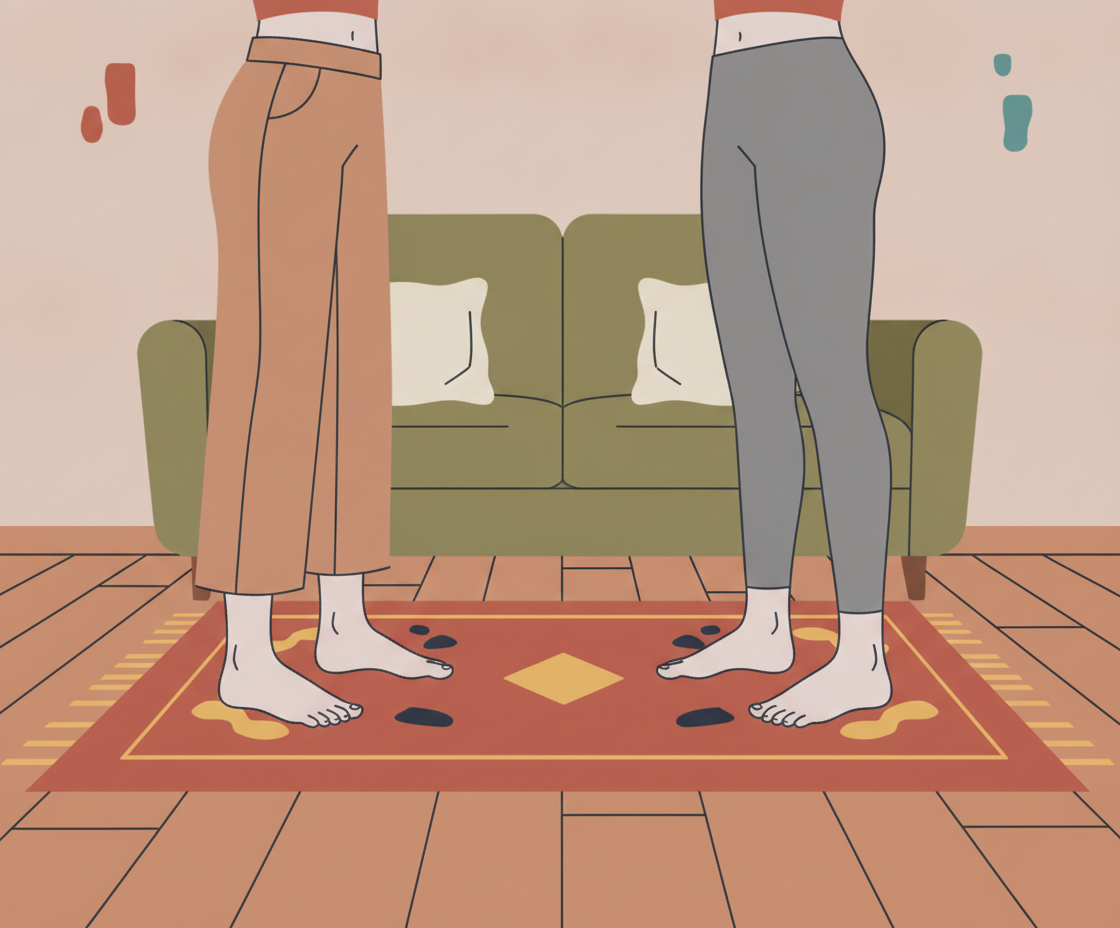
Two people standing barefoot in a room with a sofa.
Balance is a skill your body relearns the moment you start asking it to again, and yoga happens to be one of the most direct ways to ask. Not through anything dramatic. Through a handful of poses that quietly rebuild the exact wiring involved when a foot lands wrong and your body has to decide, in a tenth of a second, whether to catch itself or fall. That's where we're headed.
Proprioception and Healthy Aging: Why Balance Fails and How Yoga Rebuilds It
Here's the part most people get wrong about falling: it's rarely a strength problem. You can have decent muscle tone in your legs and still go down on a curb you didn't quite see. The real culprit is proprioception, the sense that tells your brain where your foot, knee, and hip are in space without your eyes doing the work. Skin receptors, joint sensors, and tiny muscle spindles feed this information upward constantly. After 60, those receptors fire less often and less precisely, which means your brain gets a blurrier, slower picture of your own body right when it needs a sharp one.
The cerebellum, the part of the brain that processes coordination, is also slowing its response time. So you get a double hit: weaker signal coming in, slower processing once it arrives. This is why an older adult can trip on the exact same uneven pavement a younger person walks over without noticing. It's not a muscle failing. It's a sensory and neurological delay, the gap between the world moving and the body finding out.
Yoga closes that gap in a way few other activities do, and it does it through two channels at once. Weight-bearing balance poses like Tree Pose flood the nervous system with proprioceptive input, forcing the feet, ankles, and hips to constantly report their position while you're actively standing on one leg. At the same time, the slow, synchronized breathing that runs through the practice activates the vagus nerve, which lowers overall nervous system arousal and creates better conditions for neural plasticity, the brain's capacity to physically rewire these pathways. Muscle building alone doesn't do this. Coordination training through conscious movement does.
The research on this is more textured than a single headline number, and that's a good thing to sit with. A ten-week pilot study run through the Indian Health Service tracked older adults through a yoga intervention and found measurable drops in fear of falling alongside real gains in balance. A twelve-week study led by Ohio State University researcher Arlene Schmid reached a similar conclusion: yoga is a genuinely promising way to address both the physical and psychological sides of fall risk in older adults, not just one or the other. Even in a nursing home setting, where standing balance work isn't always realistic, a study at St. Joseph's Nursing Home found that chair-based yoga sessions still reduced fall risk factors among residents, which tells you the proprioceptive channel responds to seated, adapted work too.
None of this means every yoga study lines up neatly, and a good teacher tells you that part honestly. The University of Sydney's SAGE trial, a randomized controlled study of Iyengar yoga in older adults, actually found a 33 percent increase in fall risk in one comparison, a result that surprised the researchers themselves. It's a useful reminder that pace, supervision, and pose selection matter enormously. Balance training done too fast, without proper progression or guidance, can backfire at any age. This is exactly why the sequencing in the rest of this guide, starting from grounded standing work before layering in single-leg challenge, isn't a formality. A systematic review of yoga and proprioception backs the overall direction while flagging that the research base is still thinner than we'd like, so the honest position is cautious optimism, not a guarantee.
What that mixed picture tells you is that proprioceptive retraining through yoga is real and often fast, but it depends on how the practice is taught and paced, not just whether you show up to a mat. Twelve weeks is not a long commitment, and most of the studies above land somewhere between ten and twelve weeks before showing measurable change. That's the timeline worth trusting: not a slow fade toward improvement, but a specific, coached rebuilding of how reliably your nervous system catches you.
The Neuromuscular Architecture of Falling: What Happens and What Yoga Prevents
Here is something the old teachers understood long before anyone had a name for the vestibular system: a fall is never really an accident. It is the last visible moment of a much longer, quieter conversation breaking down. Your inner ear reports on tilt and motion, your eyes report on the horizon, your joints and muscles report on pressure and angle, and something in you is supposed to be listening to all three at once. In the yogic view, this listening is not a mechanical process. It is a form of attention, and attention is trainable.
Picture what the breakdown actually looks like. An older adult steps off a curb and their ankle sends a signal about the uneven surface a fraction of a second too late. The visual system, which has quietly been doing more of the balance work to compensate for duller joint sensors, does not catch the gap in time either. The muscles around the hip fire, but out of sequence, tensing after the sway has already started instead of before. Nothing here is about weak legs. It is a timing problem, a breakdown in the sequence and speed of signals moving between foot, joint, inner ear, and spinal cord. Researchers who study aging call this proprioceptive decline, and it shows up years before most people notice any drop in strength.
What yoga does, at the level of the nervous system, is give that sequence somewhere to practice. Holding a pose on one leg is not really about the leg. It is repeated, low-stakes exposure to the exact kind of instability that a curb or a wet tile floor creates, except here you are upright, breathing, and paying attention on purpose. Every small wobble you correct in Tadasana or Vrkasana is a rehearsal of the same reflex arc that has to fire correctly at 2am when you get up for water and misjudge the step down from the bed.
This is why yoga rarely isolates a muscle without also asking a question of the mind. A pose is a small experiment in awareness before it is anything else. Where is your weight right now? Which foot is doing the honest work? Practiced this way, over years, coordination through movement becomes less about drilling a skill and more about restoring a relationship the body once had with itself and quietly let go of.
I have watched students in their sixties and seventies describe this shift in almost identical words: they feel more solid, more here, weeks before any strength gain would show up on a chart. That is not muscle. That is the nervous system remembering how to listen to itself, tightening the gap between sensing and reacting until the reflex arrives on time again. Aging gracefully, in this view, is not about resisting time. It is about staying in conversation with your own body long enough that it keeps catching you.
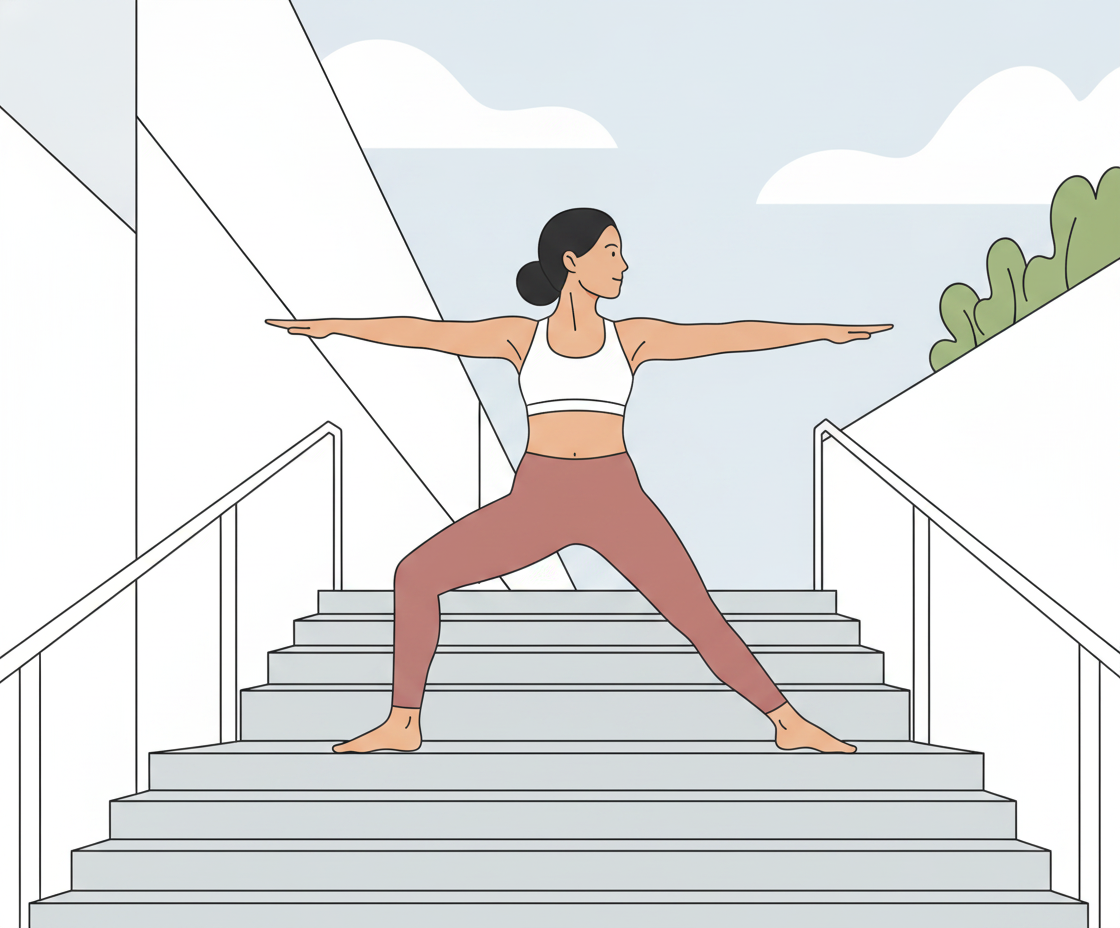
A woman in Warrior II pose on gray outdoor stairs.
Foundation Poses for Fall Prevention: Mountain Pose and Standing Stability
Tadasana (Mountain Pose) as the Blueprint for Proprioceptive Alignment
I always tell my older students that Mountain Pose is the least boring pose in the room, even though it looks like nothing is happening. Stand with your feet hip-width apart, weight spread evenly, and press all four corners of each foot into the floor. That's it. That's the whole shape. But Tadasana is not a resting position, it's an active recalibration of every sensor in your feet and legs, and that distinction changes everything about how you should practice it.
Most people, especially after decades in cushioned shoes and office chairs, have feet that have gone half numb. Not medically numb, just quiet. Understimulated. When I ask a new student to feel their heels on the mat, there's often a pause, a little confusion, like I've asked them to feel their elbows from the inside. That gap between instruction and sensation is exactly what Tadasana closes.
How Grounding Retrains the Nervous System
Underneath your skin, your feet carry mechanoreceptors, pressure-sensitive nerve endings that report the ground back to your brain every fraction of a second. When you deliberately press down rather than just stand, you're waking these receptors up on purpose, and the signal travels up through your ankles, knees, hips, and spine, stabilizing the whole postural column from the ground up rather than the top down.
Do this for two or three minutes daily and something shifts. A systematic review of yoga for balance in healthy populations found that yoga builds body awareness through posture and breath work, which are the raw materials of both balance and proprioception, and Tadasana is where that raw material gets forged. Your nervous system essentially learns a new sentence: I can trust my feet, I can feel the earth, I am stable.
I've watched this happen in real time with students in their seventies. The sway you can see when someone first stands, that small, restless shifting, quiets down over weeks. It's not imagination. It shows up in improved proprioceptive testing and measurably reduced sway. For a lot of older adults, this one unglamorous pose becomes the quiet difference between reaching for a chair and simply standing there, on their own two feet, without thinking twice.
Single-Leg Balance and Proprioceptive Challenge: Building Resilience Through Tree Pose
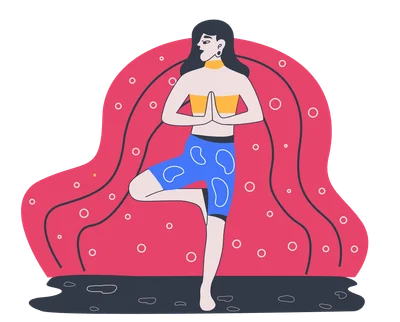
Mountain Pose teaches your feet to listen. Tree Pose, or Vrkasana, is where you find out if they actually learned anything. The moment you lift one foot off the ground, your whole balance equation changes. There's no second leg to bail you out, no wide base to hide sloppy weight distribution. Your standing leg becomes a single, overworked antenna, and every proprioceptor in that ankle and hip starts firing signals to your brain faster than you can consciously track them.
Why Single-Leg Poses Are Non-Negotiable for Fall Prevention
Here's the thing I've watched happen hundreds of times in class: someone steps into Vrkasana, wobbles, and their arms shoot out sideways before they've even registered they're tipping. That's not embarrassment, that's the exact reflex you want. Controlled instability is the whole point. You're deliberately narrowing your base so your nervous system has to work harder, faster, and more precisely than it would in daily life, which is exactly why it gets better at rescuing you when daily life throws you off balance for real.
A systematic review of yoga research on balance in healthy populations found that these poses build body awareness through the combination of physical positioning and breath control, which turns out to be the foundation proprioception is built on. You can't fake your way through Tree Pose. Either your nervous system knows where your foot is in space, or you're grabbing the wall.
Progressive Variations to Match Your Current Capacity
Nobody starts with their foot pressed into the inner thigh, heel high, gaze soft and steady. That version comes later, sometimes months later, and that's completely fine. Start with your toes touching the ground and your heel resting against the ankle, using a wall or chair back for a fingertip of support. Your proprioceptors are still working overtime even in this modest version, they don't care how impressive the pose looks.
Over weeks, I watch students quietly graduate themselves. The fingertip support drops away first, then the foot creeps higher up the shin, eventually landing on the inner thigh. A 12-week yoga program studied and published through MDPI research found measurable improvements in balance, functional mobility, and reduced fear of falling among older participants practicing this kind of progressive work. Thirty seconds a side, three times a week, is genuinely enough to start rewiring those righting reflexes.
The students who report the biggest shifts aren't the ones who nailed a perfect, magazine-cover Tree Pose. They're the ones who kept practicing the wobbly, toes-on-the-ground version consistently. One student told me she tripped on a curb, felt her body catch itself, and only afterward realized what had happened. That's proprioception doing its job before her conscious mind even clocked the danger, which is precisely what all that wobbling in class was quietly training her for.
Dynamic Balance and Weight Shifting: Warrior II for Functional Coordination
Warrior II as a Functional Stability Pattern
Mountain and Tree teach your nervous system to hold still. Warrior II teaches it to move while staying organized, which is a completely different skill and honestly the one most falls actually depend on. You plant your feet wide, bend the front knee, and sink your weight back and forth between your legs. Nobody falls while standing perfectly still. They fall while shifting, reaching, turning, stepping down. That's the exact terrain Warrior II rehearses.
I watch students discover this mid-pose all the time. They get the front knee bent, gaze steady over the front hand, and then I ask them to shift another ten percent of their weight forward. Suddenly the standing leg has to negotiate with the front leg in real time. You can see the recalculation happen in someone's face. That negotiation, quadriceps firing here, glute stabilizing there, hip abductors and adductors quietly working overtime, is the same conversation your legs need to have on a staircase.
How Dynamic Poses Prepare You for Real-World Movement
The gaze tracking is the part people underestimate. Following your extended hand with your eyes while your legs are doing something entirely different forces your visual system and your vestibular system, the inner ear's balance mechanism, to sync up with what your feet are sensing. That's three systems talking at once instead of one working in isolation. It's uncomfortable at first. Then it becomes automatic, and automatic is exactly what you want when you're descending stairs while glancing at your phone or turning to answer someone calling your name.
Students who stick with Warrior II three or four times a week tend to report something specific: stairs feel less like a hazard and more like a non-event. That's not confidence talking, that's rehearsed neuromuscular memory. A review article on the neurobiological and anti-aging benefits of yoga notes that yoga practice lowers fracture risk in older adults specifically by improving balance, reducing fall risk and fear of falling, and restoring functional independence, exactly the outcomes this pose targets through repeated, deliberate weight-shifting rather than static holding.
Breath, Nervous System, and Fearlessness: The Psychological Dimension of Fall Prevention
Here's the part nobody tells you at the physio clinic: the fall you're most afraid of having is often set up weeks in advance, by the fear itself. You stumble once, catch yourself on a railing, and something in you decides the floor can no longer be trusted. That decision isn't conscious. It shows up as stiffer hips, a shorter stride, eyes locked on your feet instead of scanning the room. Fear of falling doesn't just accompany physical decline, it manufactures it.
How Fear Amplifies Physical Decline
Picture it in real time. Someone who fell six months ago is walking to the mailbox. Their eyes drop to the pavement, scanning for cracks. Their shoulders climb toward their ears. Each step gets shorter than the last, feet placed almost flat instead of rolling heel to toe, because rolling through the foot means one instant of single-leg balance, and single-leg balance now feels like a risk instead of a normal part of walking. Their breath goes shallow and high in the chest. None of this is decided consciously. It is the body's blunt solution to a threat it can no longer locate precisely, so it braces against everything.
The yoga tradition has a word for this instinctive clinging to safety, Abhinivesha, one of the five kleshas described in classical yoga philosophy, and it maps uncannily onto what happens after a fall. But you don't need the Sanskrit to see the mechanism. Tension crowds out the subtle sensory feedback your joints need to make micro-adjustments. You brace instead of adapt. Bracing is rigid, and rigid bodies fall harder.
This is the cruel loop: fear tightens the body, tightening disrupts balance, and disrupted balance confirms the fear was justified. Nothing about this loop requires the muscles to have actually weakened.
Pranayama as a Tool for Nervous System Resilience
Yoga doesn't try to argue you out of fear with logic. It goes underneath it, through the breath. Pranayama, the yogic regulation of breath, works directly on the vagus nerve, the long nerve that runs from your brainstem through your chest and gut, telling your body whether it's in danger or safe. A long, slow exhale, or the steadying rhythm of alternate nostril breathing, sends a physical signal of safety that no amount of reassurance from a well-meaning relative can replicate. Shoulders drop half an inch. The next step lands a little more evenly.
This is where the ancient and the clinical actually meet. A 12-week yoga program, documented in a review published on MDPI, produced measurable improvements in balance, functional mobility, and fear of falling among older adults. A separate review on the neurobiological and anti-aging benefits of yoga found that yoga lowers fracture risk in elderly populations specifically by reducing fall risk, easing fear of falling, and restoring functional independence. Not because participants were told to relax. Because their nervous system, breath by breath, learned a new baseline. When that fear softens, coordination through movement returns almost on its own, and aging gracefully stops being a wish and starts being a practice.
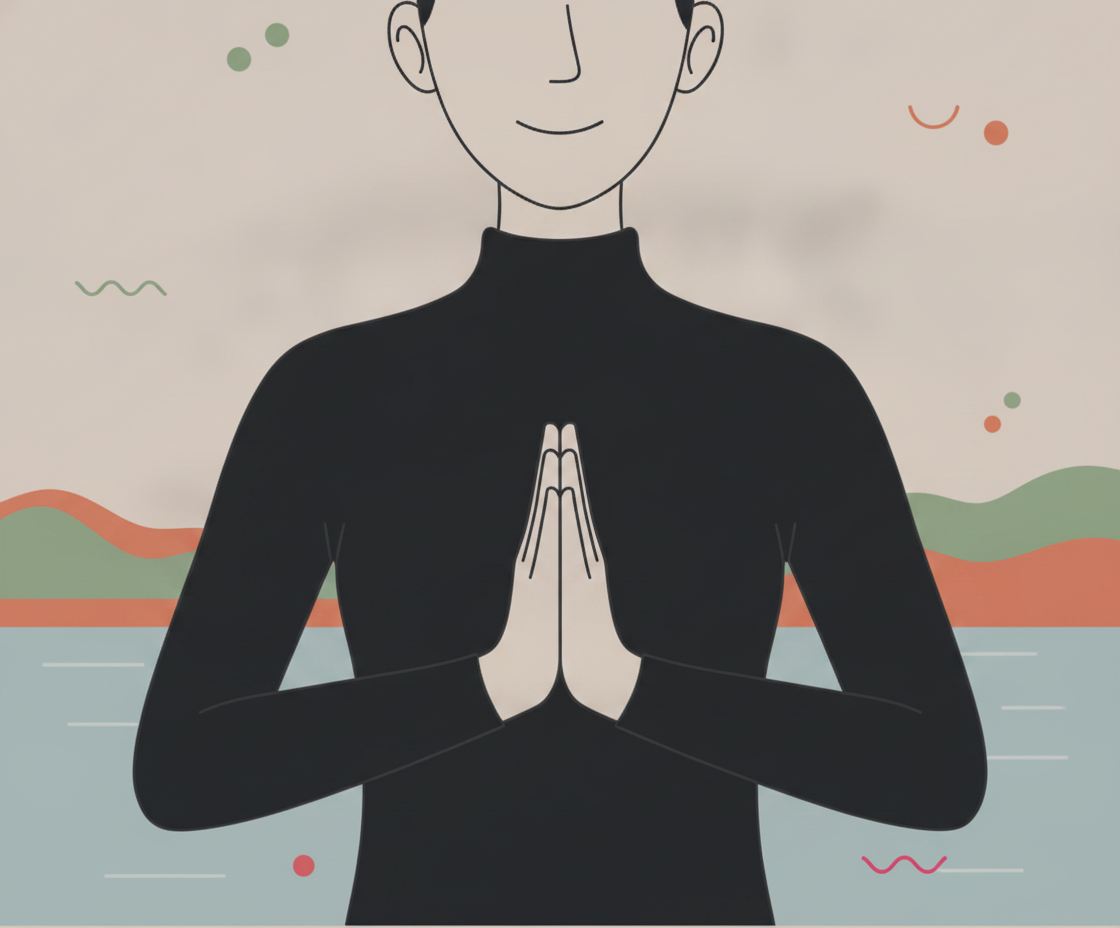
A person with hands in prayer pose against an abstract landscape.
Building Your Healthy Aging Practice: Consistency Over Perfection
So here's the thing nobody tells you at the start: none of this requires you to become good at yoga. A study published on MDPI followed older adults through a 12-week yoga program and found significant improvements in balance, functional mobility, and fear of falling, without a single advanced pose in sight. You don't need Crow Pose. You need Tadasana and Vrkasana, done often, done for years. Healthy aging through yoga is a numbers game of frequency and patience, not a talent show. That reframe alone changes how you should structure your week.
A Weekly Structure That Works
Three sessions a week, twenty to thirty minutes each, is realistic for most bodies and most schedules. Structure each one the same way: a few minutes of grounding work in Tadasana, then single-leg balance in Vrkasana, then some dynamic weight-shifting through Warrior II, closed out with slow, conscious breathing. If your legs shake or your ankle wobbles, stand near a wall or hold the back of a chair. That's not failure, that's your nervous system actually doing the work of recalibration.
A review on the neurobiological and anti-aging benefits of yoga notes that regular practice decreases fracture risk in older adults specifically by improving balance, reducing fear of falling, and restoring functional independence, the exact outcomes this weekly rhythm is designed to build toward, session by session.
Long-Term Adaptation and Progressive Challenge
Twelve weeks gets you measurable change. But the real transformation, the kind that shows up as sturdier steps on gravel or confidence on a dark staircase, takes years of small additions. Every two or three weeks, hold a challenging pose fifteen to thirty seconds longer. That's it. No dramatic leaps, no comparison to what you could do at thirty. Slow, boring, repeated stimulus is what actually rebuilds proprioceptive pathways, not intensity.
Over a year, this quietly becomes embodied wisdom: better posture without thinking about it, quicker reflexes, real trust in your own legs. Many long-term practitioners describe a shift in how they relate to aging altogether, curiosity replacing dread, coordination reclaimed instead of mourned. That's aging gracefully in practice, not as a slogan.
That quiet, embodied trust in your own legs, the kind that grows over months and years of showing up on the mat, is really a form of abundance: the vitality, mobility, and well-being your body keeps offering you when you keep asking. The mantra Om Shreem Mahalakshmiyei Namaha stands for exactly that gratitude, for recognizing prosperity not as wealth but as a steady body and a nervous system you can trust. As a daily reminder there is our Lakshmi shirt, so you carry that sense of abundance with you long after you've stepped off the mat.
So start small this week. Ten minutes, Tadasana into Vrkasana, nothing fancier. Notice what shifts, in your feet, your breath, your balance. That's the whole practice, repeated for decades.

 AsanaBaumVrkasanaZur Asana →