A heated yoga room sits at around forty degrees. The air is damp, the mirrors fog up, and your skin reacts before your thoughts get a vote.
The honest question is whether any of that reaches depression, or whether it is just an uncomfortable hour in a warm room.
Researchers at Massachusetts General Hospital put exactly that question to the test, and the result was strong enough that both the National Institutes of Health and Harvard Health wrote it up. The numbers are further down.
One thing before we go on. Depression and anxiety often travel together, and much of what heat does helps both. But they are not the same condition. This article stays with depression. If anxiety is your main experience, the section on the vagus nerve still applies to you.
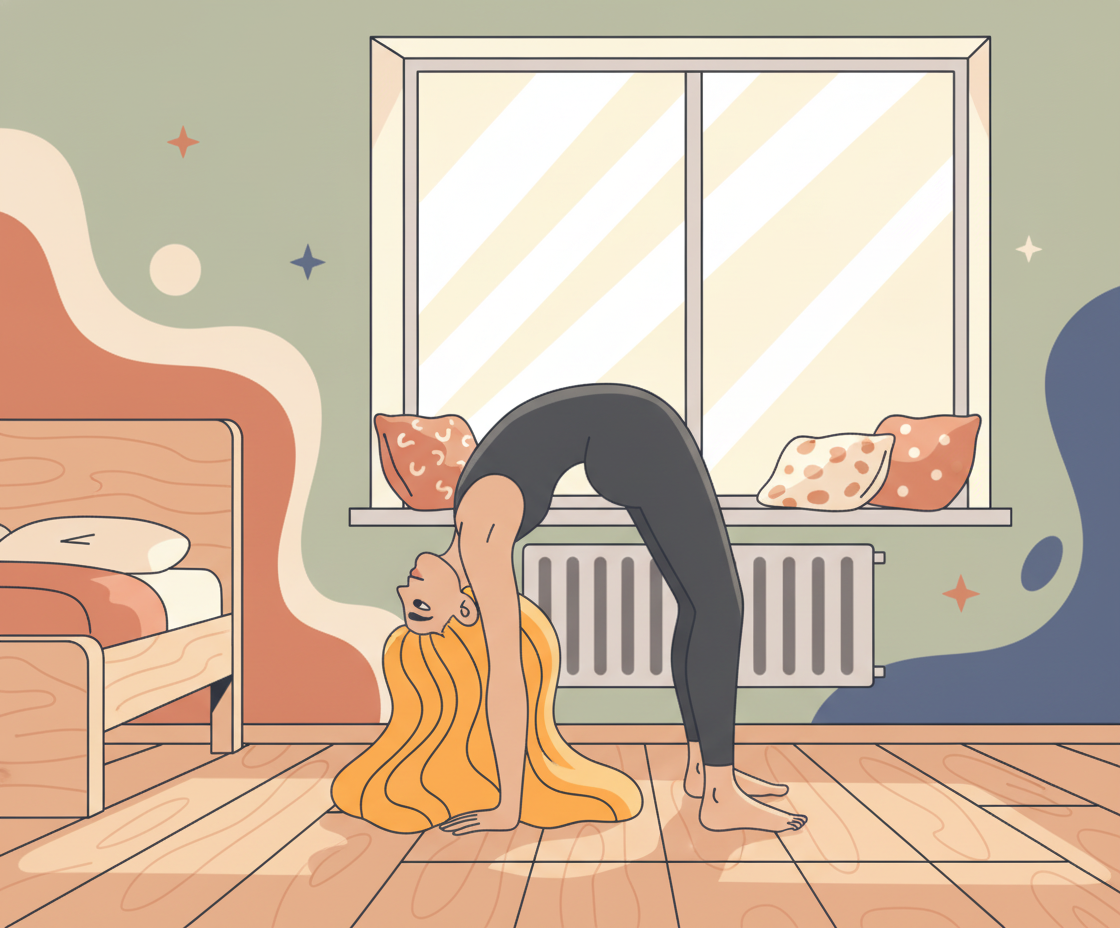
A woman practicing a backbend yoga pose in a bedroom.
There is a fair scepticism here worth naming. Yoga gets filed under gentle and spiritual, which makes it easy to doubt whether it has the weight to meet something as heavy as clinical depression.
Add heat and it can start to sound like a wellness gimmick. Or worse, like something that might overwhelm a nervous system that already feels fragile.
That doubt deserves an answer rather than reassurance.
Does Hot Yoga Actually Help With Depression?
The Trial This All Rests On
Most of what follows comes from one randomised controlled trial run at Massachusetts General Hospital, the teaching hospital of Harvard Medical School.
Adults with moderate to severe depression were assigned at random to one of two groups. One did heated yoga. The other went on a waiting list.
That waiting list is the part that makes the study worth reading. Those were people who wanted the classes and had not started yet, which separates the effect of the practice from the effect of time simply passing, and from the lift anyone gets out of having something new in the diary.
By the end of the eight weeks, the yoga group's depression scores had dropped considerably further than the waiting group's. The NIH write-up and Harvard Health's summary both report the response rate as being in the range clinicians look for from a first-line treatment.
One Study, Not Three
You will find this trial reported in several places under different names, which makes it look like more evidence than it is.
The NIH piece, the Harvard piece and the Mass General piece are all describing the same trial. One study, three write-ups. Worth knowing before anyone quotes it at you as three independent findings.
And a 2025 review in Sports Medicine Open gathered the physiological effects of hot yoga across several studies, finding consistent drops in acute anxiety alongside lifts in mood. In Germany, Uniklinikum Jena reached a similar conclusion about yoga more broadly for depression and anxiety.
What That Does and Does Not Mean
One good trial is a real finding. It is not the same as a settled question.
What it does mean is that a physical practice moved a clinical measure of depression more than waiting did, in adults who actually had the condition. That is a different category of evidence from a testimonial on a studio website.
Depression rarely answers to one single approach. Research like this does not ask hot yoga to replace psychiatry. It asks whether a physical practice can sit alongside medication, or serve as an option for people for whom medication has not worked.
A close-up of a hand in Gyan Mudra.
Why Does Heat Calm the Nervous System?
Your nervous system runs on two settings.
The sympathetic branch is the accelerator: fight, flight, freeze, the whole alarm system. The parasympathetic branch is the brake: rest, digest, repair.
Depression rarely sits calmly on either side. It swings between the racing thoughts and tight chest of high alarm, and the flat numbness where nothing seems worth doing. Both are a nervous system stuck in survival mode, just pointed in different directions.
Warmth as a Safety Signal
The Yoga Sutras of Patanjali describe the ideal posture as sthira sukham asanam, steady and comfortable at once. That is usually read as instruction for the body on the mat.
It also names something the nervous system needs before the mind can settle: a state where effort and ease sit side by side and the body stops bracing. That is tradition speaking, not neuroscience, and it is worth saying so plainly.
What the science does show is that warmth is one of the oldest safety signals your brainstem recognises. Sustained heat tells the old, wordless part of your brain that you are not in danger, and that message travels largely along the vagus nerve.
It is why a hot bath settles you in a way that logic never quite manages. Not just comfort. Permission to stand down.
In a heated room your body cannot tell yogic heat from summer heat, and that is the point. It reads warmth as evidence of a safe place and lowers its guard before a single pose has begun.
What Heat Does to Serotonin and the Brain
Depression does not only live in your thoughts. It shows up in brain tissue you can measure.
The hippocampus, the part of your brain that handles memory and helps regulate emotion, physically shrinks under long-term depressive stress. Serotonin runs low. The brain's ability to rewire itself slows down.
That is the floor depression puts you on. And it is exactly where body heat starts doing work that no amount of positive thinking manages on its own.
Why a Warm Room Beats a Warm Up
When your core temperature climbs during a heated flow, your body produces more BDNF, a substance you can think of as fertiliser for nerve cells. It helps them survive, encourages new ones, and strengthens the connections between them.
Depression suppresses that process. Sustained heat, paired with the effort of moving through postures, appears to push back against the suppression, particularly in the hippocampus, the exact region depression wears down.
This is not a symbolic warming of the spirit. It is cell chemistry happening on your mat while you are on it.
A cold-room workout lifts your temperature briefly and lets it drop straight back. A heated room keeps it up for the whole class, which gives that signal time to register.
Serotonin Works Better Warm
Serotonin, the messenger most tied to steady mood, does not just get released more easily in warmth. Its whole production line runs better.
The enzymes that build serotonin work more efficiently at higher tissue temperature, and the handoff of signal between nerve cells becomes measurably sharper. This is a direct relationship, not a loose association.
Practise this over weeks, not one hot class but a rhythm of them, and you give your nervous system repeated exposure to the conditions serotonin needs to do its job.
Depression has a posture. You have seen it, and maybe you have lived it. Shoulders rolled forward, chest caved slightly in, chin tucked down as if the body were shielding something.
I watch people walk into a heated room carrying exactly this shape. It is not a mood, it is a holding pattern that has been reinforced for months or years. The chest muscles shorten. The upper back rounds.
Emotional weight gets stored as tissue tension, and no amount of talking about your feelings unwinds that on its own.
Wheel Pose (Urdhva Dhanurasana)
In a heated room the tissue around the chest and shoulders softens faster than it would cold, which means you can find a real backbend without forcing anything.
Urdhva Dhanurasana takes that collapsed, protective chest shape and does the exact opposite. It opens the front wide and asks the body to expand instead of contract.
I have had students come up into wheel and start crying. Not from pain. From something letting go. It happens often enough that it stopped surprising me years ago.
What is happening physically is worth saying plainly. The sternum, the front of the shoulders, the whole front line of the body gets a stretch that ordinary days never ask for. Combine that with heat already easing the nervous system, and wheel becomes less about flexibility and more about taking up space again.
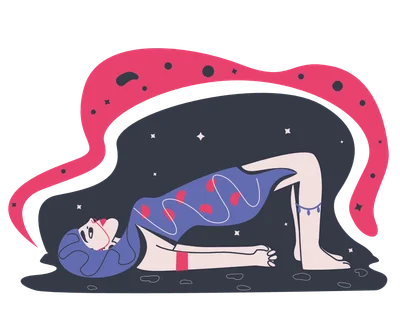
Bridge Pose (Setu Bandha Sarvangasana)
Not everyone is ready for wheel. Honestly, not every day is a wheel day, even after years of practice.
Setu Bandha Sarvangasana does quieter work. It still opens the chest, but the head and neck stay supported, which makes it far more reachable for anyone whose alarm rises the moment they feel exposed.
People with racing thoughts settle noticeably faster in bridge than in wheel.
I use it constantly as the step towards deeper backbends, because it lets the body learn the feeling of an open chest without the vulnerability of going upside down. The breath stays long and even here in a way it often cannot in wheel. That steadiness is the lesson: opening does not have to mean danger.
Why the Release Has No Story Attached
None of this is metaphor dressed as science. Fascia does hold tension, and heat does make it more pliable, which is why these releases tend to show up in a warm room rather than a cold one.
What I notice after years of teaching it: the release rarely arrives with an explanation. Someone will not necessarily know why they are crying in wheel pose. They just are, and afterwards they feel lighter.
The body works through what the mind could not find words for. Sometimes that is the whole session.
That same letting go is what the mantra Om Namah Shivaya points at: releasing what no longer serves you and trusting change over control. As a daily reminder there is our Shiva shirt, so you carry that shift with you after you roll up the mat.
Here is the part almost nobody mentions: heat opens the door, but breath walks through it.
Yoga has long treated breath as a kind of remote control for the nervous system, something you can operate on purpose even though most of what it reaches runs on its own. That old intuition lines up with what we now know about the vagus nerve.
What Ujjayi Actually Does
Ujjayi is the soft ocean sound you make by slightly narrowing the back of your throat. It is not an aesthetic flourish teachers add for atmosphere.
Mechanically, it slows your exhale and raises the pressure inside your chest. That pressure change presses on the vagus nerve, your body's main calming cable. Sensors near the heart pick up the shift and pass it straight to the brainstem.
Slower heart rate, calmer signal, all from a breath pattern you control on purpose.
This matters for depression specifically. A dysregulated nervous system does not settle because someone tells it to calm down. It needs a physical signal it can register, and Ujjayi in a warm room becomes that signal, repeated dozens of times in a single class.
Why All Three Together
None of the three does the job alone.
Heat tells the body it is safe enough to soften, but safety by itself teaches the system nothing new. Controlled breath layered on top turns a passive state into a rehearsal. Think of heat as lowering the threshold and Ujjayi as the repetition that trains the muscle.
To be honest about the limits: nobody has scanned a depressed brain mid-flow and watched the vagus nerve rewire itself. What seems likely, and fits what is known, is that heat plus breath plus movement gives a stuck nervous system repeated practice at the one thing depression makes nearly impossible. Coming back down.
Do that often enough and you are not managing a symptom any more. You are retraining a default.
Why Is Savasana the Part People Skip?
What Happens When the Room Goes Quiet
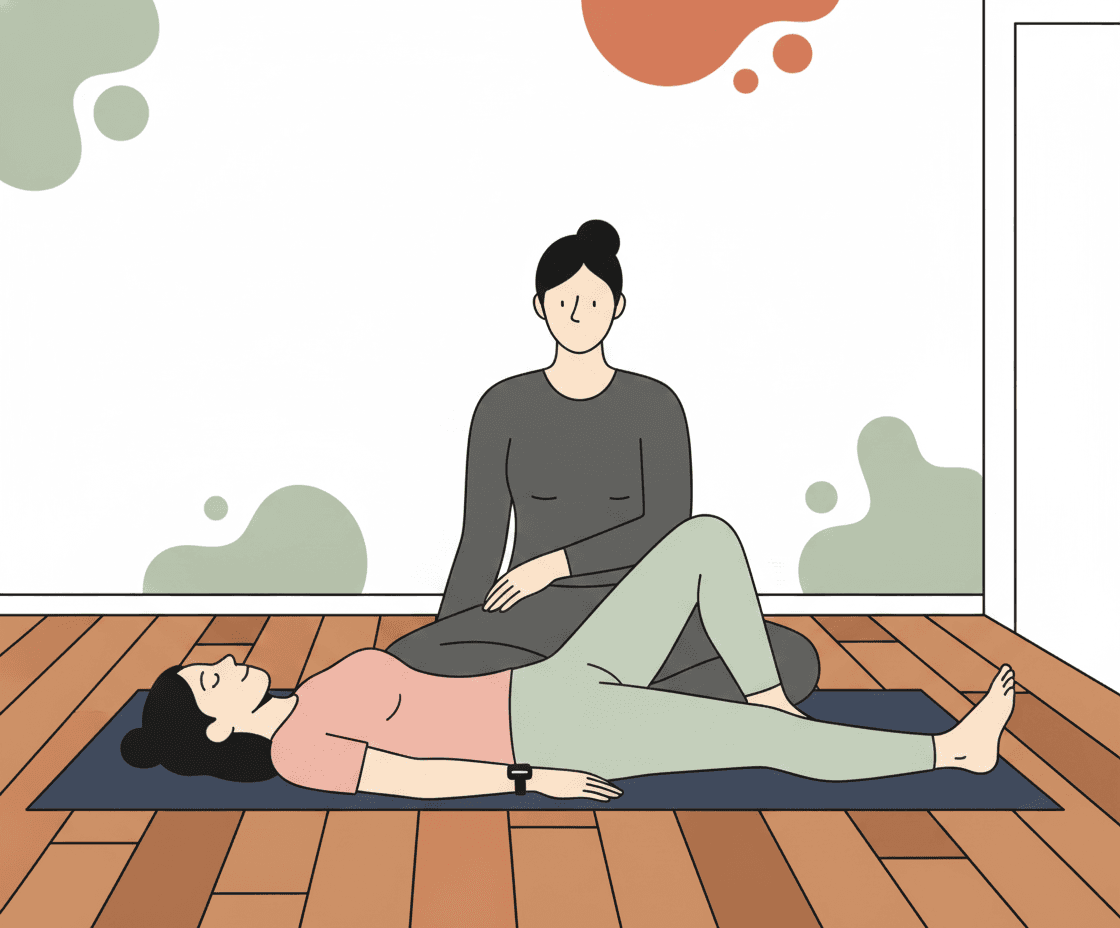
Here is what I watch in almost every hot class once bodies reach the floor.
The room goes quiet in a different way than at the start. At the beginning, stillness is nervous, held, waiting for something to happen. At the end it is loose. Jaws unclench. Fingers uncurl.
People have told me they did not notice they had been making fists for the entire practice until Savasana let them feel it.
That noticing is the point. Depression flattens the felt sense of your own body. You move through the day managing thoughts about how you feel rather than feeling anything specific.
Lying warm and still, with the heat still coming off your skin, gives the nervous system an unhurried moment to report back. Here is where the tension is. Here is where it let go.
Why the Last Ten Minutes Matter
I have taught enough heated classes to notice a pattern. The people who roll up their mats the second the last pose ends often come back the following week describing the same flatness they walked in with.
The ones who stay for the full ten minutes describe something else. A settledness that lasts into the evening, sometimes into the next day.
Nothing dramatic happens in that stillness. That is exactly why it works. No cueing, no breath count, no pose to get right. Just the leftover warmth doing slow work while the mind, finally unoccupied, has nowhere it needs to be.
A woman sitting on a mat in a room.
For a nervous system that has spent years swinging between shutdown and alarm, ten minutes of nowhere-to-go is close to a foreign language. Savasana teaches it by repetition, not explanation.
And to be straight about the limits: Savasana will not undo a depressive episode on its own. What it does reliably is give the body proof. Proof that the alarm can switch off. Proof that warmth can be received rather than endured.
How Do You Start Without Wrecking It?
Here is the honest part, the bit studios do not always put on the flyer.
Everything above only works inside a bigger picture. Hot yoga is not a replacement for medication or therapy. It is a strong companion to them, and it earns that word only when you fold it into your actual care rather than use it instead of care.
Before Your First Class
Talk to your doctor or therapist first, especially if you take medication or manage a medical condition. Heat is not safe for everyone.
From there, aim for two to three classes a week for at least eight weeks. Eight weeks sounds long, but at three classes it is around 24 sessions, and that is roughly the dose the research points to. It is not a marketing number.
Go back to the same room, and the same teacher if you can. Your nervous system builds trust through repetition, not novelty.
If you already take antidepressants, hot yoga can support what the medication is doing. And if you are living with severe depression or thoughts of suicide, this is one tool among several, never the whole set. Pair it with therapy, psychiatric care, and people who know what you are carrying.
What Progress Actually Looks Like
Change tends to arrive in layers rather than all at once.
Sleep usually improves first, along with less physical tension. Weeks later, mood swings soften and rumination loosens its grip. Later still, something shifts in how you see yourself and what you can hold.
If that feels slower for you than for someone else, that is not you failing at yoga. Depression is not one condition with one switch, and your response is information, not a verdict.
Track your sleep, your energy, your mood. That is your real evidence, not a studio's promise.
Questions People Ask
Is hot yoga safe if I take antidepressants? Usually, but ask your doctor first. Some medications affect how you sweat and how you sense heat, which matters a lot in a forty degree room. Bring water, take breaks, and tell the teacher before class rather than after.
How hot is too hot for a beginner? If you cannot breathe through your nose in a steady rhythm, the room is too hot for you today. That is a better gauge than the number on the wall. Sitting down for a few breaths is not failure, it is the practice.
How long until I notice anything? Most people report better sleep within two or three weeks. Mood usually takes longer, closer to six or eight weeks of practising two to three times a week.
Can I do this instead of therapy? No. The studies that found a benefit tested hot yoga alongside normal care, not as a replacement for it. It works best as one part of a plan, not the plan itself.
What if I cry in class? Then you cry in class. It happens in heart-opening poses more than anywhere else, and it usually arrives without a story attached. Any teacher worth their salt will leave you alone and let it pass.
It is a Tuesday in February. It got dark at half past four, and your mat is still rolled up behind the door. Everything in this article comes down to the next ten seconds. You can pick it up.