Maybe you have been there. You walk into a class, the teacher says close your eyes, and your chest locks before you even reach the mat.
Or you are mid-pose, hips opening, and a wave of panic arrives with no story attached. Just heat, shake, and the urge to leave.
If that has happened to you, you probably did not come back for a while. That makes complete sense.
Here is what a trauma-informed teacher says in that same moment. Instead of close your eyes and surrender into the stretch, you hear: you can keep your eyes open, and you can come out of this shape any time, without explaining yourself.
Same pose. Same room. Completely different message to a nervous system that is scanning for danger.
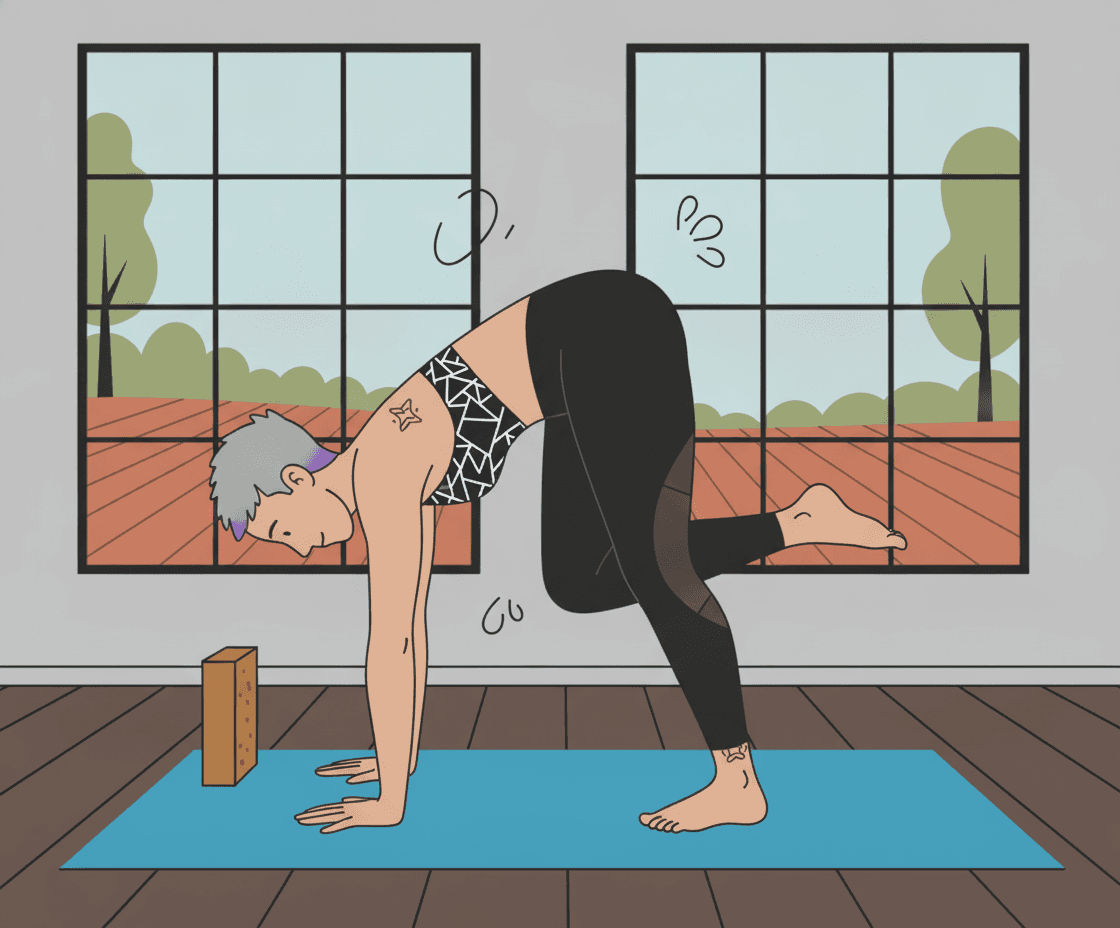
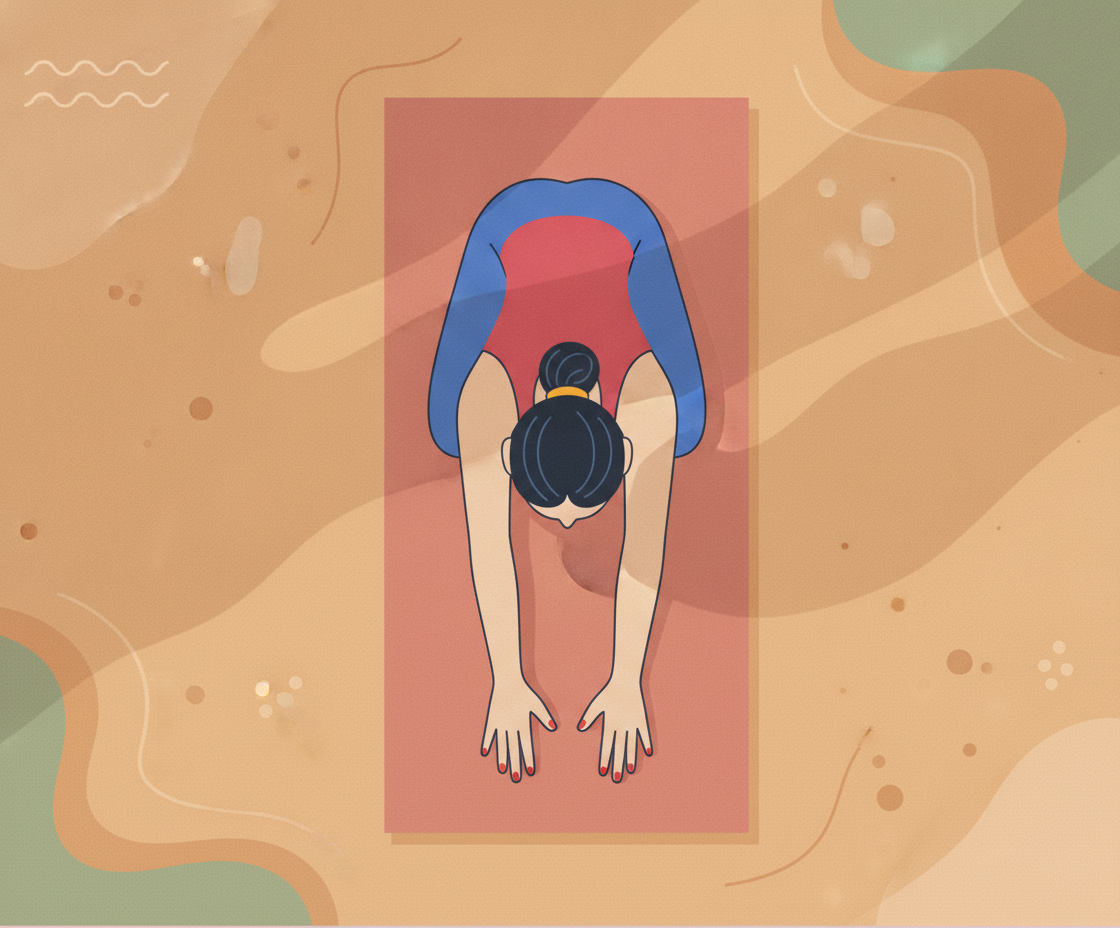
A person in a yoga pose on a mat.
Most survivors cannot simply relax their way through a normal class. Their nervous system is not broken. It is doing exactly what it was trained to do, which is scan for danger.
A cue that sounds harmless to most people can read as a threat to a body that has been through something. That is not a flaw in you. It is biology.
What Makes Trauma-Informed Yoga Different?
This is probably the question you actually came with, so here it is plainly.
Trauma-informed yoga is not a style. It is a flip of yoga's usual hierarchy.
Classical hatha yoga, as it is often taught, puts the teacher in the position of knowing the correct shape and the student in the position of receiving correction. Trauma-informed practice throws that out.
Your own felt sense of your body becomes the highest authority in the room. Above the teacher. Above the pose. Above any idea of what a posture should look like.
Where the Idea Comes From
This is not a modern invention pretending to be ancient wisdom, and it is worth saying so.
It does draw on something real in the tradition though: svadhyaya, self-study, and ahimsa, non-harm, which the classical texts describe first of all as non-harm toward yourself.
A trauma-informed teacher takes that seriously in a way a packed vinyasa class rarely has time for. Every cue becomes an invitation. Sit like this, or do not. Close your eyes, or keep them open and find a spot on the floor.
There is no wrong answer, because the point is rebuilding your trust that your own choices are safe to make.
The clearest example is Trauma Center Trauma-Sensitive Yoga, or TCTSY. Bessel van der Kolk and David Emerson developed it from 2002 at the Trauma Center in Boston, and it remains one of the few yoga approaches with a genuine research trail behind it.
What matters here is not only its results. It is how deliberately it was built around choice instead of correction. Emerson has said plainly that the model removes hands-on adjustments and replaces fixed instructions with options, because for someone whose body was once controlled against their will, being told exactly how to hold a pose can quietly repeat the injury.
How a Normal Class Can Go Wrong
Trauma, at its core, is what happens when your body could not fight, could not flee, and could not stop what was happening. Control was taken away.
So when a class asks you to push deeper, hold past comfort, or follow instructions without pause, it can recreate that exact shape: an outside voice overriding your inside signals.
I have watched students freeze when a teacher walks over and adjusts them without asking. Nothing dramatic happens. They go quiet, the breath gets shallow, and they stay in the pose anyway, because that is what you do in a yoga class.
That is the fawn response showing up on a mat, not relaxation.
The research points the same way. A qualitative study followed 31 women with PTSD rooted in chronic childhood trauma through a ten-week trauma-sensitive programme, and found what I have seen in person: people needed explicit permission before they could actually rest in a pose, not just be told to.
In separate work, Emerson ran controlled trials comparing trauma-sensitive yoga against dialectical behaviour therapy and found a stronger reduction in PTSD symptoms in the yoga group.
Why Does It Work on the Nervous System?
The vagus nerve runs from your brainstem down through your throat, lungs, heart and gut. It is the main channel your body uses to decide, moment by moment, whether it is safe.
Trauma does not only live in memory. It changes how this nerve fires. Which means the disruption is physical, trackable, and trainable back toward safety.
What the Vagus Nerve Does
Under normal conditions it sends your brain quiet, boring updates. Heart rate steady. Breath easy. Digestion fine.
After trauma that signal gets corrupted. The nerve either stays braced for danger, keeping the alarm system running hot, or it swings the other way into shutdown and dissociation.
Neither is a choice anyone is making. It is a nerve doing exactly what trauma taught it.
Humming, slow exhalation and gentle neck rolls physically stimulate the vagus nerve and nudge it toward its calm setting. A study on trauma-sensitive yoga as a complementary treatment for PTSD found that this kind of mindful movement measurably lowers emotional arousal, not through insight, but through repeated felt experience of safety.
The Ladder Out of Shutdown
Polyvagal theory gives a map: three nervous system states stacked by evolutionary age. Calm connection on top. Fight or flight underneath. Shutdown at the bottom.
Survivors often get stuck swinging between the bottom two, never touching the top state where rest and relationship become possible.
Trauma-informed yoga climbs that ladder one rung at a time instead of demanding a leap straight to calm. Slow movement and breath become a route out of shutdown that you can rehearse.
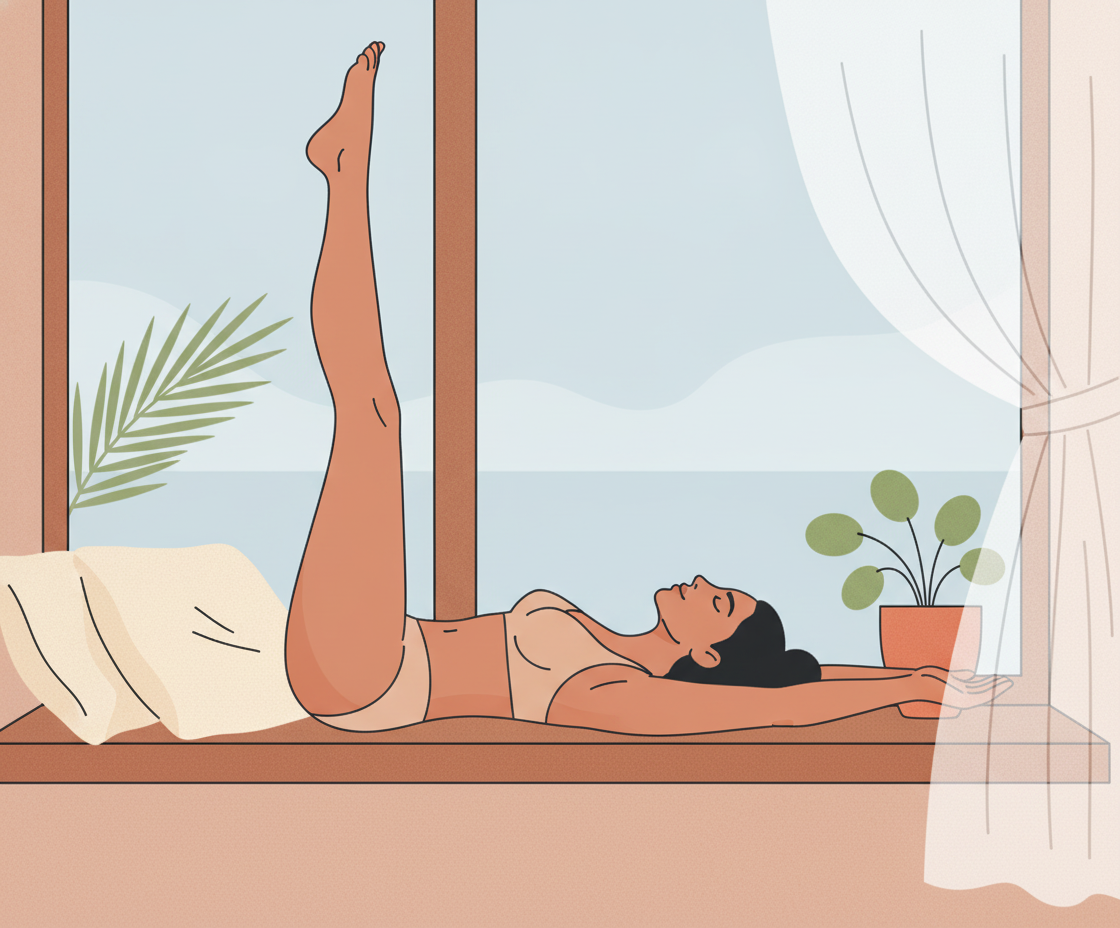
A woman practising yoga on a window sill.
Which Poses Actually Help?
I have watched hundreds of people come into a room braced, waiting to be told to push, to hold, to perform.
What changes a nervous system is not a harder pose. It is an easier one, offered with an exit. The body does not heal because it is challenged. It heals because it finally gets to stop defending itself.
Legs Up the Wall and Child's Pose
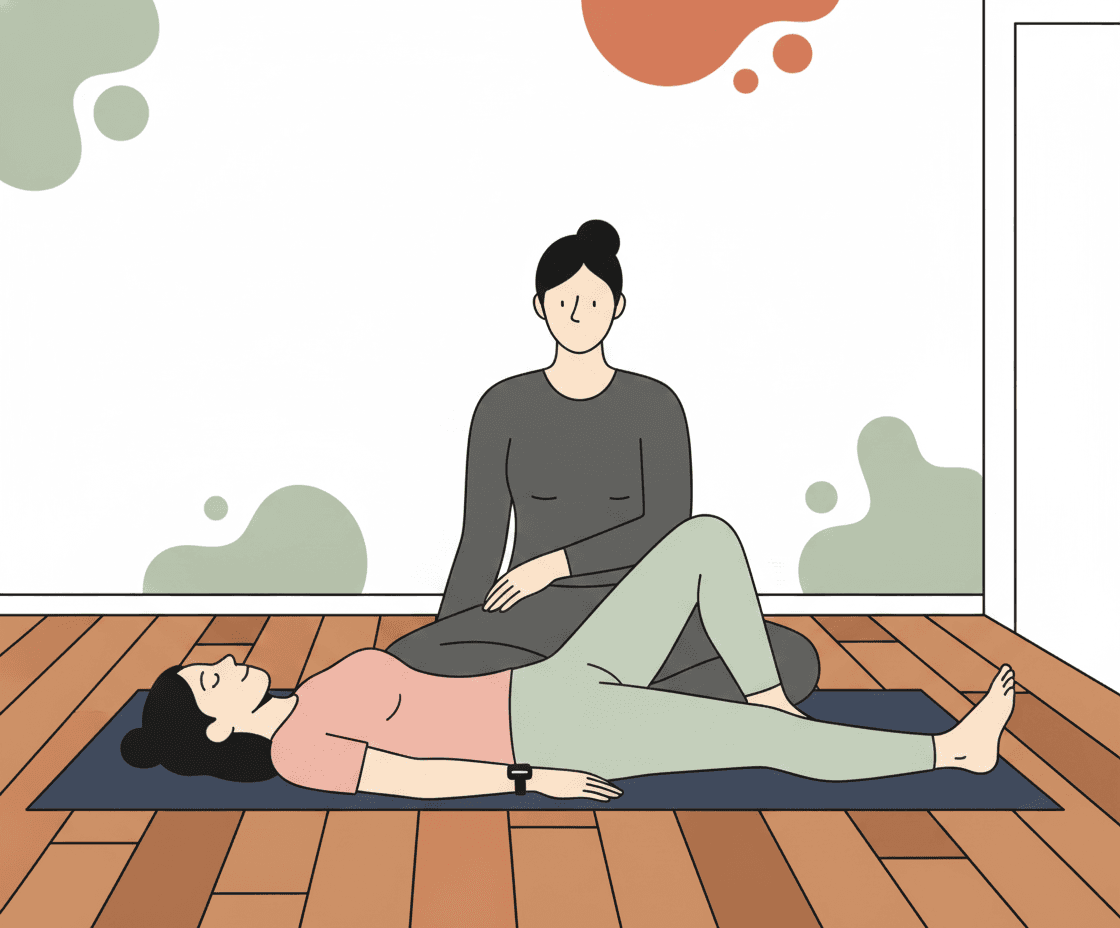
Legs Up the Wall, Viparita Karani, looks almost too simple to matter. Legs against a wall, hips maybe on a blanket, eyes closed if that feels alright.
Watch someone's breathing over five minutes and you see it drop, literally, into the belly. People often say their hands got warm, or that a heaviness spread through their legs they had not noticed was missing.
Balasana works through a different doorway. Not the mild inversion, the shape. Knees bent, forehead down, the body curled into something small and enclosed.
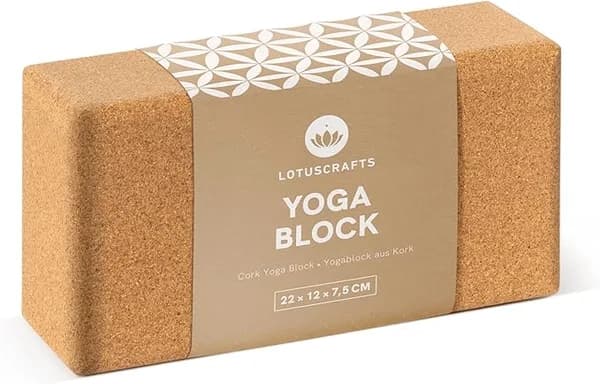
I have had students cry the first time they rest their forehead on a block. Not from sadness exactly. More like relief. The forehead holds a lot of unspoken bracing, and when it is finally supported instead of held up by will, the whole face can stop working.
A bolster under the knees in Savasana. Blankets under the hips in Viparita Karani. A block under the forehead in Balasana. Each one removes a small tax the body would otherwise pay to stay in the shape.
Full support tells the muscles that nothing is required of them, and a nervous system on high alert reads that as permission to stand down.
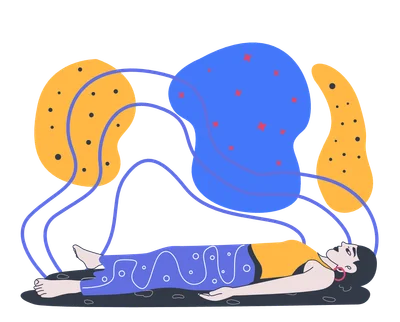
Savasana closes the arc. Offered with permission to modify, add a blanket, keep the eyes open or leave early, the choice itself becomes part of the treatment. Being fully held, and knowing you chose it, is a different experience than being told to relax.
What Does a Safe Room Look Like?
Here is what most studios miss: the poses are almost incidental. What does the repair work is the room itself.
A nervous system that has learned danger does not care how correctly you cue Warrior Two. It cares whether the exits are blocked, whether the lighting feels like an interrogation, whether the teacher's voice carries an edge of command.
Invitation Instead of Command
Classical instruction is built on directive language. Teacher as authority, student as follower. For most people that is harmless.
For someone whose body once had to obey under duress, reach your arms overhead can quietly replay submission, or trigger resistance. Neither has anything to do with the shoulder joint.
If it feels right, you might explore lifting your arms gives something the command never could: the felt experience of choosing.
Light, Sound and the Door
Harsh overhead light keeps a watchful nervous system scanning. Sudden sound does the same.
Trauma-informed spaces stay dim and quiet. Doors unlocked, so nobody feels cornered. Teachers at eye level to the side rather than raised at the front, because a level gaze reads as safety in a way a platform never will.
Hands-on adjustment needs fresh consent before every single pose, not a blanket yes at the start of class.
None of this is written in an ancient text and it should not be sold as such. What the old teaching does offer is the premise underneath: the field in which an action happens shapes the action.
One slammed door, one unrequested touch, one impatient breathe deeper can undo weeks of work in a moment. The environment is not the backdrop to the healing. It is the healing, or it is the thing that quietly cancels it.
Does the Research Actually Back This Up?
Two things matter to a clinician: does it work, and do people stay?
Adherence is not a soft measure. It is the variable that decides whether anything else counts.
A therapy that works on paper but that people quietly stop attending is not treating anyone. Participants in this research kept returning week after week, without the dread that often surrounds recounting trauma out loud.
Retraining Rather Than Managing
Studies of survivors practising trauma-informed yoga show measurable improvements in heart rate variability, a direct sign of how flexible the nervous system has become. Stress hormone levels drop, and hypervigilance and dissociation show sustained rather than temporary reduction.
The distinction is retraining versus managing. A pill lowers a number while it is in your system. A single processing session gives an insight that fades by Thursday.
Repeated practice shifts the baseline itself, so the calm is not something you have to manufacture on demand. It is simply more available, on an ordinary day, long after class ended.
Where Does Breath Fit In?
The Tool You Can Take Anywhere
Here is what I tell every new student who arrives braced: forget the pose, follow the breath.
Breath is the most reliable lever a survivor has, because it works anywhere. No mat, no quiet room, no class schedule. Standing in a supermarket queue with your chest tightening, you can lengthen the exhale and shift something real.
Two tools, taught in the first session. Ujjayi, the soft ocean sound, adds an anchor for attention that is neither a memory nor a threat scan. Try it standing in line, before opening an email that frightens you, in the car before a hard conversation.
Humming works the same way and is often easier to reach for. A few seconds on the exhale, quiet enough that nobody notices, works on a crowded train or at a desk between meetings.
I have watched this hundreds of times. Shoulders that were climbing toward the ears drop. A jaw unclenches without anyone mentioning the jaw.
Learning to Feel Your Own Body Again
Breath awareness opens the door to something harder: noticing your own heartbeat, temperature, tension, ease.
Many people I work with are, in a real sense, homeless in their own bodies. They can describe a panic attack in clinical detail but cannot tell you what their stomach feels like right now. That gap is the wound.
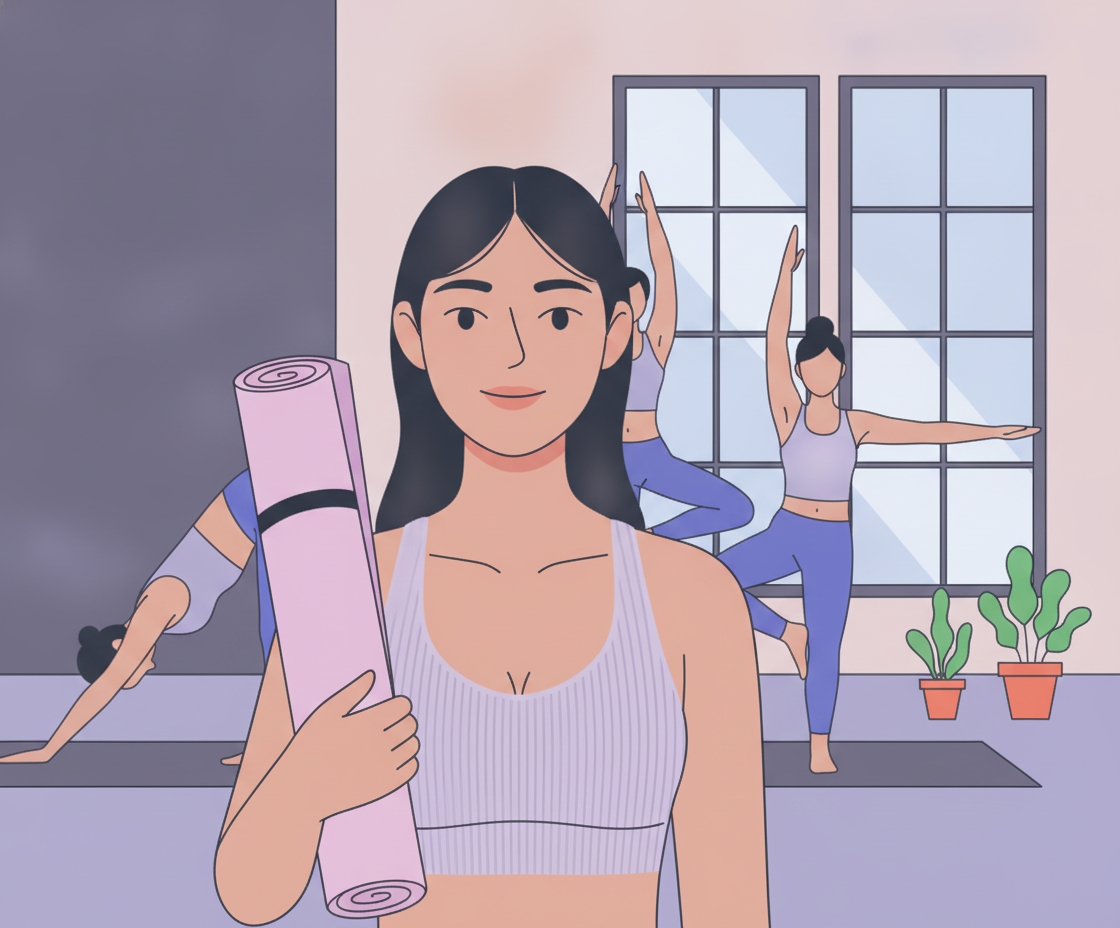
A woman holding a yoga mat and others practicing yoga indoors.
So I ask small, low-stakes questions mid-practice. What do you notice in your chest right now? Is that tightness, or is it protection?
There is no wrong answer, and that is the point. Someone who braces because a held breath means danger starts, slowly, to notice it might just mean effort. That single shift, from reacting to being curious, is often the first moment a person feels safe inside their own skin.
It does not happen in one class. It happens on the fortieth try, when curiosity finally outpaces fear.
How Do You Carry This Home?
Nobody says this loudly enough in a studio: the goal was never to depend on a class, a teacher or a perfectly curated room.
Every safety cue and every choice-based instruction exists to teach you something you can eventually do with nobody watching.
A Small Kit You Keep Within Reach
Ten minutes of grounded breathing on your bedroom floor, done because you chose it, does more than a ninety minute class you dragged yourself to out of guilt.
Duration is not the measure. Presence is.
Legs Up the Wall when activation creeps up and thoughts start racing. Child's Pose when overwhelm hits and you need to feel your own edges. Savasana when the body is simply asking for rest.
That quiet ten minutes is the same work the mantra Om Namah Shivaya points at: stillness over striving, release over control. As a daily reminder there is our Shiva shirt, so you carry that attitude into everyday life.
None of these need a teacher's voice in the room. That is deliberate. You are not memorising poses. You are memorising a relationship with your own body, one you can reach on a bad Tuesday with nothing scheduled.
When You Need More Than a Mat
Trauma-informed yoga is not a replacement for trauma-focused psychotherapy, somatic experiencing or EMDR. It is a foundation underneath them.
A regulated nervous system gives talk therapy something stable to work with. Without that groundwork, processing at the level of thought can feel like building on sand.
And healing will not move in a straight line. You might feel steady for weeks, then a smell or a tone of voice brings the old pattern straight back. That is not failure. It is your nervous system doing what it learned, and an invitation to practise choosing again, this time with kindness instead of judgement.
Questions People Ask
How do I find a genuinely trauma-informed teacher? Ask two questions before you book. Do you use hands-on adjustments, and do you ask before each one? Can I leave the room at any point? A teacher trained in this work will answer both without hesitation and without making you explain why you asked.
Can I do this if I have never done yoga? Yes, and in some ways it is easier. There is no shape to get right and nothing to keep up with. The first classes are often mostly breathing and lying down.
What if I get flooded during a class? Open your eyes, put both feet on the floor and name three things you can see. That is not giving up on the practice, it is the practice. A trauma-informed teacher expects it and will not come over unless you ask.
Is this instead of therapy? No. It works best underneath therapy, not in place of it. A steadier nervous system gives the talking work something solid to stand on.
How long before something shifts? Most people notice sleep and body tension first, within a few weeks. The deeper change, the one where calm is simply more available, takes months of small, regular practice.
It is Tuesday evening. The mat is under the bed where you pushed it after the class that went wrong. Nobody is watching, nobody will cue you, and nothing has to look like anything. You can pull it out and lie down with your legs up the wall for five minutes.

 AsanaLegs Up the WallViparita KaraniTo the asana →
 AsanaChild's PoseBalasanaTo the asana →