Yoga can support the immune system in a rather simple way. Research shows that regular yoga can help lower inflammation in the body, especially the kind of inflammation that is linked to long-term stress.
The interesting part is that the effect seems to depend more on how regularly you practise than on how hard you practise in any single session. That changes the way we should think about a useful winter practice.
This matters because there are many claims about yoga and immunity. Twists are often said to "massage the organs", while inversions are said to "drain the lymph". These ideas sound convincing, but the research points in a different direction. It gives us something much more useful: an idea of how much practice may actually matter.
What yoga does to the immune system, and what it does not
So, does yoga actually help your immune system?
Research suggests that it can. A review of fifteen studies found that regular yoga was linked to lower levels of inflammation in the body (Falkenberg 2018).
The researchers also point out that the evidence is still developing. The results are not completely consistent, and there is still too little research to draw firm conclusions about many parts of the immune system.
A larger review looked at 34 studies with more than 2,200 people. These studies included yoga, tai chi, qi gong and meditation (Morgan 2014). After seven to sixteen weeks of regular practice, people showed lower levels of inflammation.
The interesting part is what happened with immune cells. The number of important immune cells in the blood showed very little change.
In other words, yoga does not seem to work like an "immune booster" that simply gives you more immune cells.
The effect seems to be more about helping the body regulate inflammation and respond to stress.
The same research also found evidence that mind-body practices can improve the way the immune system responds to a challenge, such as a vaccination.
That gives us a much clearer picture of what yoga may actually be doing: supporting a better-regulated immune system rather than simply producing more immune cells.
The dose is the finding most people miss
The most practical finding comes from a review that looked specifically at yoga and inflammation across fifteen studies (Djalilova 2019).
The researchers found that the total amount of practice mattered. Once people accumulated roughly 1,000 minutes of yoga, the improvements in inflammation became stronger.
A thousand minutes sounds like a lot, but it is about seventeen hours in total.
At forty minutes per session, that means around 25 practices.
Practising three times a week gets you there in roughly two months.
The important point is that the number rewards consistency. A practice that feels manageable on a dark winter evening can take you much further than a demanding practice that becomes difficult to maintain.
This also tells us something about one-off sessions.
A single yoga session may feel good, help you relax and make you breathe more freely. The research on immunity, however, points towards an effect that builds over time.
Practising regularly throughout the winter gives the body a much better chance to accumulate the amount of practice seen in the research.
There is also a practical problem here. Yoga rooms tend to fill up in September and become quieter in January and February. Those are exactly the months when regular practice could add up to something meaningful.
That makes the barrier to practice important.
The most useful winter practice is one you can start easily. A short, familiar sequence with everything ready to go makes it easier to practise when it is dark outside and motivation is low.
That is why the sequence below finishes with your legs against a wall. It gives you a gentle way to bring the practice down and makes the whole sequence easier to repeat.
A fifteen-minute version is also included at the end of the article.
Stress is the mechanism, and it is well mapped
Stress affects the immune system, but the effect depends heavily on how long the stress lasts.
Imagine someone suddenly braking in front of you. Your chest tightens, your palms become sweaty and your jaw gets tense. A short time later, the situation is over.
This kind of short-term stress can actually activate parts of the immune system. The body is preparing itself for a possible injury or immediate danger.
A stressful week at university or work looks different. Several days of poor sleep and constant tension can begin to weaken parts of the immune response.
Long-term stress has an even stronger effect. Think of a difficult job, caring for someone close to you or a situation that simply has no clear end.
A large review of more than 300 studies looked at exactly this question (Segerstrom and Miller 2004).
The researchers found that the duration of stress matters more than its intensity when it comes to its effects on the immune system.
That makes winter interesting.
Winter can create a kind of background stress that is easy to overlook. You wake up when it is dark. Your heating dries the air. You spend more time indoors. You move less. You may go through weeks without spending much time outside.
There is rarely one big event that creates this feeling. Instead, small factors can continue for weeks.
That pattern is similar to the long-term stress that the research connects with changes in immune function.
One particularly interesting finding is that people are often poor judges of how much stress their bodies are actually under.
The way someone feels does not always match what researchers find in the body. Someone can feel perfectly fine while their body is responding to long-term stress.
This is one reason regular practice can be useful even when you feel completely well.
A study of 50 women gives another interesting perspective (Kiecolt-Glaser 2010).
Half of the women had many years of yoga practice. The other half were beginners.
The experienced practitioners had lower levels of inflammation than the beginners. One marker was 41 percent higher in the beginners, and another marker was almost five times more likely to be detectable.
The groups were similar in age, fitness and abdominal fat. The difference therefore cannot simply be explained by the experienced practitioners being fitter.
There is another important detail in this study.
The researchers also looked at what happened after a single restorative yoga session. That one session produced no measurable advantage in inflammation or stress-related hormones.
The experienced practitioners had the differences seen in the study because of years of regular practice.
That is perhaps the most useful lesson here: the body responds to what you do repeatedly.
Does it actually stop you getting sick
This is probably the question most people really want answered.
Can yoga or meditation actually stop you from catching a cold?
One study looked directly at this question. 413 adults were divided into three groups: eight weeks of mindfulness training, eight weeks of moderate exercise, or a control group (Barrett 2018).
The participants were then followed through an entire cold season, with viral testing used to confirm illnesses.
The meditation group had 112 illness episodes and 1,045 sick days.
The exercise group had 120 illness episodes and 1,010 sick days.
The control group had 134 illness episodes and 1,210 sick days.
Both active groups also missed less work than the control group.
The overall direction is interesting: the people doing meditation or exercise experienced fewer sick days.
The study itself, however, could not confirm a clear reduction in how often people became ill or how severe their illnesses were. The researchers also considered the study likely to have been too small to detect a definite difference.
So the most useful conclusion is simple:
Regular mind-body practice may help people get through cold season with fewer sick days, while the evidence for actually preventing colds remains uncertain.
That distinction matters.
Yoga can support your overall health and stress regulation. A claim that yoga prevents colds goes further than the current research allows.
Why this practice is built the way it is
There is one thing you notice when teaching yoga through winter that research has not measured.
By late January, people often breathe higher into the chest.
Ask a room in October to lengthen the exhale during a twist and most people can do it easily. Ask the same room in February and the breath often becomes shorter. The ribs move less, and the shoulders start doing more of the work.
I have no measurement showing that this directly changes inflammation. I would not claim that it does.
It is simply one reason this practice puts so much attention on twists and breathing.
The sequence contains four main twists.
The purpose is straightforward: twisting moves the ribcage and diaphragm through a wider range of movement. After months of sitting indoors and protecting yourself from the cold, that movement can feel especially useful.
Good breathing is a plausible part of a practice that supports relaxation and stress regulation.
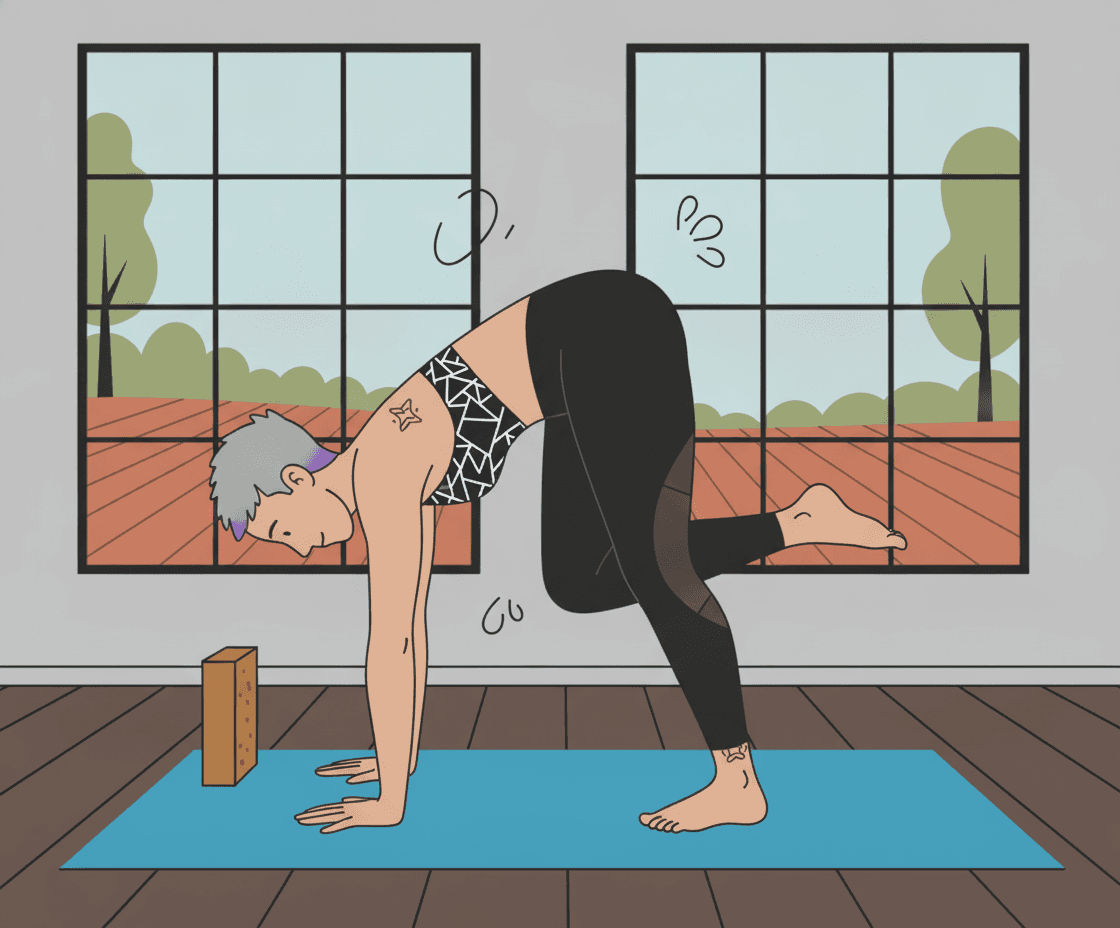
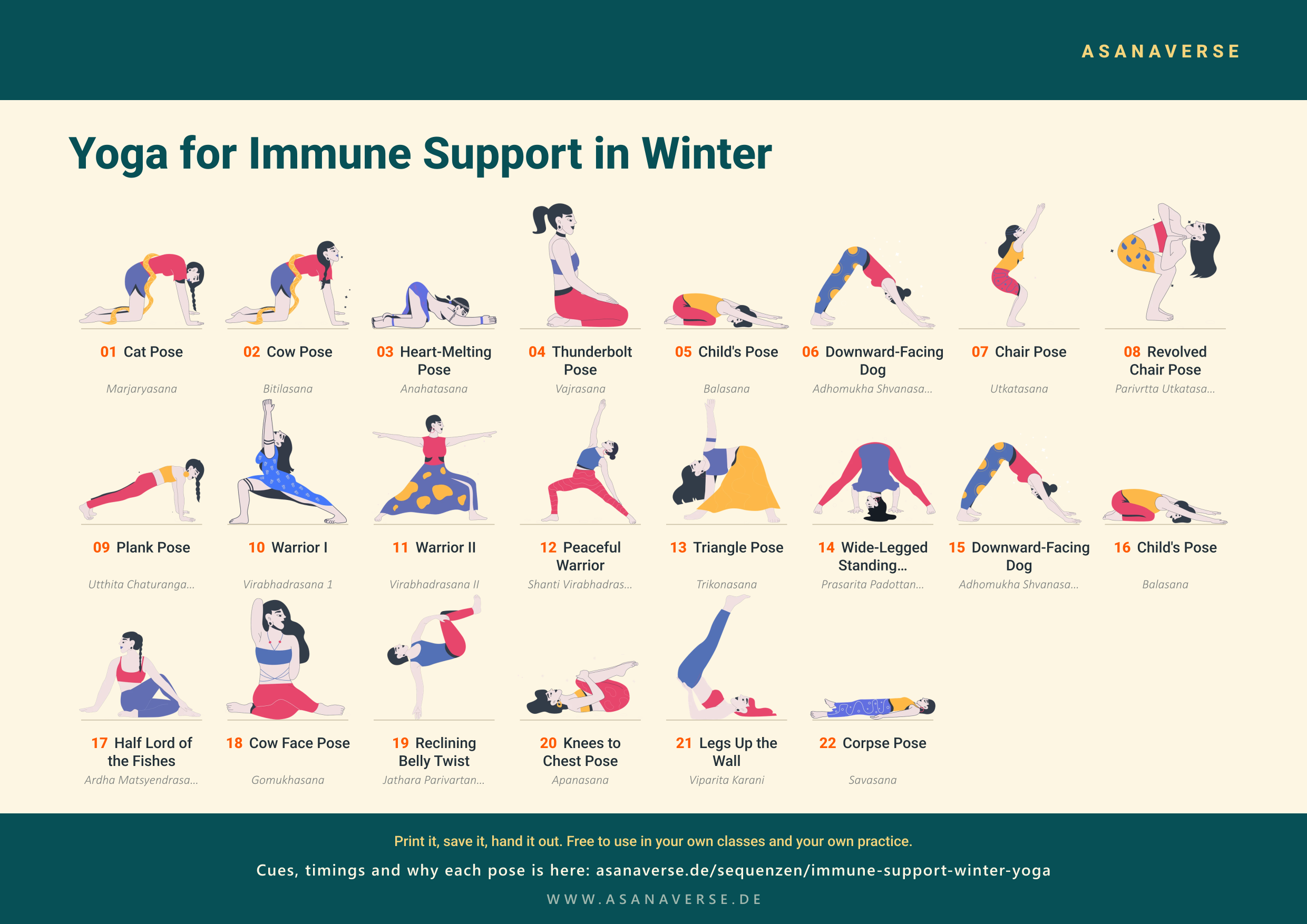
The sequence starts with Cat and Cow, then builds some warmth through Revolved Chair and the standing poses. From there, the practice comes back down to the floor for two twists.
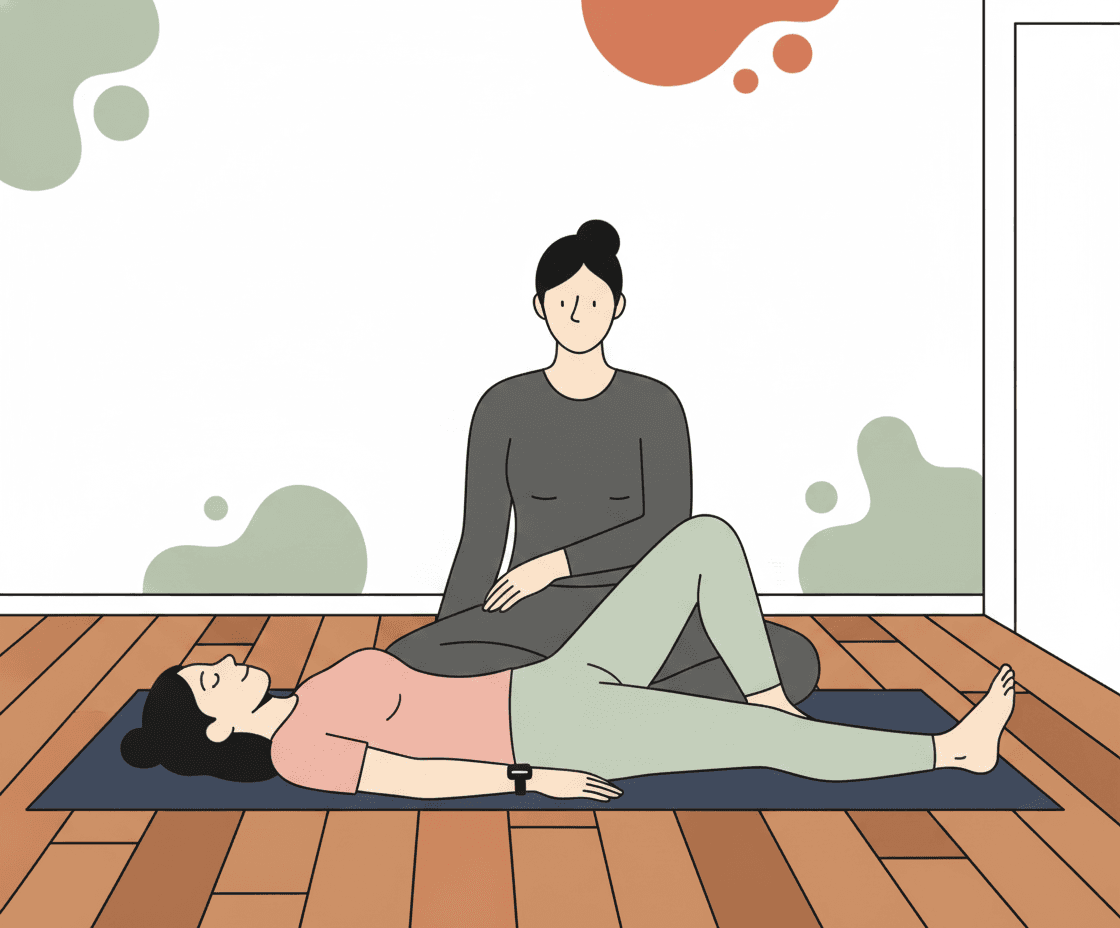
Reclining Belly Twist comes near the end because it is simple, accessible and easy to stay with even when you are tired.
Two decisions in this sequence are worth explaining because they came from running the practice through our own sequencing checker.
The first is a three-breath pause in Thunderbolt Pose, sitting back on the heels.
It sits between Melting Heart and Child's Pose.
The pause gives the spine and breath a neutral moment between the backbend and the forward fold. Three relaxed breaths are enough to create that transition.
It also gives you a useful moment to check how your lower back feels before moving into the standing part of the practice.
The second decision is the final pose.
The sequence finishes with Legs Up the Wall.
A traditional winter sequence might finish with a headstand, but the sequencing checker showed a much smoother progression with Legs Up the Wall.
The pose brings the intensity down while keeping the inversion element of the practice.
It is also a pose that remains accessible when you are tired. That matters because the research points towards accumulated practice over many weeks.
The best sequence is therefore the one you can keep returning to.
The full sequence with timings and cues is available here: Yoga for Immune Support in Winter.
What to take from this
It is a Tuesday in early February. It has been dark since half past four, and your yoga mat is still rolled up behind the door.
Everything in this article comes down to what happens in the next ten seconds.
You can unroll the mat.
The research gives us three useful pieces of information.
The dose analysis points towards accumulated practice rather than intensity.
The comparison between experienced and new practitioners points towards the importance of years of regular practice.
And the research on stress shows that long-term stress can affect the immune system even when you do not particularly feel stressed.
Three different findings point towards the same simple idea:
Make your practice easy enough to repeat.
That is why this sequence finishes with your heels against a wall.
A headstand can certainly have a place in a yoga practice. Legs Up the Wall simply fits this particular goal better because it keeps the final part of the practice gentle and easy to repeat.
The research gives us a reason to think in weeks and months rather than in individual sessions.
That is where the real value of a winter practice lies.
Questions people ask
How often do I need to practise for this to matter?
Three times a week is a useful target.
The dose analysis points towards roughly 1,000 accumulated minutes before measurable changes in inflammation appear.
At forty minutes per session, that works out to around 25 practices.
The important thing is the accumulated practice over time.
Do inversions really drain the lymphatic system?
The lymphatic system moves through muscle activity and breathing, so movement supports lymph flow.
Yoga can therefore contribute to normal lymphatic movement.
Research has not shown that spending a few minutes upside down creates a measurable immune benefit, however.
The better-supported effects of yoga on immunity involve stress regulation and inflammation.
Should I practise when I already have a cold?
Gentle movement is usually fine when symptoms stay above the neck.
Once you have a fever, body aches or a chest infection, rest becomes the better choice.
The research discussed in this article looks at regular practice during the cold season. It tells us about prevention and overall immune function rather than treating an illness that is already present.
Is yoga better than other exercise for this?
The research gives us no clear reason to rank yoga above other forms of exercise.
In the study that compared moderate exercise with meditation, both groups showed similar overall patterns.
Exercise performed slightly better for illness severity, while meditation performed slightly better for illness incidence.
Yoga combines movement, breathing, relaxation and meditation, which makes it an appealing all-round practice for winter.
What if I only have fifteen minutes?
You can keep the practice very simple:
Cat, Cow, Melting Heart, three breaths on your heels, Child's Pose, Downward Dog, then Reclining Belly Twist for one minute on each side, Knees to Chest, and five minutes with your legs up the wall.
That gives you nine shapes and keeps the key elements of the full sequence: movement, a twist, breathing and a gentle inversion.
The research points towards consistency.
A fifteen-minute practice that becomes part of your week can therefore be much more useful than an ambitious practice that disappears after a few sessions.