Your nervous system has two settings. One speeds you up so you can act. The other slows you down so you can recover.
Neither one is the good one.
The trouble starts when you get stuck in either, and most of us are stuck in the first. Yoga seems to help less by switching you into calm and more by making the change between the two easier. That is a smaller claim than the usual one, and it is better supported.
The most useful thing in the research is also the simplest: a slow breath out is the part that does most of the work.
What your nervous system is doing while you read this
Right now, without you deciding anything, your heart is beating, your gut is working and your pupils are adjusting to the light.
That is the automatic side of your nervous system, and it has two branches.
One branch gets you ready to act. Heart rate up, breathing faster, muscles ready, digestion on hold. It is the branch people call fight or flight, though it is also just the branch that gets you out of a chair.
The other branch does the opposite. Heart rate down, breathing slower, digestion back on, muscles softening. Rest and recover.
They are not enemies. You need both, all day, in different amounts.
The problem is being stuck. When the first branch stays switched on for weeks, you get the state most people describe as wired and tired at the same time: too restless to rest, too worn out to do anything useful.
It rarely announces itself as stress.
It shows up as reading the same paragraph three times. As a jaw that is tight when you notice it, and tight again ten minutes later. As lying down and finding your legs want to move.
Most people put those down to a busy week rather than to a nervous system that has forgotten how to come down.
Why the practice moves before it rests
Here is the question this practice is built around.
If you feel wound up, should you go straight to something calming?
You can, and it sometimes works. But many people lie down to relax and find their mind speeds up instead. The body was still full of energy and had nowhere to put it.
So this practice does the other thing first.
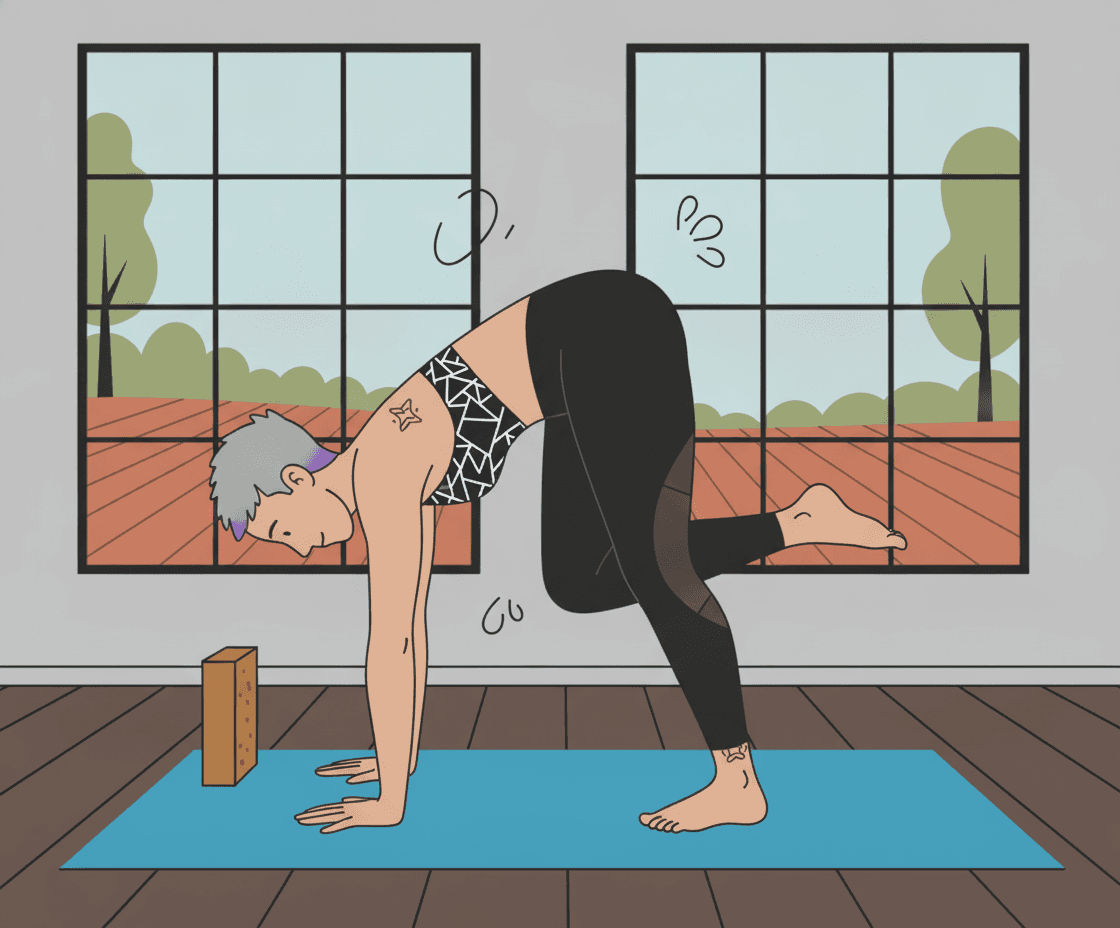
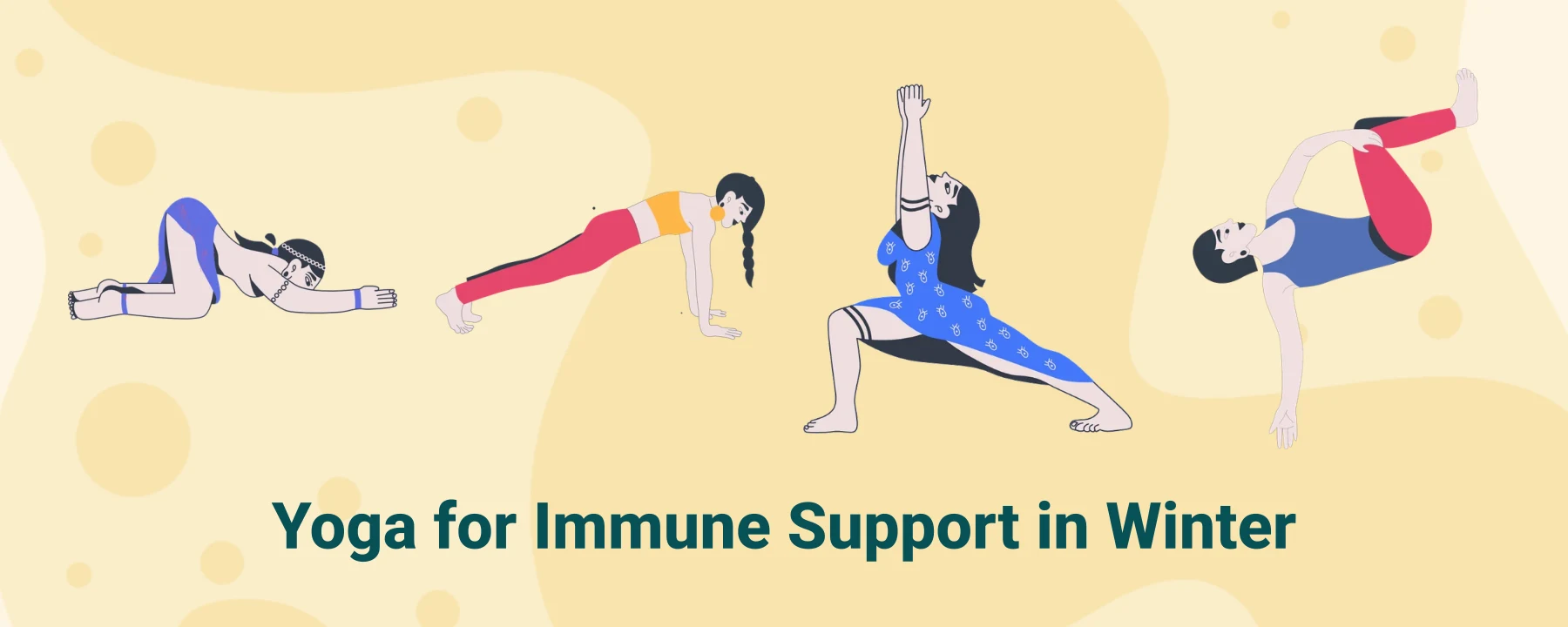
The first half stands you up and asks your legs to work. Warriors, a lunge, a balance. Your heart rate goes up. That is the point.
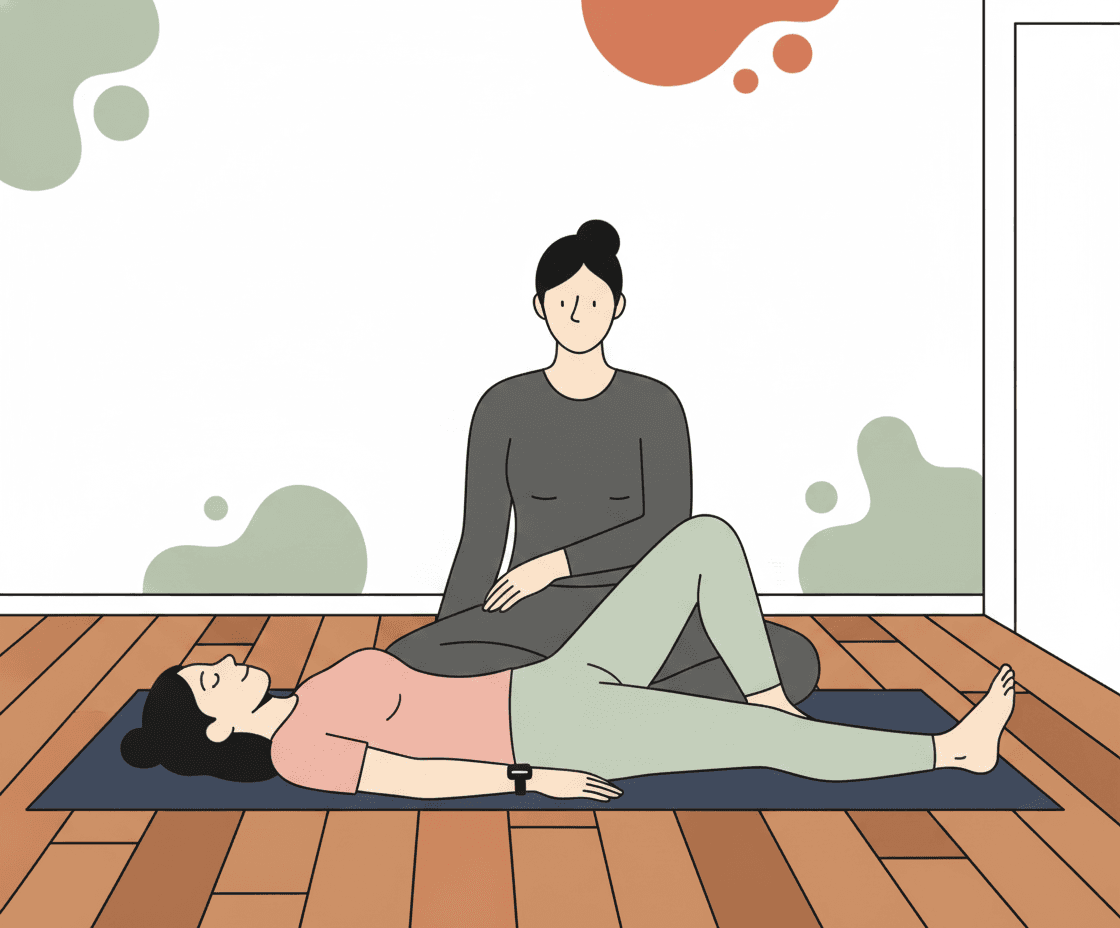
The second half puts you on the floor with something soft underneath you and asks for nothing at all.
The change between the two halves is what you are actually practising. Not the calm at the end, but the ability to go from one to the other.
Think of it like a light on a dimmer rather than a switch. Most of us have a switch that sticks.
The breath out is the lever
Of everything in a yoga practice, slow breathing has the clearest evidence behind it.
A review of fifteen studies looked at what happens when people deliberately slow their breathing down (Zaccaro 2018).
The measurable changes were consistent. The calming branch of the nervous system became more active. Brain activity shifted towards the pattern seen in relaxed, alert states.
What people reported was just as clear: more comfort, more relaxation, more alertness, and less anxiety, anger and confusion.
The practical part is that you do not need a technique with a name.
Make the out breath longer than the in breath. That is it.
Breathing in gently speeds the heart up. Breathing out gently slows it down. Spending more time on the out breath tips the balance towards the branch that settles you.
You can test this in about thirty seconds, sitting where you are.
Breathe in for a count of four. Breathe out for a count of six. Do that five times and stop.
If six feels like a stretch, use three and five. The ratio matters, the numbers do not.
Two things usually happen. Your shoulders drop a little, and you notice you had been holding them. And the fifth breath is easier than the first, because the ribs have started moving again.
This is also the reason the resting half of the practice is worth doing at all. Lying supported over a bolster does not calm you by itself. It puts your body in a position where a long slow breath out is easy, and then the breath does the rest.
Does yoga actually change the nervous system?
This is the question worth asking, because a lot is claimed here.
The strongest answer comes from a review of 42 randomised trials (Pascoe 2017).
What makes it strong is a detail in the method. Every trial in it compared yoga against an active control group, meaning people who were also doing something rather than sitting on a waiting list. That is a much harder test to pass.
Yoga still came out ahead on several everyday measures: lower blood pressure over the day, a lower resting heart rate, and lower levels of the body's main stress hormone both in the morning and in the evening.
The authors describe this as better regulation of the branch that speeds you up.
Note the word. Not switched off. Regulated.
A second, much smaller study compared 19 long-term practitioners with 8 people who did not practise (Kaur 2023). The practitioners had been at it for an average of eleven years, and their hearts showed a clear lean towards the calming branch.
A study of twenty-seven people is small, and it looked at one moment in time rather than following anyone. It cannot tell us that yoga caused the difference.
What it does fit is the pattern from every other question like this: the differences show up in people who have been practising for years, not in people who did one good session.
So how would it work at all?
The honest answer is that nobody has nailed this down. One proposal that gets discussed a lot suggests the effect runs along the long nerve connecting the brain to the heart, lungs and gut, and that slow breathing and gentle movement together nudge the whole system towards its settling branch (Streeter 2012).
That paper is explicitly a hypothesis rather than a trial. It is a good idea waiting to be tested, and worth knowing about mostly so you can recognise it when someone presents it as settled fact.
What is not in doubt is the smaller, duller finding: slow breathing changes measurable things, reliably, in minutes.
Why this practice is built the way it is
There is something you notice teaching a class like this that no study measures.
The first two minutes of the resting half are usually the worst.
People lie down over a bolster expecting relief and instead find their leg twitching, their jaw tight, and a strong urge to check whether that was long enough yet. Then somewhere in the third minute something lets go.
That is the reason the held poses in this sequence are four minutes and not two. The first part is not the practice. It is the queue.
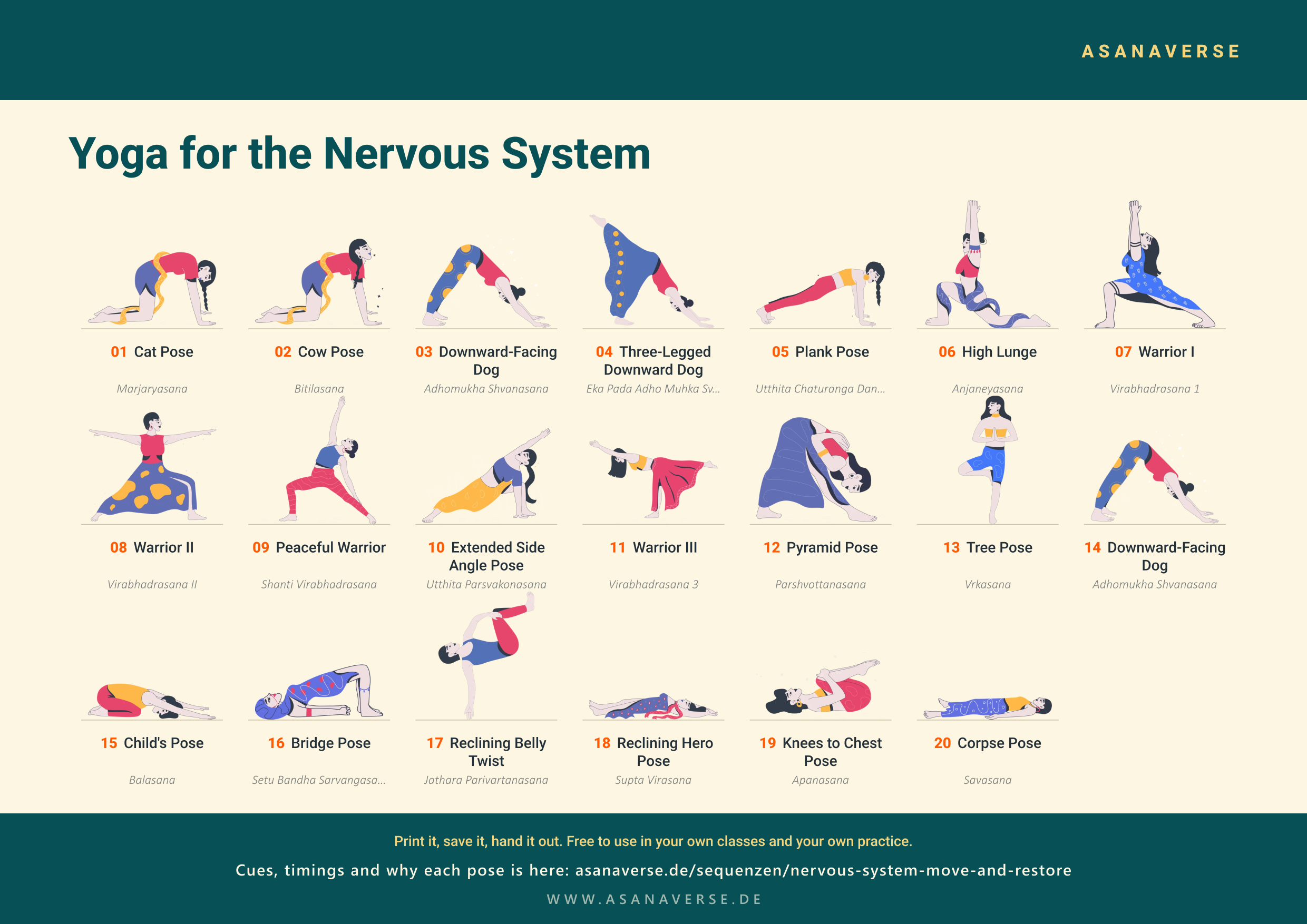
The moving half starts on your hands and knees with Cat and Cow, then builds through the dog and a plank into the standing poses.
Nine standing poses is a lot of standing work, and that is deliberate. Standing up against gravity is what asks the speeding-up branch to work, and you cannot practise coming down from somewhere you never went.
Tree Pose is the last one standing. Balancing on one leg asks your whole system to pay attention, which makes it a surprisingly good doorway into the quiet half.
Then everything changes. Bridge comes back as a supported shape, with a bolster under your hips so you are not holding anything up. The twist is done lying over the bolster rather than pulling yourself into it.
Nothing in the second half should feel like a stretch. If it does, add more support until it does not. A pose you are working in is not a pose you are resting in.
The practice ends with ten minutes of Savasana. Longer than feels reasonable, and the part people skip first.
The full sequence with timings and cues is here: Yoga for the Nervous System.
What to take from this
It is nine in the evening. You have been busy since seven this morning, you are too tired to do anything and too wound up to sleep.
That is the state this practice was built for.
Three things are worth carrying away.
The breath is the fastest lever you have, and a longer out breath is the whole technique.
Moving before resting works better than going straight to calm, because the body needs somewhere to put what it is carrying.
And the differences that show up in research belong to people who practise for years, not to anyone's best single session.
None of that requires you to do the full fifty-five minutes tonight.
The last five poses on their own take twenty minutes and are the half most people need. Start there. The standing work will still be waiting on a morning when you want it.
Questions people ask
How is this different from a normal yoga class?
Most classes move for most of the time and finish with a few minutes of rest.
Here the rest is half the practice, and it uses props so that you are genuinely supported rather than holding a shape.
The moving half exists to give the resting half something to settle from.
What if I do not have a bolster?
Two towels wrapped around a firmly rolled pillow and tied securely work well.
Two thick books stand in for the blocks, and any dense blanket will do.
What matters is that the support is firm and holds its shape. A soft pillow that flattens under you leaves you holding yourself up, which is the one thing these poses are meant to avoid.
How long before I notice anything?
Most people notice something within a single practice, usually in the resting half and usually as a change in the breath.
The lasting differences in the research belong to people who practised regularly over months and years.
Treat one session as useful for tonight, and the habit as the thing that changes the baseline.
Can I do this before bed?
The resting half, yes. It is well suited to it.
The moving half is better earlier. Nine standing poses will wake most people up, which is exactly what you do not want an hour before sleep.
Is slow breathing on its own enough?
It is the single most evidence-backed part of what happens in a yoga practice, and you can do it anywhere without a mat.
But it is easier to slow your breath when your body has already moved and is supported.
The poses are not a competing method. They are what makes the breathing part possible on a day when sitting still feels impossible.