Asanaverse

Asthma and Everyday Breathing

Yoga and Breathing Practice for Living With Asthma

Asthma treatment handles the flare ups well. What it does not usually touch is the everyday pattern of how you breathe, which for most people with asthma sits higher and shallower than it needs to, and which is almost impossible to notice from the inside.

This guide explains what to do about that. Why the out breath is the part that matters, which breathing techniques were tested and what they changed, which poses make room for the ribcage to move, and where the line runs between practice and medication.

Who this guide is for

Signs this guide was written for you

This is for the settled version of asthma. Your treatment is working, nothing has landed you in hospital, and what you want is to work on the breathing itself.

  • ·You have a diagnosis of mild to moderate asthma and you are on treatment for it.
  • ·Things are stable. No hospital admissions or emergency treatment in the last year.
  • ·You notice your breathing on stairs, in cold air, or at the end of a long day.
  • ·You want to work on the pattern of your breathing alongside your medication, not instead of it.
  • ·You can put aside twenty minutes, three or four times a week.

What causes Asthma and Everyday Breathing

The part of breathing worth training is the part where you breathe out.

Almost every breathing exercise people are given focuses on the in breath. Take a deep breath in, fill the lungs, hold. With asthma that is the wrong end of the cycle, because the problem is not getting air in. It is getting it out of narrowed airways, completely and without effort.

The one study that went through the techniques individually rather than as a block found exactly that. The techniques built around a long controlled exhalation were the ones that moved the symptom counts, and the authors recommended making them a regular part of treatment.

  • ·In an eight week trial of 57 people, FEV1 rose from 70.2 to 77.9 percent of predicted and peak flow from 68.6 to 85.3, alongside their usual treatment.
  • ·Among the participants in that trial whose airways narrowed during exercise, the narrowing fell from 26.7 percent to 8.0.
  • ·In the trial that named its techniques individually, coughing fell from 73 percent of participants to 12, wheezing from 76 to 8 and breathlessness from 73 to 10 over twelve weeks.
  • ·A Cochrane review of 15 trials with 1,048 people found improvements in quality of life and symptoms, and no serious harms.
  • ·Every one of these studies ran breathing practice alongside existing asthma treatment, which is the only way it has ever been tested.

Safety

When to practise and when to get it looked at

Two things decide whether this is useful or not, and both of them come from how these studies were actually run.

How to practise so it works

  • ·This is an addition to your asthma treatment, never a replacement. Every trial behind this program ran breathing practice alongside existing medication, and that is the only condition under which these results exist.
  • ·Breathing exercises are not a rescue technique. During an attack the reliever inhaler is what works. Keep it in reach during every session.
  • ·Never hold your breath, in a pose or at the end of an exhale. The protocol this follows was explicit about that, and holds were kept to about thirty seconds with the breath moving throughout.
  • ·No forced or rapid breathing. Kapalabhati and Bhastrika are left out on purpose, because fast forced exhalation can tighten airways and was not the mechanism in any of this research.
  • ·Warm up longer than usual before anything dynamic. Exercise-related tightening is common, and in the trial that measured it the improvement took the full eight weeks.

The asanas

The yoga poses that matter for Asthma and Everyday Breathing

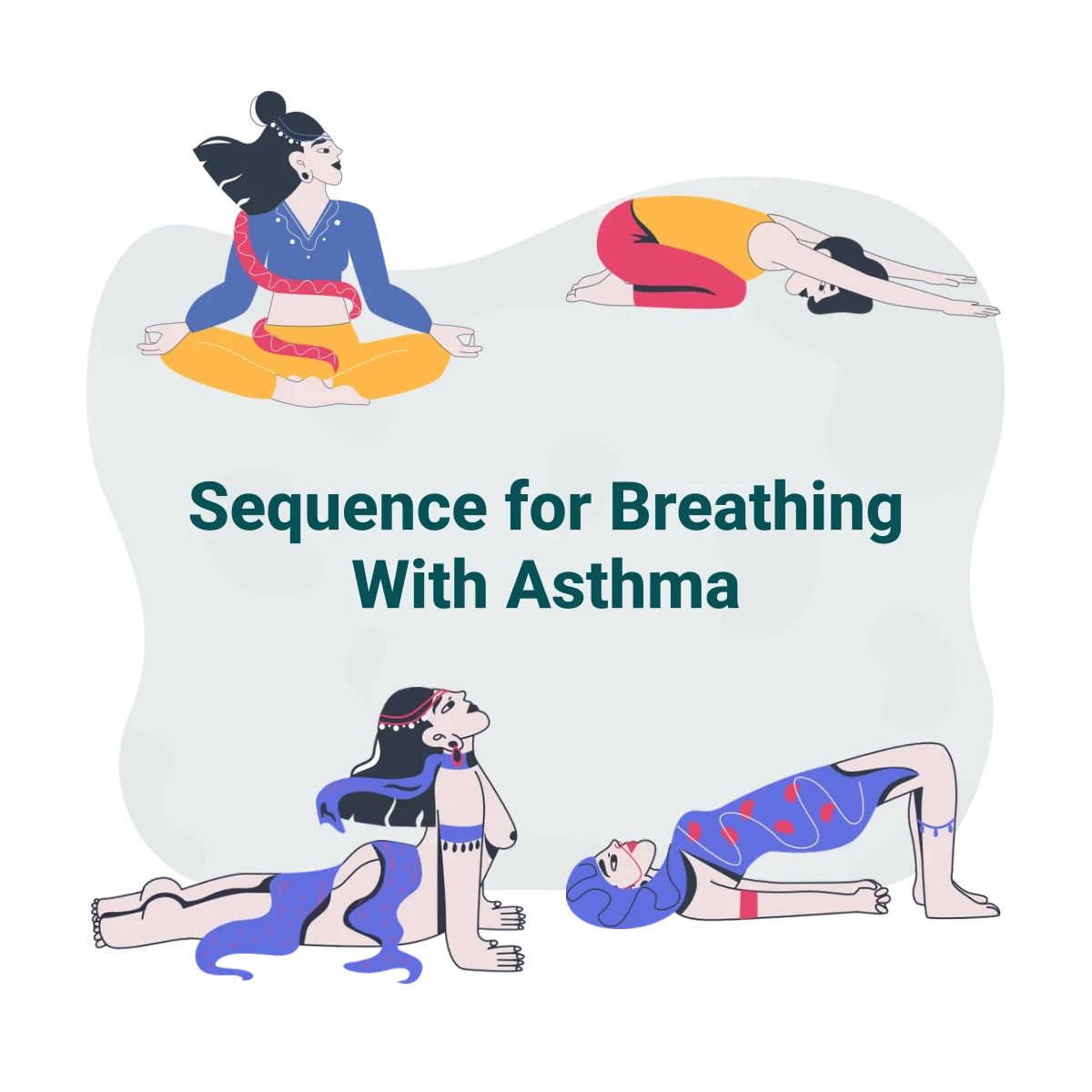
Grouped by what each one asks the body to do. Tap any pose to see how it is done, what it works on and who should leave it out.

For yoga teachers

Teaching a class for Asthma and Everyday Breathing

A breathing class for people with asthma is a different job from a general pranayama class, and the difference is mostly about what you leave out. Kapalabhati and Bhastrika use fast forced exhalation, which can tighten airways rather than open them, and they were not the mechanism in any of the trials. The evidence points at slow breathing with a long controlled out breath, so that is what the class is made of.

Cue the exhalation as the active part. In for four, out for six, and let it lengthen over the weeks rather than pushing it on day one. Never cue a breath hold, in a pose or between breaths, and say why: an empty pause at the end of an exhale is uncomfortable for anyone whose airways narrow.

Keep the holds short and the breath continuous. The protocol behind this program held poses for up to thirty seconds with a specific breathing pattern and explicitly without breath holding. That is a good rule for a class too, and it changes how you sequence: many short holds rather than a few long ones.

Two things that belong in the room and often are not:

  • ·Say once, clearly, at the start, that this is alongside their treatment and that inhalers stay within reach. Everyone in the room already knows it. Saying it removes the awkwardness of being the person who gets their inhaler out.
  • ·Warm up longer than you think before anything dynamic. Exercise-related tightening is common, and in the trial that measured it, the improvement took the full eight weeks rather than arriving in week one.

Build your own

Put together your own class for Asthma and Everyday Breathing

The sequence builder gives you all 108 asanas and lets you arrange them yourself. While you build, it watches the shape of the class: whether the intensity rises and falls the way a practice should, whether every strong pose gets its counterpose, and whether the order makes anatomical sense.

Save what you build, come back to it, and teach it. It is the fastest way to turn what you just read into a class of your own.

The research

What the studies actually found

The clearest result here comes from an eight week trial where 57 people added structured yoga and breathing to their existing asthma treatment: FEV1 rose from 70 to 78 percent of predicted, peak flow from 69 to 85, exercise-related narrowing fell from 26.7 percent to 8.0, and quality of life improved in every domain from week two. A second trial went through the breathing techniques one at a time and found coughing, wheezing and breathlessness all dropping sharply, mainly with the techniques built around a long exhalation. Behind those sit a Cochrane review of 15 trials and 1,048 people, which found improvements in quality of life and symptoms and no serious harms, and a head to head comparison in which breathing practice clearly beat treatment alone.

BMC Pulmonary Medicine2009

The efficacy of a comprehensive lifestyle modification programme based on yoga in the management of bronchial asthma: a randomized controlled trial

57 people, eight weeks, alongside their usual treatment. FEV1 rose from 70.2 to 77.9 percent of predicted and peak flow from 68.6 to 85.3. Among those whose airways narrowed during exercise, the narrowing fell from 26.7 percent to 8.0. Quality of life improved in every domain from week two, and rescue medication use dropped. This is the trial our eight weeks and our thirty second holds come from.

Read the source →
International Journal of Yoga2009

The effect of various breathing exercises (pranayama) in patients with bronchial asthma of mild to moderate severity

50 people, twelve weeks, twenty minutes twice a day. Coughing fell from 73 percent of participants to 12, wheezing from 76 to 8 and breathlessness from 73 to 10, with lung function improving as well. This is the only study that names each technique separately, and it concluded that mainly the expiratory ones were doing the work. It is the reason our sessions are built around the out breath.

Read the source →
Cochrane Database of Systematic Reviews2016

Yoga for asthma

15 randomised trials with 1,048 people, mostly adults with mild to moderate asthma. Moderate quality evidence that yoga leads to improvements in quality of life and in symptoms, and no serious harms reported. The strictest look anyone has taken at this literature.

Read the source →
Journal of Asthma2013

Comparison of the effects of Buteyko and pranayama breathing techniques on quality of life in patients with asthma

120 people across three groups over three months, fifteen minutes twice a day. Breathing practice came out clearly ahead of standard treatment alone on quality of life and asthma control. Useful because it tests breathing practice against ordinary care rather than against nothing.

Read the source →
Complementary Therapies in Clinical Practice2020

Effect of pranayama breathing technique on asthma control, pulmonary function, and quality of life: A single-blind, randomized, controlled trial

50 people, one month, twenty minutes a day. Asthma control and quality of life improved significantly across every subscale. A useful marker of how quickly the things people actually feel begin to move.

Read the source →

Frequently Asked Questions

Can breathing exercises help asthma?

Yes, alongside treatment. A Cochrane review of 15 trials with 1,048 people found improvements in quality of life and symptoms and no serious harms, and individual trials have shown changes in lung function too. In every one of them, breathing practice was added to existing asthma treatment rather than replacing it.

Which breathing technique is the best one for asthma?

The ones built around a long, controlled out breath. One trial went through the techniques individually and concluded that mainly the expiratory ones were doing the work, with coughing, wheezing and breathlessness all dropping sharply over twelve weeks.

Should I avoid Kapalabhati and Bhastrika?

In a general class, ask for an alternative. Both use rapid forced exhalation, which can provoke tightening rather than relieve it, and neither was part of the mechanism in the research on asthma. Nothing is lost by leaving them out.

Can I use a breathing exercise during an asthma attack?

No. During an attack the reliever inhaler is what works and what the guidance says to use. Breathing practice is something you do between attacks, on ordinary days, to change the everyday pattern.

My chest gets tight when I exercise. Can I still do yoga?

Usually yes, with a long warm up and a gradual start. In the eight week trial, exercise-related narrowing dropped from 26.7 percent to 8.0 over the full eight weeks, so it improves with time rather than immediately. Begin with the seated and lying sessions and let the standing work arrive later.

How long before anything changes?

Quality of life measures moved from week two in the trial this program follows, while the lung function numbers took longer. Expect how you feel to shift before anything a spirometer would notice.

Where to next

All programs

See the other programs

Every program here was built around one complaint and around the trials that studied it. Back, neck, knees, hips, sleep and stress, each one running for as long as the research says it takes.

Browse programs →