Prana-Magic: Understanding the 5 Vayus and Integrating Them Into Your Daily Life
Feel how the air flows gently into your lungs and how it fills you with vital life force, with Prana. This is the magic of the Vayus: five subtle winds that guide life energy through our physical and energetic self, accompanying every breath, every thought and every movement. Understanding the 5 Vayus is an invitation to dive deeper into the subtle aspects of our being and to consciously shape our health, our emotions and our wellbeing.
In the ancient texts of yoga, particularly in the Upanishads, five main Vayus or Prana-Vayus are described: Prana Vayu, Apana Vayu, Samana Vayu, Udana Vayu and Vyana Vayu. Each of them has a specific direction and function in our body and plays a crucial role in our health and wellbeing.
The journey to discover the Vayus is like a dance with the wind. It is a delicate interplay of balance and harmonization, a loving dialogue with our inner self. It is a practice of mindfulness that helps us understand ourselves better.
You will learn:
- The fascinating concepts of the five Vayus: Prana, Apana, Samana, Udana and Vyana. You will come to understand their properties and functions in the human body and mind.
- Insights into specific yoga therapy approaches and asanas that aim to support and balance the different Vayus.
- The important role of the Vayus in maintaining inner balance and harmony. You will integrate these ancient yogic concepts into your daily life.
What are the 5 Vayus? An Overview
You surely know the feeling when a cool, gentle wind touches your skin on a hot summer day, refreshing and revitalizing you. The Vayus have this refreshing quality too, but on a much more subtle, deeper level. They influence and regulate many physiological and psychological processes in our body and mind and are thus essential for our wellbeing.
The wisdom of the Vayus enables us to perceive the different movements and currents of our Prana. We can learn how these invisible winds influence us, shape our health and even affect our emotions and thoughts.
The 5 Vayus in Detail: Properties and Functions
Prana Vayu: The Life Energy of the Heart
Prana Vayu, for example, is like a heavenly conductor who directs the melody of our breathing and our heart activity. It is the life energy that nourishes and vitalizes us. When Prana Vayu is in harmony, you feel alive, energized and creative. But when it falls out of balance, you can feel tired, sluggish or even anxious and nervous.
- Energy: Inward-directed and ascending energy
- Seat in the body: In the lungs and in the heart
- Function: Activation and energization; connected with inhalation
- Physiological area: Immune system, functions of the heart and lungs
- Psychological area: Vitalizing and energizing the mind; learning new things and taking in information
- Supporting asanas: Backbends and Side bends
Apana Vayu: The Wind of Letting Go
Apana Vayu, the wind of downward movement, governs elimination and excretion in our body. It helps us let go of everything we no longer need: be it an old thought, a feeling or waste products from our body. When Apana Vayu is strong, you feel pure, light and clear. When it weakens, you can feel heavy, sluggish or emotionally stuck.
- Energy: Downward-moving, cool, grounding energy
- Seat in the body: In the pelvic floor between the navel and the perineum, in the legs and feet
- Function: Elimination and letting go; connected with exhalation; supports a solid meditation practice
- Physiological area: Excretion, menstruation, birth
- Psychological area: Forgiveness, letting go of old emotions, patterns and concepts
- Supporting asanas: Forward bends and Twists
Samana Vayu: The Digestive Fire in the Middle
Samana Vayu is the magician in our center, taking care of the digestion and assimilation of food and experiences. When it is in balance, you can digest food and life experiences well and integrate them. When it is out of balance, digestive problems or an inability to process what you have experienced can be the result.
- Energy: Even, balancing, centering energy
- Location in the body: In the abdominal space
- Function: Assimilation, transformation, integration
- Physiological area: Energy behind the digestive fire (Agni), draws strength and nutrients from food, transforms substance into energy
- Psychological area: Extract wisdom from life experiences, integrate it, and develop ourselves further
- Supporting asanas: Twists and Forward bends
Udana Vayu. The ascending wind of communication
Udana Vayu, the ascending wind, is connected to our communication and self-expression. It helps us speak our truth and bring our creativity to expression. When Udana Vayu is strong, we can express ourselves clearly and authentically. When it is blocked, difficulties in communication can arise and we may feel unheard.
- Energy: "ud" means "to grow"; ascending energy
- Location in the body: In the throat and head
- Function: Striving; self-realization
- Physiological area: Production of sounds and energy of the five senses
- Psychological area: Enthusiasm and personal growth
- Supporting asanas: Inversions and Backbends
Vyana Vayu. The omnipresent wind of connection
Finally, we have Vyana Vayu, the omnipresent wind that permeates and harmonizes our entire being. It ensures that energy, nutrients, and information are distributed throughout the body. When Vyana Vayu is in balance, we feel grounded and connected. When it is disturbed, feelings of isolation and separation can arise.
- Energy: Expanding and integrating energy
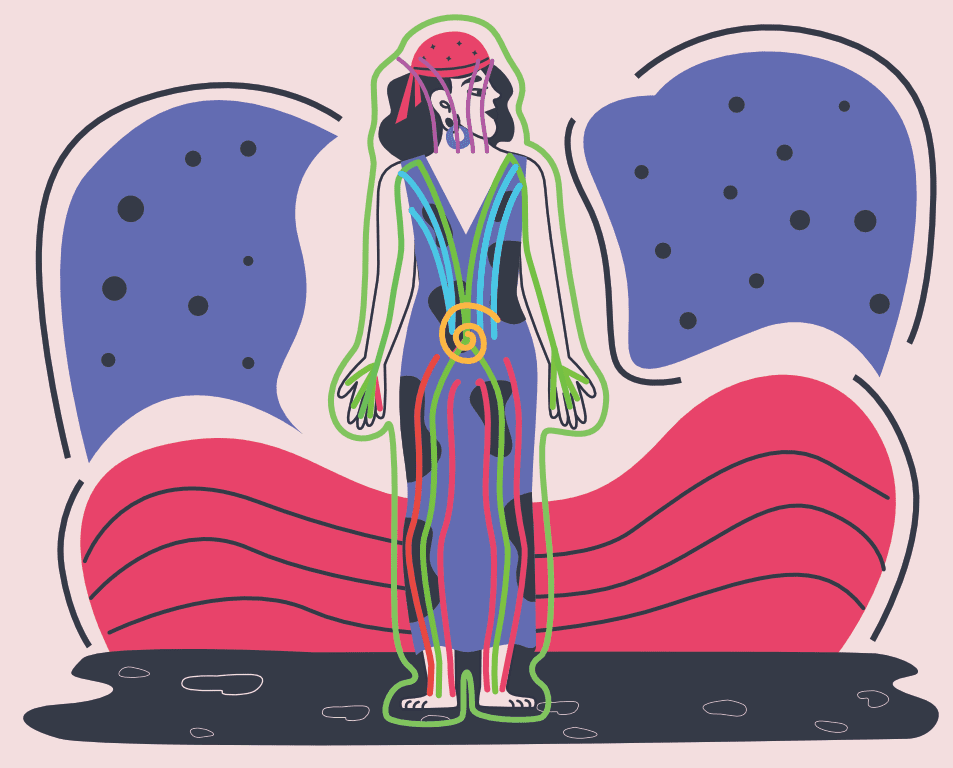
- Location in the body: Distributed throughout the body and around it; forms the aura
- Function: Master vayu that distributes and integrates the other vayus
- Physiological area: Regulation of nerves and veins; movement of our muscles; balancing energy that flows through the body
- Psychological area: Expansion of personality, personal growth
- Supporting asanas: Side bends, Extensions and Inversions
Yoga therapy for the individual vayus: Practical applications
Strengthen Prana Vayu: Asanas and Pranayama
Prana Vayu, often called the ruler of the breath, is like the captain of a ship sailing on the infinite ocean of life. It sits in the command center, our heart and lungs, and directs the movement of life energy in our body. At the same time, it serves as a kind of shield that protects our body and mind from negative influences by directing prana in a positive, healthy direction.
Asanas specifically designed to support Prana Vayu typically include postures that open our heart and expand our chest:
- The Cobra (Bhujangasana): This posture stretches the chest, promotes breathing, and thus supports the flow of prana.
- The Fish (Matsyasana): This posture opens the chest and throat, allowing for deeper breathing and enhanced intake of prana.
- The Dancer (Natarajasana): This powerful posture promotes heart opening and thus supports the flow of prana.
Combined with conscious and deep breathing (pranayama), these postures can offer an effective way to strengthen and balance Prana Vayu. In your practice, you could integrate breathing techniques such as complete yogic breathing or alternate nostril breathing (Nadi Shodhana).
Balance Apana Vayu: Cleansing and letting go
Apana Vayu ensures that everything we no longer need finds its way out, whether through breathing, sweat, digestion, or other natural elimination processes. Without a strong and balanced Apana Vayu, we could feel weak, overwhelmed, or sick, since unneeded substances and energies could stagnate in our body.
Among the asanas that support Apana Vayu, postures that apply pressure to the lower abdomen or open the pelvis take first place. Malasana and Baddha Konasana are excellent options to strengthen the energy of Apana Vayu and support the elimination process.
Pranayama techniques such as deep belly breathing and the Apana Vayu breathing technique can also help activate the flow of this energy. In the Apana Vayu breathing technique, the focus is on the exhalation, which is longer and deeper than the inhalation. This creates a cleansing and grounding effect that helps us let go and relax. A diet oriented towards natural, clean and easily digestible foods can also support Apana Vayu.
Activating Samana Vayu: Digestion and Integration
Samana Vayu, which can be translated as the "balancing wind", maintains our inner balance and harmony. It sits in the middle of our body, in the area of the navel, and its energy radiates from there in all directions. When Samana Vayu is balanced, we feel centered, grounded and nourished. An imbalanced Samana Vayu, on the other hand, can manifest itself in digestive problems as well as in feelings of restlessness and emotional imbalance.
Here are some key strategies to promote Samana Vayu:
- Twists: By rotating the torso, we help massage and stimulate the digestive organs. Asanas such as Ardha Matsyendrasana and Marichyasana are ways to kindle our inner digestive fire.
- Breath awareness: Practices such as complete yogic breathing or Kapalabhati can help activate and strengthen this Vayu.
- Core exercises: Asanas such as Navasana or Plank Pose, which engage the abdominal area, can help activate Samana Vayu and kindle the inner digestive fire.
Harmonizing Udana Vayu: Communication and Expression
Udana Vayu, the "upward moving wind", is active in the areas of the throat, head and lungs and plays a key role in the processes of speaking, singing, laughing and even yawning. A well-functioning Udana Vayu is like a crystal-clear mountain stream flowing joyfully and unobstructed, giving you clarity, expressive power and vibrant vitality.
Asanas and pranayama that strengthen Udana Vayu aim at improving communication and self-expression:
- Sarvangasana (Shoulder Stand): This asana works directly on the throat area and thus promotes the energy flow of Udana Vayu. It improves communication skills and increases mental clarity.
- Halasana (Plow Pose): Similar to Sarvangasana, this posture focuses on the throat area and helps strengthen Udana Vayu.
- Bhramari Pranayama (Bee Breath): The humming sound of this pranayama helps draw the energy flow upward, thereby harmonizing Udana Vayu.
- Ujjayi Pranayama (Victorious Breath): By focusing on the larynx, Ujjayi Pranayama activates and balances Udana Vayu.
Strengthening Vyana Vayu: Balance and Holistic Connection
Vyana Vayu, which circulates in all directions and allows us to coordinate movements, is the cosmic force that brings together and harmonizes all other Vayus. It is present everywhere in the body and ensures balanced circulation of energy, nutrients and information throughout the system. On the emotional level, Vyana Vayu is responsible for the free circulation of feelings and thoughts, which enables us to remain flexible and open to change.
Yoga therapy for Vyana Vayu aims to strengthen this energy and thus promote balance and smooth communication throughout the system:
- Moving asanas such as Sun Salutations (Surya Namaskar) or flowing sequences (Vinyasa Flow) promote blood circulation, flexibility and coordination. All of these are important aspects of Vyana Vayu.
- Pranayama techniques that connect breath with movement, such as Three-Part Breathing (Dirga Pranayama), can help harmonize Vyana Vayu.
- Mindfulness practices and meditation help regulate the flow of feelings and thoughts, thereby promoting a calm and clear mind.
- Visualization exercises that focus on expansion and connection can also be useful.
Integrating the Vayus into Daily Life: Conclusion and Outlook
Our magical journey through the world of the Vayus ends here, yet in reality it has only just begun. By knowing and understanding the Vayus. Prana, Apana, Samana, Udana and Vyana. We have the key to inner balance and harmony in our hands. They are our inner teachers, showing us in subtle ways how we can harmonize our body, our breath and our mind.
Whether you practice yoga asanas, meditate or go through your day, the Vayus are always there supporting you. They are the silent dance of energy within you, the currents of life that nourish you, cleanse you, balance you, express you and connect you.
The Vayus are subtle energy currents that permeate every facet of our being. Through yoga and specific practices, we can learn to sense, regulate and balance these energies, which helps us experience a deeper sense of connection, health and harmony. Remember: these ancient wisdoms are gifts waiting to be discovered and lived by you.
Namaste.
Note: Some of the links in this article may be affiliate links, which can bring us compensation at no cost to you if you decide to purchase something. These are products we have personally used and stand behind. This website is not intended as financial advice, but is for entertainment purposes only. You can read our partner disclosure in our privacy policy.
Frequently Asked Questions
- What are the 5 vayus in yoga?
- The 5 vayus are subtle energy streams that direct prana (life force) through our body. They are described in the Upanishads and are called prana vayu, apana vayu, samana vayu, udana vayu, and vyana vayu. Each vayu has a specific direction, a seat in the body, and physiological and psychological functions.
- How can I balance the vayus in my yoga practice?
- Through targeted asanas, pranayama techniques, and mindfulness practices, you can support and balance the individual vayus. For example, backbends promote prana vayu, forward folds and twists promote apana vayu, while inversions and backbends strengthen udana vayu. Flowing sequences like vinyasa flow are particularly well suited for vyana vayu.
- What happens when a vayu becomes imbalanced?
- An imbalanced vayu can manifest itself both physically and emotionally. A weakened prana vayu can cause fatigue and nervousness, an imbalanced apana vayu leads to sluggishness and the feeling of not being able to let go, while a disturbed samana vayu can cause digestive problems and emotional imbalance.
- What connection exists between the vayus and the breath?
- The breath is closely connected to the vayus: prana vayu is linked to the inhale and stands for activation and energization, while apana vayu is associated with the exhale and promotes elimination and letting go. Pranayama techniques such as nadi shodhana, kapalabhati, or ujjayi pranayama are therefore valuable tools for harmonizing the vayus.