Asanaverse

Winding Down and Sleep

Evening Yoga for Winding Down and Sleeping Better

Being tired and being able to sleep turn out to be two different things. The tiredness arrives in the afternoon and the alertness arrives at eleven, and no amount of being told to relax has ever made that go the other way around.

This guide is about the practical version of winding down. What an evening practice should contain and in what order, why the last ten minutes matter more than the first ten, what the research found and where it stops, and which sleep problems this is not the answer to.

Who this guide is for

Signs this guide was written for you

This is for the gap between being tired and being able to sleep. Nothing is diagnosed, nothing is dramatic, and it has been going on for a while.

  • ·You are tired during the day and awake at bedtime.
  • ·Falling asleep takes longer than it used to, or the sleep you get does not feel like enough.
  • ·The evening ends with a screen because there is nothing else in the slot.
  • ·Nobody has suggested you might have sleep apnoea, and you are not exhausted despite plenty of hours in bed.
  • ·You can find twenty minutes most evenings.

What causes Winding Down and Sleep

What makes an evening practice work is not what is in it. It is that it happens at the same time every night.

Winding down is a learned response rather than a mood. If the same sequence of things happens in the same order at roughly the same time, your body starts anticipating what comes next, and by the second week the first pose is already doing some of the work before you get to the rest.

Which is why the design decisions here are mostly about order and repetition rather than about the poses. Anything stimulating goes at the start of the evening. The last ten minutes ask for nothing at all. And a ten minute version exists so that the slot survives a bad week, because a ritual that only happens on good days is not a ritual.

  • ·In the largest trial, 410 people, four weeks: sleep quality improved more than in the control group, with time awake after falling asleep and sleep efficiency confirmed by a wrist monitor.
  • ·Use of sleep medication fell 21 percent a week in the yoga group and rose 5 percent a week in the control group.
  • ·Across 16 trials, perceived sleep quality improved with a moderate effect size. On insomnia severity specifically, pooled across three trials, there was no significant effect.
  • ·A daily 45 minute evening practice put 65 percent of people with sleep onset problems into remission after eight weeks, and over 80 percent at six months.
  • ·The trials that reported on safety found no serious adverse events.

Safety

When to practise and when to get it looked at

This is a wind down practice, and three things decide whether it works. There is also one sleep problem it is not the answer to.

How to practise so it works

  • ·Same time every evening, roughly an hour before you want to be asleep. The repetition is the mechanism, not the poses.
  • ·Anything stimulating goes at the start. Twists, back bends and anything fast or forced belong in the first third of the session, never in the last.
  • ·Use props everywhere and hold the restorative poses longer than feels necessary. It takes about ninety seconds to stop fidgeting and start resting.
  • ·Heavy snoring, pauses in breathing at night, or exhaustion despite plenty of hours in bed point at sleep apnoea. That is a mechanical problem with the airway and it belongs with a doctor rather than a practice.
  • ·Falling asleep during the last relaxation is a good outcome. Get into bed.

For yoga teachers

Teaching a class for Winding Down and Sleep

An evening class is defined by its order more than its content. Anything with stimulation in it, twists, back bends, anything that raises the heart rate, belongs in the first third. The last third should ask for nothing at all. Getting that sequence right does more for the room than any individual pose you choose.

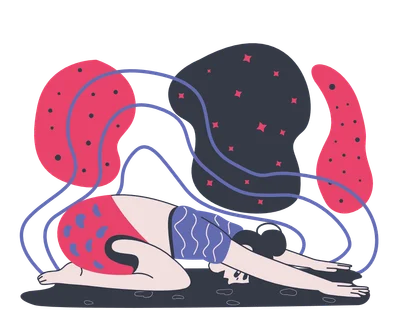
Give the restorative poses real time. Three minutes in Child’s Pose is a different experience from one minute, because it takes about ninety seconds for most people to stop fidgeting and start resting. If that means cutting two poses to give three of them proper length, cut them.

Have props out before people arrive, and use them everywhere. A supported forward bend with the head resting on a bolster is a completely different pose from an unsupported one, and it is the one that belongs in this class. Nobody should have to get up mid session to fetch a block.

Two things to leave out and one to say once:

  • ·Leave out Kapalabhati, Bhastrika and anything else fast or forced. None of the three documented evening protocols in this research use them, and the reason is obvious the moment you try one at nine in the evening.
  • ·Leave out anything requiring concentration in the last third. Balance poses, complicated transitions and detailed alignment cues all keep people alert.
  • ·Say once that falling asleep in the final relaxation is a good outcome rather than an embarrassment. It takes the edge off the room.

Build your own

Put together your own class for Winding Down and Sleep

The sequence builder gives you all 108 asanas and lets you arrange them yourself. While you build, it watches the shape of the class: whether the intensity rises and falls the way a practice should, whether every strong pose gets its counterpose, and whether the order makes anatomical sense.

Save what you build, come back to it, and teach it. It is the fastest way to turn what you just read into a class of your own.

The research

What the studies actually found

The largest trial in this field ran for exactly four weeks with 410 people, and improved sleep quality enough to show up on a wrist monitor as well as in the questionnaires, while use of sleep medication fell in the yoga group and rose in the control group. A meta-analysis of 19 trials with 1,832 people puts a moderate effect size on perceived sleep quality across the literature. And a trial in people who take a long time to fall asleep found 65 percent in remission after eight weeks of daily evening practice, rising to over 80 percent six months later.

Journal of Clinical Oncology2013

Multicenter, randomized controlled trial of yoga for sleep quality among cancer survivors

410 people with disturbed sleep, four weeks, yoga against usual care. Sleep quality improved significantly more than in the control group, with time awake after falling asleep and sleep efficiency both confirmed by a wrist monitor. Use of sleep medication fell 21 percent a week in the yoga group and rose 5 percent a week in the control group. Our four weeks come from here.

Read the source →
BMC Psychiatry2020

The effect of yoga on sleep quality and insomnia in women with sleep problems: a systematic review and meta-analysis

19 randomised trials with 1,832 people. Perceived sleep quality improved with a moderate effect size across 16 trials. On insomnia severity specifically, pooled across three trials, there was no significant effect. This is the paper that draws the line our program respects.

Read the source →
Journal of Clinical Sleep Medicine2021

Treatment of chronic primary sleep onset insomnia with Kundalini yoga: a randomized controlled trial

40 adults who took more than thirty minutes to fall asleep, a 45 minute evening practice every day for eight weeks against sleep hygiene advice. Time to fall asleep, total sleep time and sleep efficiency all improved more with yoga, 65 percent were in remission at the end, and at six months that had risen to over 80 percent. This is why our program is a daily one.

Read the source →
National Medical Journal of India2021

Yoga nidra practice shows improvement in sleep in patients with chronic insomnia: a randomized controlled trial

Guided deep relaxation against cognitive behavioural therapy for insomnia, with sleep laboratory measurement. The relaxation group improved on deep sleep and sleep efficiency, and salivary cortisol fell significantly. The rare study in this field that found something on a physiological measure, and the reason our second phase is built around a body scan.

Read the source →
BMC Psychiatry2022

Tailored individual Yoga practice improves sleep quality, fatigue, anxiety, and depression in chronic insomnia disorder

Fourteen weeks of individually tailored practice. Sleep quality improved from 14 to 8, anxiety, depression and fatigue all improved, and nightly wakings measured by wrist monitor fell significantly. The sleep laboratory showed no change in sleep stages. Both halves of that are worth knowing, and they are why we describe this program in terms of how rested you feel.

Read the source →

Frequently Asked Questions

Does yoga help you sleep better?

The kind you feel, yes. Across 16 randomised trials, perceived sleep quality improved with a moderate effect size, and in the largest single trial some of the improvement showed up on a wrist monitor as well as in the questionnaires.

What should an evening practice actually contain?

Gentle movement early, supported forward bends in the middle, and ten minutes of doing nothing at the end. The order does more than the poses. Anything stimulating, including twists and back bends, belongs at the start rather than near bedtime.

How long before it makes a difference?

The trials ran between four and eight weeks. Four weeks is enough for sleep quality to change measurably. Doing it most evenings matters more than the length of any individual session.

Is this a treatment for insomnia?

No. Sleep quality and insomnia severity are different measures, and the research separates cleanly. Sleep quality improves reliably. Insomnia severity, pooled across trials, does not. If you have a diagnosis, this sits alongside your treatment.

Does it change sleep physically?

Sometimes, and the evidence is genuinely mixed. One study with a sleep laboratory found more deep sleep and lower cortisol. Another found the sleep stages unchanged even though people slept better by every other measure. What reliably changes is how rested you feel.

Can I do this in bed?

The last part, yes, and by week four that is the point. The body scan and the long slow out breath both work lying in the dark, and those are the two things worth being able to use without a mat.

Where to next

All programs

See the other programs

Every program here was built around one complaint and around the trials that studied it. Back, neck, knees, hips, sleep and stress, each one running for as long as the research says it takes.

Browse programs →