Chronic Neck and Upper Back Tension
Yoga for a Neck and Upper Back That Never Fully Let Go
Neck tension that keeps coming back is a different problem from a neck you slept on badly. There is usually nothing to point at on a scan, the advice was to move more without much detail, and by now you have a chair, a screen and a habit that all pull in the same direction.
This guide is the reasoning behind the practice. Which movements a stiff upper back actually needs, why the work happens at the shoulder blades rather than at the neck, what the research supports and what it does not, and when tension is a signal that belongs with a doctor instead.
It is worst by late afternoon and mostly gone by morning, and it has been doing that for months. Turning your head to look behind you has quietly become a movement of the whole body.
Before you start
See a doctor first if any of this applies
If none of that applies, practise like this
Open the front of the shoulders

Gomukhasana
Cow Face arms takes one shoulder into external rotation and the other into internal rotation at the same time. That pair of movements is exactly what a desk removes, and it appears in almost every Iyengar neck protocol.

Anahatasana
The strongest thoracic extension available with no load on the neck at all. The hips stay over the knees, the chest melts, and the front of the shoulders lengthens without anything having to hold you up.

Urdhva Hastasana
Getting the arms overhead without arching the lower back or shrugging is deceptively hard for a stiff upper back. It is also the position most days never ask for.

Setu Bandha Sarvangasana
Bridge with the shoulders rolled underneath opens the chest from the opposite direction, under a little load. It is the counter to every hour spent reaching forward.

Ustrasana
The largest chest opener in the program, and the one that needs the most care. The back of the neck stays long and the head is supported, never thrown back.
Move the upper back, not the neck
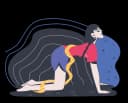
Bitilasana
Cow is extension that belongs to the ribcage. Doing it without cranking the head back is the whole lesson of this guide in one pose.

Parivrtta Sukhasana
A seated twist where the ribs turn first and the head arrives last. That order is precisely what a stiff neck has stopped using, and it is retrainable.
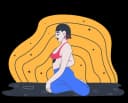
Bharadvajasana 1
Bharadvaja's Twist adds the shoulder to the rotation with the pelvis quiet. It shows up in nearly every documented neck protocol, and this is why.

Ardha Matsyendrasana
A deeper seated twist for later in the program, with the arm pressing against the leg. The pressure is what lets the mid back turn further than it manages on its own.
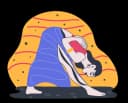
Parshvottanasana
Pyramid Pose lengthens the whole back of the body and, with the hands clasped behind, opens the chest while the head hangs free. Its revolved version is the strongest rotation in the plan.
Build something that holds you up

Tadasana
Standing well is not a pose, it is the thing every other standing pose is a variation of. It is also the cheapest place to notice where your head sits over your ribs.
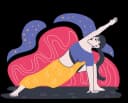
Utthita Parsvakonasana
Extended Side Angle turns the ribcage open while the top arm reaches. The rotation under load is the useful part, not the side bend.
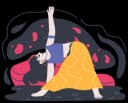
Trikonasana
Triangle loads the top arm straight up for the length of the hold. Endurance in that position is what stops the shoulders creeping up by mid afternoon.

Vrkasana
Tree Pose asks the trunk to stabilise on one leg with the arms up. Balance and shoulder blade control turn out to be the same skill seen from two sides.

Dandasana
Staff Pose looks like sitting and is not. Holding the spine upright with the legs straight is a plain endurance test for exactly the muscles that give up first.
Let the shoulders come down
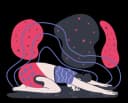
Balasana
Child's Pose with the arms alongside the body lets the shoulders roll forward and rest. They almost never do that in a normal day.
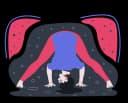
Prasarita Padottanasana
A wide legged fold with the hands clasped behind lets gravity do the shoulder opening, so the neck can stay completely passive while it happens.

Viparita Karani
Legs up the wall asks for nothing at all. For a shoulder girdle that has been working all day, an inversion with no effort in it is its own kind of useful.

Supta Virasana
Reclining Hero opens the front of the body over support rather than through effort. Props are not a lesser version here, they are how the pose works.
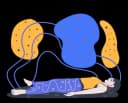
Savasana
With a folded towel under the head and a loose jaw. The jaw is part of a tight neck more often than people expect, and it lets go last.
Ready to practice
Chronic Neck and Upper Back Tension sequences you can follow today
Ten Minutes for a Tight Neck
Go to sequence →
Fifteen Minutes of Shoulder Strength
Go to sequence →
Fifteen Minutes to Keep Your Neck Free
Go to sequence →
Gentle Yoga for Neck and Shoulder Tension
Go to sequence →
Yoga for Shoulder and Upper Back Strength
Go to sequence →
Standing Yoga for a Neck That Holds Up
Go to sequence →Teaching a Chronic Neck and Upper Back Tension Class
Two things change how a class lands for someone whose neck has been tight for years. The first is the order of a twist. Cue the ribcage to turn and let the head arrive last, and say it every single time, because the habit of leading with the chin is deep and it is the habit that keeps the neck busy. The second is that the strengthening work is the point rather than the cool down. The strongest evidence in chronic neck pain is for resistance and motor control training, so arms at shoulder height held long enough to be work, overhead positions without shrugging, and Warrior I late in a class when the shoulder girdle is already tired. Offer a strap for Cow Face arms before anyone has to ask, and never cue the head back in a backbend.
Open the Sequence Builder →Frequently Asked Questions
Does yoga actually help chronic neck pain?
Two nine week trials found less pain, less disability and better cervical range of motion against both self-care exercise and a home exercise programme. A meta-analysis of ten trials points the same way while noting that the interventions varied a lot. Against other good exercise, yoga performs comparably rather than better. The full list of studies is at the bottom of this page.
Why does the practice barely touch my neck?
Because that is how the interventions that worked were built. They go through the ribcage, the shoulder blades and the way the spine stacks under the head. Direct neck stretching feels productive and is not what shifted the outcomes.
Which poses should I avoid with neck tension?
Anything that puts weight through your head, so no headstand and no shoulder stand while this is an active problem. Beyond that it is less about which pose and more about how: never let the head drop back in a backbend, and never lead a twist with the chin.
Should I stretch or strengthen?
Both, and most people arrive doing only the first. A shoulder girdle that only ever gets stretched stays exactly as strong as it was, and by late afternoon it hands the work back to your neck. That is the pattern this guide is built to interrupt.
My neck is sore the day after. Did I overdo it?
Soreness between the shoulder blades after a session that asked more is expected and settles in a day or two. Temporary worsening was the most common side effect in the trials. Numbness, tingling or weakness in an arm or hand is a different thing entirely and belongs with a doctor.
Can I practise at my desk?
Some of it. Sitting on the front edge of a chair with both feet down, you can do the side bend, the seated twist and all of the arm work. Cat and Cow and Heart-Melting Pose need the floor. Doing the seated half twice a day beats doing nothing until the weekend.
Related Practices
The research
What the studies actually found
These are the studies the guide and the 9 week program are built on, including the ones that found less than you might hope. The short version: for chronic nonspecific neck pain, yoga has two clean nine week trials behind it and a meta-analysis that points the same way, on a small and varied evidence base. Against other good exercise it performs comparably rather than better. That is a real finding and worth more than a bigger claim.