Asanaverse

Focus and Screen Time

Yoga for Focus and Attention With High Screen Time

There is a particular tiredness that comes from a day of screens. It is not physical, sleep does not fix it, and the thing most people reach for in the gaps is another screen, which is why it does not go anywhere.

This guide is about the part of that which is actually trainable. Which two exercises train attention and why they give immediate feedback, what happens to concentration in the research, what does not change no matter what anyone promises, and how to break up a day of screens in a way that counts.

Who this guide is for

Signs this guide was written for you

This is for the version where concentrating has quietly got harder. Nothing is diagnosed, and most of your day is spent switching between things on a screen.

  • ·Most of your working day is spent switching between screens, tabs and apps.
  • ·Reading something long takes several attempts in a way it did not used to.
  • ·The tiredness at the end of the day is mental rather than physical.
  • ·You do not have an ADHD diagnosis, or you have one and are already being treated.
  • ·You want to concentrate better rather than to use your phone less.

What causes Focus and Screen Time

Attention is trainable. Screen habits are a different project, and mixing them up is why most attempts at this fail.

The trial that measured both put the difference beyond doubt. A mindfulness and self monitoring programme cut how distracted people felt by their phones by a large margin, and improved their stress and anxiety along with it. What it did not change was habitual checking, phone anxiety, or how many minutes a day they actually used social media.

So this program does the half that works. It trains attention directly, with two exercises that give you feedback within seconds, and it gives you a structured way to break up screen time. It does not claim to change what you do with your phone, because nothing here would.

  • ·Across 15 randomised trials, multi week yoga programmes improved cognition, with attention and processing speed among the clearest effects.
  • ·The effect of a single session, measured immediately afterwards, was larger than the effect of a whole programme. Attention responds fast.
  • ·In 2,000 adolescents, a simple weekly protocol improved concentration test scores by 18 percent against 7 percent in a health education group.
  • ·Four weeks of breath counting, three times a week, improved sustained attention and working memory against an active control group.
  • ·The one trial that measured actual phone use found the feeling of distraction much improved and the behaviour itself unchanged.

Safety

When to practise and when to get it looked at

Nothing here is physically demanding. The things worth being clear about are what this program does and what it does not.

How to practise so it works

  • ·This does not reduce screen time. The trial that measured it found the feeling of distraction much improved and habits, phone anxiety and daily usage unchanged.
  • ·Losing count is the exercise. Going back to one without commentary is the instruction, and most people get to four the first time.
  • ·Do the balance work after the legs are tired, not before. Fresh legs make it a physical exercise rather than an attention one.
  • ·Keep a wall or a desk in reach for every balance pose. Falling over is the one physical risk here and it is easy to remove.
  • ·ADHD is a clinical condition with its own treatments, and none of this research was done in people who have it. This can sit alongside treatment but not in place of it.

The asanas

The yoga poses that matter for Focus and Screen Time

Grouped by what each one asks the body to do. Tap any pose to see how it is done, what it works on and who should leave it out.

For yoga teachers

Teaching a class for Focus and Screen Time

A focus class is a different job from a relaxation class, and the difference is that half of it has to be demanding. Balance poses are the useful tool because they give feedback within seconds: the moment attention moves, the pose tells them. Cue that explicitly, as information rather than as failure, and the room stops treating wobbling as embarrassing.

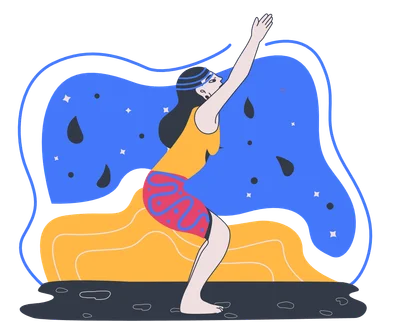
Put the effort before the balance work rather than after. Standing on one leg on fresh legs is a physical exercise. Standing on one leg after two rounds of Chair Pose is an attention exercise, and that is the one you are trying to teach.

Teach breath counting as a practice of returning rather than of concentrating. Count out breaths to ten, start again at one whenever you lose the count, and say clearly that most people get to four the first time. Framing the return as the exercise is the whole difference between this being useful and being another thing people feel bad at.

Two things worth being straight about:

  • ·This does not reduce screen time. The trial that measured it found the sense of distraction much improved and the actual usage unchanged. Saying so protects you from a promise the practice cannot keep.
  • ·Keep the ending short and end standing when the class is midday. A long Savasana at one in the afternoon sends people back to work asleep, which is not the outcome anyone came for.

Hand made yoga sequences for Focus and Screen Time

Full sequences you can teach or practise today
Our yoga teachers built each of these around the same trials the guide above is based on. The order of the poses, the length of the holds and the props are not a stylistic choice. They follow what the studied programmes actually did.

If you teach, take one of them straight into your class. Every pose comes with its timing, the cue that matters and the reason it sits where it sits.

Build your own

Put together your own class for Focus and Screen Time

The sequence builder gives you all 108 asanas and lets you arrange them yourself. While you build, it watches the shape of the class: whether the intensity rises and falls the way a practice should, whether every strong pose gets its counterpose, and whether the order makes anatomical sense.

Save what you build, come back to it, and teach it. It is the fastest way to turn what you just read into a class of your own.

The research

What the studies actually found

This is a smaller evidence base than most of our guides, and it points in a clear direction. Across 15 randomised trials, multi week yoga improved cognition, with attention among the clearest effects, and single sessions produced larger effects than whole programmes did. A trial of 2,000 adolescents found concentration test scores improving 18 percent against 7 percent in a control group. And a four week trial of breath counting improved sustained attention against an active control. The fourth study here is the one that keeps the promises honest: it measured actual phone use and found it unchanged.

Psychosomatic Medicine2015

Yoga and Cognition: A Meta-Analysis of Chronic and Acute Effects

15 randomised trials of multi week programmes plus seven studies of single sessions. Attention, processing speed and executive function all improved. The striking part is that single sessions produced larger effects than the multi week programmes did, which is why this program is four weeks rather than twelve.

Read the source →
PubMed Central2023

The impact of yoga on stress, metabolic parameters, and cognition of Indian adolescents: a cluster randomised trial

2,000 adolescents across 24 schools. Weekly 45 minute sessions of breathing, simple postures, a short meditation and relaxation. Concentration test scores improved 18 percent against 7 percent in the health education group, with stress scores and salivary cortisol falling too. The simplest documented protocol in this field.

Read the source →
Frontiers in Aging2024

Four weeks of meditation training improves sustained attention in community-dwelling older adults

Four weeks, three 20 minute sessions a week of focused breath counting, against an active control group listening to music. Sustained attention and working memory both improved more in the meditation group. A small pilot, and the only trial with exactly the duration of this program, which is why our sessions open with counting.

Read the source →
PubMed Central2020

Mind over Matter: Testing the Efficacy of an Online Randomized Controlled Trial to Reduce Distraction from Smartphone Use

143 students over ten days. The feeling of being distracted by their phones fell substantially, along with stress and anxiety. Habitual checking, phone anxiety and actual daily usage did not change. This is the study that decides what this program is allowed to promise.

Read the source →

Frequently Asked Questions

Can yoga improve concentration?

Modestly and measurably. Across 15 randomised trials, multi week programmes improved cognition with attention and processing speed among the clearest effects, and in a trial of 2,000 adolescents a simple weekly protocol improved concentration test scores by 18 percent against 7 percent in a control group.

How quickly does it work?

Faster than most things in this field. In the pooled research, the effect of one session measured immediately afterwards was larger than the effect of a whole programme, which is unusual and is why a four week program is defensible here.

Will it help me use my phone less?

No. The one trial that measured actual behaviour found the feeling of being distracted dropped a lot while habitual checking, phone anxiety and daily usage all stayed the same. Changing how distracted you feel and changing what you do are separate problems.

What actually trains attention in a yoga practice?

Two things. Balance poses, because they tell you within seconds that your mind moved. And breath counting, because starting again at one every time you lose the count is a repetition of exactly the skill you want.

Is this suitable for ADHD?

It is not a treatment for it. All the research here comes from people without a diagnosis, and ADHD has established treatments of its own. As a focus practice alongside proper treatment it is reasonable, and as a replacement for any part of it, it is not.

What is the best length for a screen break?

Three minutes is enough if you get up, move and look at something further away than your desk. What matters is that it is a break from directing your attention, which is why checking a different screen does not count.

Where to next

All programs

See the other programs

Every program here was built around one complaint and around the trials that studied it. Back, neck, knees, hips, sleep and stress, each one running for as long as the research says it takes.

Browse programs →