Asanaverse

Anxiety and Worry

Yoga for Persistent Anxiety and Excessive Worry

The tiring thing about persistent worry is not any individual worry. It is that it runs in the background, so a good afternoon has something underneath it and a bad one has nowhere to go.

This guide is about what yoga can and cannot do here, and both halves are worth knowing. Which breathing techniques belong in this and which are best left out, why the practice ends up short rather than long, what the largest trial found, and where therapy is simply the better answer.

Who this guide is for

Signs this guide was written for you

This is for worrying that has become a setting rather than a reaction. It has been months, it does not need a reason, and it is exhausting in a way that is hard to explain.

  • ·The worrying has been going on for months and does not need a specific trigger.
  • ·You notice it in your body as much as your head: shoulders, jaw, sleep, an inability to settle.
  • ·You are not in a crisis and you have no thoughts of harming yourself.
  • ·If you have a diagnosis, you already have care in place and want something alongside it.
  • ·You can find thirty minutes three times a week.

What causes Anxiety and Worry

The aim is not a calm session. It is two or three things you can do while it is actually happening.

A thirty minute practice that leaves you feeling better afterwards is pleasant and it is not the point. The worrying does not happen on a mat. It happens at eleven at night, in a car park, halfway through a meeting, and what decides whether a practice is useful is whether any part of it is available in those moments.

So everything here is built backwards from that. Two breathing techniques, practised at the start of every session until they need no instructions. A five minute sequence that works on any floor. And a long programme whose main job is to make those short things automatic.

  • ·Across eight trials with 319 people, yoga reduced anxiety against no treatment, with a larger effect against active comparison conditions.
  • ·In 226 adults with generalised anxiety disorder, 54.2 percent of the yoga group were much improved against 33.0 percent on stress education.
  • ·In that same trial cognitive behavioural therapy reached 70.8 percent and kept its advantage at six months, while the yoga advantage faded. Therapy comes first.
  • ·In older adults with persistent worry, gentle yoga matched structured telephone therapy on depression, generalised anxiety and fatigue.
  • ·Yoga was not associated with any increased risk of injury across the pooled trials.

Safety

When to practise and when to get it looked at

Four things make this practice useful rather than counterproductive, and there is one line where a program is the wrong tool.

How to practise so it works

  • ·Slow breathing only. No fast or forced techniques: rapid breathing produces sensations that can resemble the beginning of a panic response, and nothing is lost by leaving those out.
  • ·Practise the breathing when nothing is wrong. A technique you only ever reach for in a crisis has not been learned yet.
  • ·In any pose, the breath is the gauge. If it goes short and fast, come out. Coming out is the correct response and not a failure of the pose.
  • ·Eyes open is always an option. Long periods with the eyes closed are not restful for everyone, and a soft gaze at the floor works just as well.
  • ·A crisis, thoughts of harming yourself, or untreated trauma need a person rather than a practice. Therapy is the first line here and this program says so.

For yoga teachers

Teaching a class for Anxiety and Worry

The most useful thing you can give a room full of anxious people is a way to leave. Say at the start that anyone can sit down, lie down, leave the room or stop at any point, without explaining themselves and without it being a thing. That single sentence does more for a nervous system than any pose in the sequence.

Be careful with the breathing techniques. Fast forced practices such as Bhastrika and Kapalabhati appear in some published protocols, but rapid breathing produces sensations that resemble the beginning of a panic response, and for some people in the room that resemblance is enough. Alternate nostril breathing, humming and a long exhale do the job without that risk.

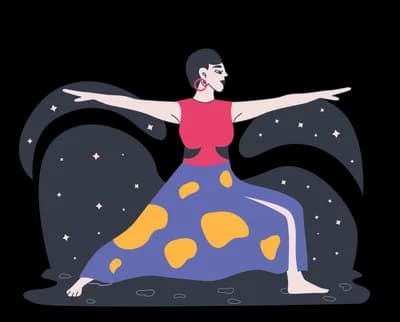
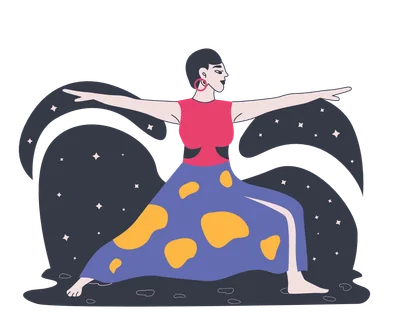
Teach standing poses as a chance to notice rather than a chance to achieve. The useful moment in Warrior II for someone with anxiety is realising their breathing has gone short, coming out, and finding that nothing happened. Cue that explicitly, and cue coming out as the correct response rather than as giving up.

Two more things worth saying once:

  • ·Long closed eyes are not restful for everyone. Offer a soft gaze at the floor as an equal option in every seated and lying pose, not as a modification for people who ask.
  • ·Be clear that this is not therapy. In the largest trial, cognitive behavioural therapy outperformed yoga and held that advantage six months later. Saying so builds trust and puts the class in the right place in someone else’s week.

Build your own

Put together your own class for Anxiety and Worry

The sequence builder gives you all 108 asanas and lets you arrange them yourself. While you build, it watches the shape of the class: whether the intensity rises and falls the way a practice should, whether every strong pose gets its counterpose, and whether the order makes anatomical sense.

Save what you build, come back to it, and teach it. It is the fastest way to turn what you just read into a class of your own.

The research

What the studies actually found

This is a field where the honest picture is also the more useful one. Across eight trials with 319 people, yoga reduced anxiety against no treatment. In the largest and most rigorous trial, 226 adults with generalised anxiety disorder, yoga clearly beat the control condition, and cognitive behavioural therapy clearly beat yoga and kept its advantage six months later. And in older adults with persistent worry rather than a formal disorder, gentle yoga matched structured telephone therapy on depression, anxiety and fatigue. Which is to say: real, worth doing, and second to therapy where therapy is available.

Depression and Anxiety2018

Yoga for anxiety: A systematic review and meta-analysis of randomized controlled trials

Eight randomised trials with 319 people. Yoga reduced anxiety against no treatment, with a larger effect against active comparison conditions, and mood improved alongside. No association with increased injury risk. The best summary of the general case.

Read the source →
JAMA Psychiatry2021

Efficacy of Yoga vs Cognitive Behavioral Therapy vs Stress Education for the Treatment of Generalized Anxiety Disorder

226 adults with generalised anxiety disorder over twelve weeks, with blinded assessors. 54.2 percent of the yoga group were much or very much improved against 33.0 percent on stress education. Cognitive behavioural therapy reached 70.8 percent and kept its advantage at six months while the yoga advantage faded. Both halves of that shape our program.

Read the source →
PubMed Central2022

A Randomized Preference Trial Comparing Cognitive-Behavioral Therapy and Yoga for the Treatment of Late-Life Worry

Older adults with high levels of worry, randomised to a gentle Hatha programme or structured telephone cognitive behavioural therapy. Both produced clinically meaningful improvements in depression, generalised anxiety and fatigue, with no significant difference between them on those outcomes. For worry rather than a formal disorder, that is a strong result.

Read the source →
PubMed Central2024

Effect of Integrated Yoga as an Adjuvant to Standard Care for Panic Disorder

64 people over twelve weeks, added to standard care. Anxiety scores and quality of life both improved substantially more than in the control group. Its main value to us is that it names every pose and breathing technique it used, which is where several of the choices in this guide come from.

Read the source →

Frequently Asked Questions

Does yoga help with anxiety?

Yes, and the evidence is reasonable. Across eight trials with 319 people, yoga reduced anxiety against no treatment, and in the largest trial of people with generalised anxiety disorder, 54.2 percent of the yoga group were much improved against 33 percent on the control condition.

Is it as good as therapy?

No, and the trial that tested it directly makes that clear. Cognitive behavioural therapy reached 70.8 percent much improved against yoga’s 54.2 percent, and the therapy advantage was still there at six months while the yoga advantage had faded. Yoga is a good addition, not a substitute.

Which breathing exercises help with anxiety?

The slow ones. Alternate nostril breathing, humming bee breath and anything with a long exhale. Fast forced techniques are best avoided, because rapid breathing produces sensations that can resemble the start of a panic response.

What should I do when I am anxious right now?

Something short that you have practised when you were not anxious. Five minutes of humming breath and a couple of simple shapes is far more useful than a thirty minute sequence you cannot face. That is exactly what the five minute session in this program is for.

How long does it take to work?

The trials ran ten to twelve weeks. What usually shifts first is how long an episode lasts rather than whether it starts, and that change is easy to miss unless you are looking for it.

When should I not be doing this on my own?

If you are in a crisis, if you have any thoughts of harming yourself, if you have a severe or untreated panic disorder, or if you are dealing with untreated trauma where body work itself can be triggering. Those need a person, and asking for one is the right first step.

Where to next

All programs

See the other programs

Every program here was built around one complaint and around the trials that studied it. Back, neck, knees, hips, sleep and stress, each one running for as long as the research says it takes.

Browse programs →