How Do You Set Up an Altar? Instructions & Symbolism
How Do You Set Up an Altar? Instructions & Symbolism
Expert verified by Mamta Rana
The Vedic tradition is one of the oldest spiritual systems in the world and continues to influence areas such as philosophy, architecture and ritual practice to this day. In rituals, ceremonies and even in yoga, the altar is a recurring motif: a space that represents the connection between humans, nature and the transcendent, both in material and symbolic terms. But how do you set up an altar? What belongs on it? And what does a daily altar ritual look like? This article examines the multilayered concept of the Vedic altar and shows how ancient knowledge can be brought into the present day.
Here you will learn:
- Historical and ritual concepts: what is an altar and what symbolism lies behind it?
- The structure of an altar, the meaning of the five elements and the cardinal directions, as well as the selection of ritual objects.
- The course of traditional puja rituals for creating a sacred space in everyday life.
Why we chant om after a yoga class
The altar is not merely an architectural element. It is the expression of a deeply rooted spiritual and cosmological idea that emerged in the earliest times of the Indian subcontinent.
1.1 Origins of the altar in the Vedic traditionAlready in the oldest Vedic hymns, such as the Rigveda, we find early references to the use of altars as central sites of sacrificial acts. These altars, or "Vedīs", served not only as physical platforms on which offerings were made, but also symbolised the primordial ground of cosmic order.
The Vedic idea of the altar is closely linked to the concept of cosmic sacrifice, as addressed for example in the Puruṣa Sūkta of the Rigveda. Here the universe is understood as a gigantic, redemptive act of sacrifice in which every element, from human beings to nature, has its place and its meaning. This early understanding underscores the idea that the altar functions as a microcosm and carries within itself the totality of the universe.
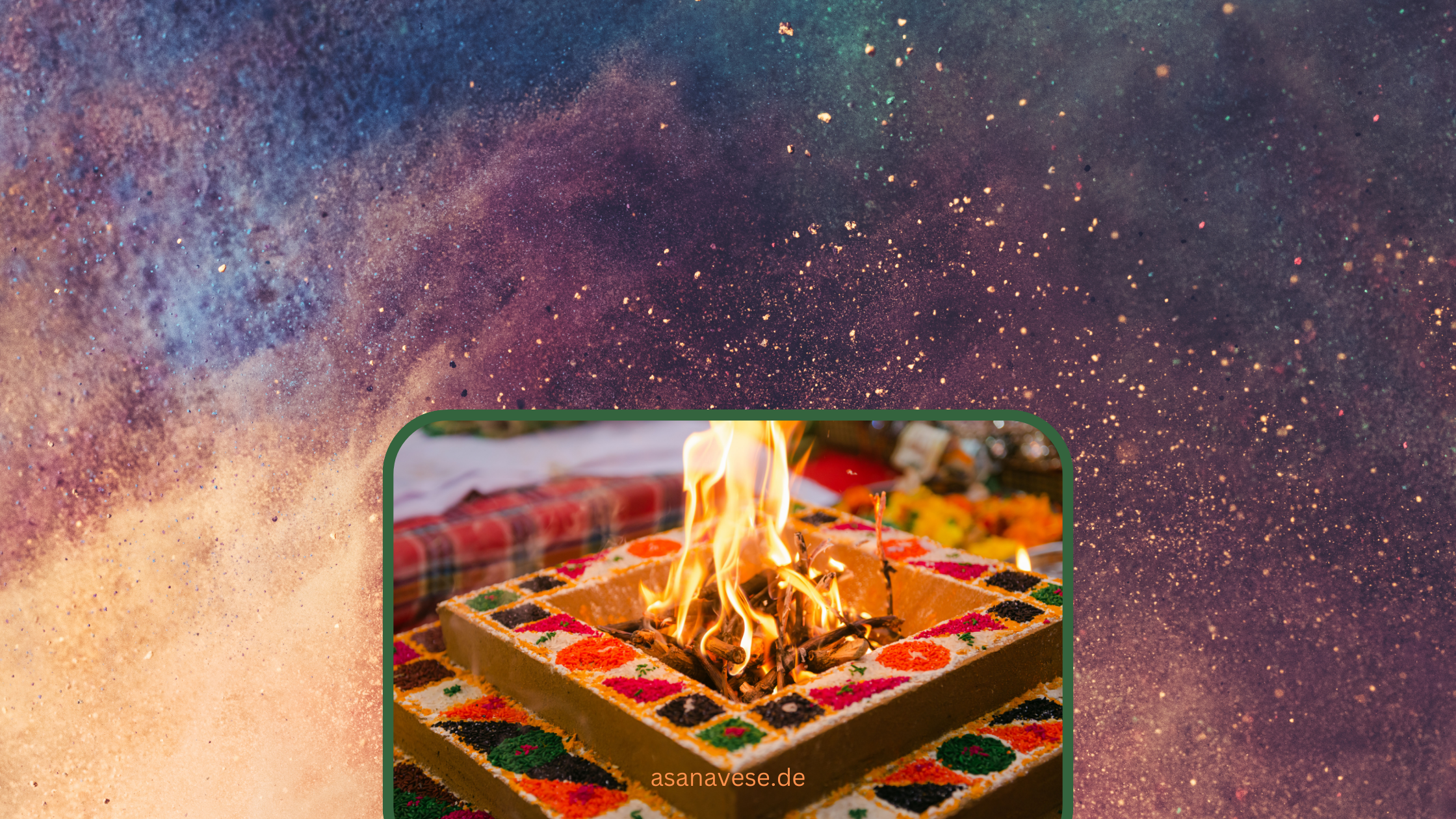
Over the course of the Vedic period, altar practice undergoes a remarkable refinement and differentiation. While the early Vedas offer a rather symbolic and narrative approach to the altar, the later Brahmanas, in particular the Śatapatha Brāhmaṇa, provide precise instructions for the construction and performance of sacrificial ceremonies.
In these texts, the altar is presented as a place where physical and metaphysical elements merge with one another. It becomes a space that, through the exact arrangement of materials, geometric shapes and ritual actions, reflects the order of the cosmos.
The Sulba Sutras, regarded as mathematical and ritual handbooks, complement this picture by providing exact construction rules. The measurement systems and geometric principles recorded in these texts attest to a deep understanding of natural laws and the idea that the material world is connected to the spiritual through mathematical precision and harmonious proportions.
This development shows how, out of an initial, perhaps intuitive, form of altar construction, a highly complex system grows, in which every aspect, from orientation to the choice of materials, carries a specific symbolic meaning.

Manusmriti: The Laws of Manu
1.3 Cross-cultural comparisons and ritual concepts in other culturesWhile the Vedic altar appears unique in its conception and execution, parallels can also be found in other ancient cultures, reflecting the universal human urge to enable contact with the divine through ritual spaces.
For instance, the ancient cultures of Mesopotamia and Egypt used altars as central sites for sacrificial acts, in order to appease the gods and renew the order of the cosmos. In Mesopotamia, altars were often erected within temple complexes to stabilize the relationship between humans and the forces of nature, which were often perceived as unpredictable. In ancient Egypt, the altar tradition was closely tied to the veneration of the sun god Ra, with the altar serving as a means of rebirth and renewal.
Altars also played a significant role in ancient Greek religion, although here the focus was often on harmony between humans and nature. Greek altars served as places of sacrifice and of establishing cosmic order, similar to the Vedic system, where the altar functions as a connection between the material and the transcendent.
While in many cultures the altar is regarded primarily as a place of sacrifice, in the Vedic tradition a multilayered system develops, in which architecture, ritual and philosophy are inseparably linked with one another.
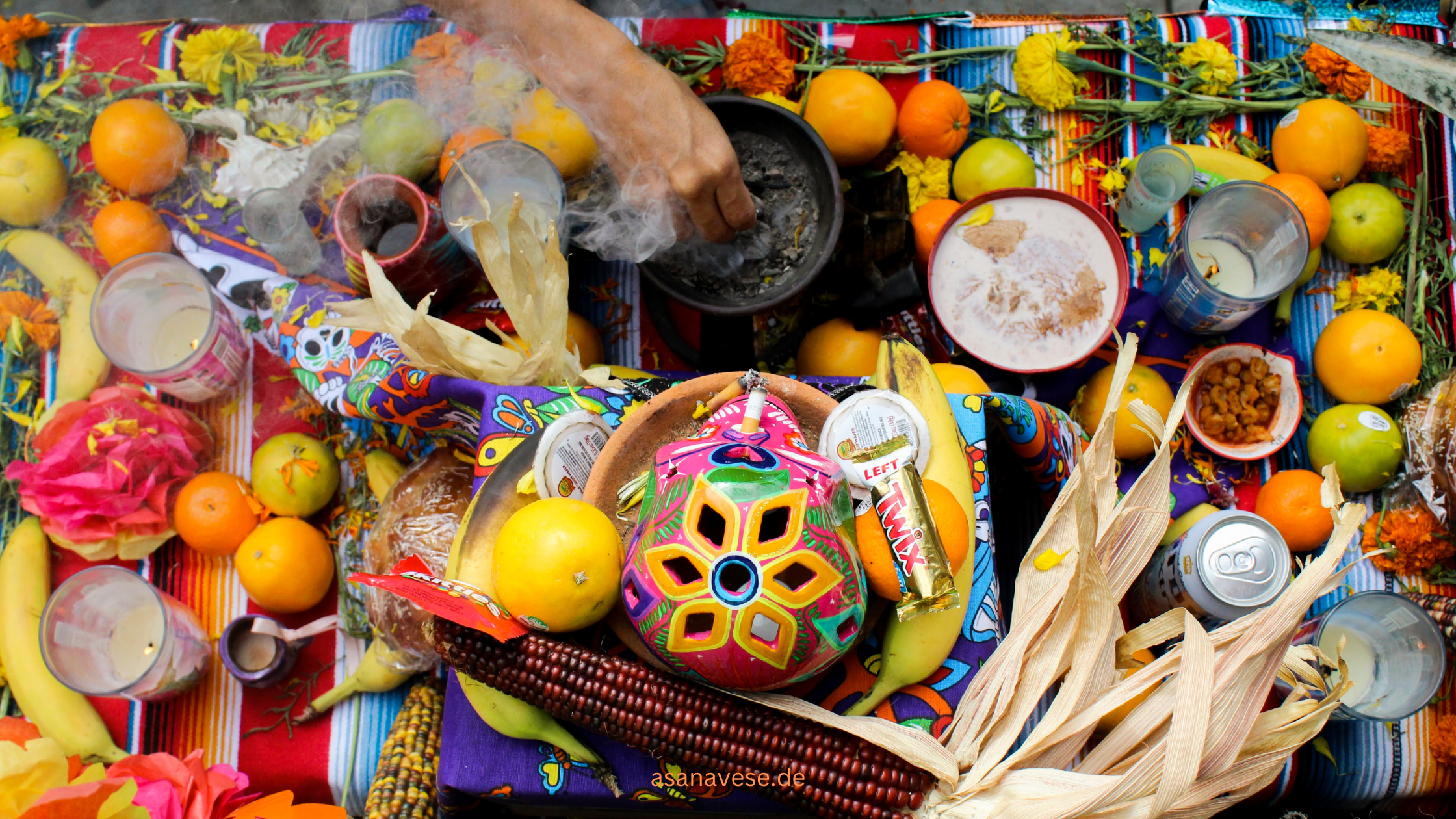
In the Vedic system, the altar, often referred to as Vedī, is a concrete, tangible place where ritual actions are performed. It fulfills several functions in doing so:
- Place of sacrifice: The altar serves as a platform on which offerings, such as ghee, grain, Soma and other ritual substances, are presented to the fire (Agni). This physical offering forms the foundation of numerous Yajnas (sacrificial ceremonies).
- Architectural precision: The construction of the altar follows the mathematically precise specifications of the Sulba Sutras. The exact geometry, the use of specific materials and the fixed orientation (for example, facing east) make the altar a structured and standardized space that reflects the natural order.
- Spatial arrangement: In household practice, a small, separate area of the living space is often established as the Pūjā Sthān (place of worship). This physical space is not only functional, it is also experienced as a sacred place where purity and order are of central importance.
Beyond its purely physical dimension, the Vedic altar carries a deep symbolic meaning that is rooted in the philosophical texts of the Vedas, Upanishads and Brahmanas:
- Mikrokosmos und Makrokosmos: The altar functions as an image of the universe. In Vedic texts, it is often emphasized that the altar mirrors the entire cosmos within itself. There are allusions to the three worlds (Bhur, Bhuvah, Svah) as well as to the five fundamental elements (Pancha Mahabhutas), which are represented by the structure of the altar.
- Transformation und Transzendenz: In the ritual, when the offering is presented to the fire, a transformation of the material substance into an energetic force takes place. This transformation symbolizes the passage from the earthly to the transcendent and serves as a metaphor for spiritual renewal. The philosophical interpretation, as developed in the Upanishads, also sees the altar as a space of inner knowledge and self-transcendence.
- Symbolische Sprache der Rituale: Every component of the altar, from the materials used to the arrangement of the offerings, carries a specific symbolic meaning. This symbolic language conveys cosmic orders and metaphysical principles, which are reflected many times over in the Vedic scriptures.
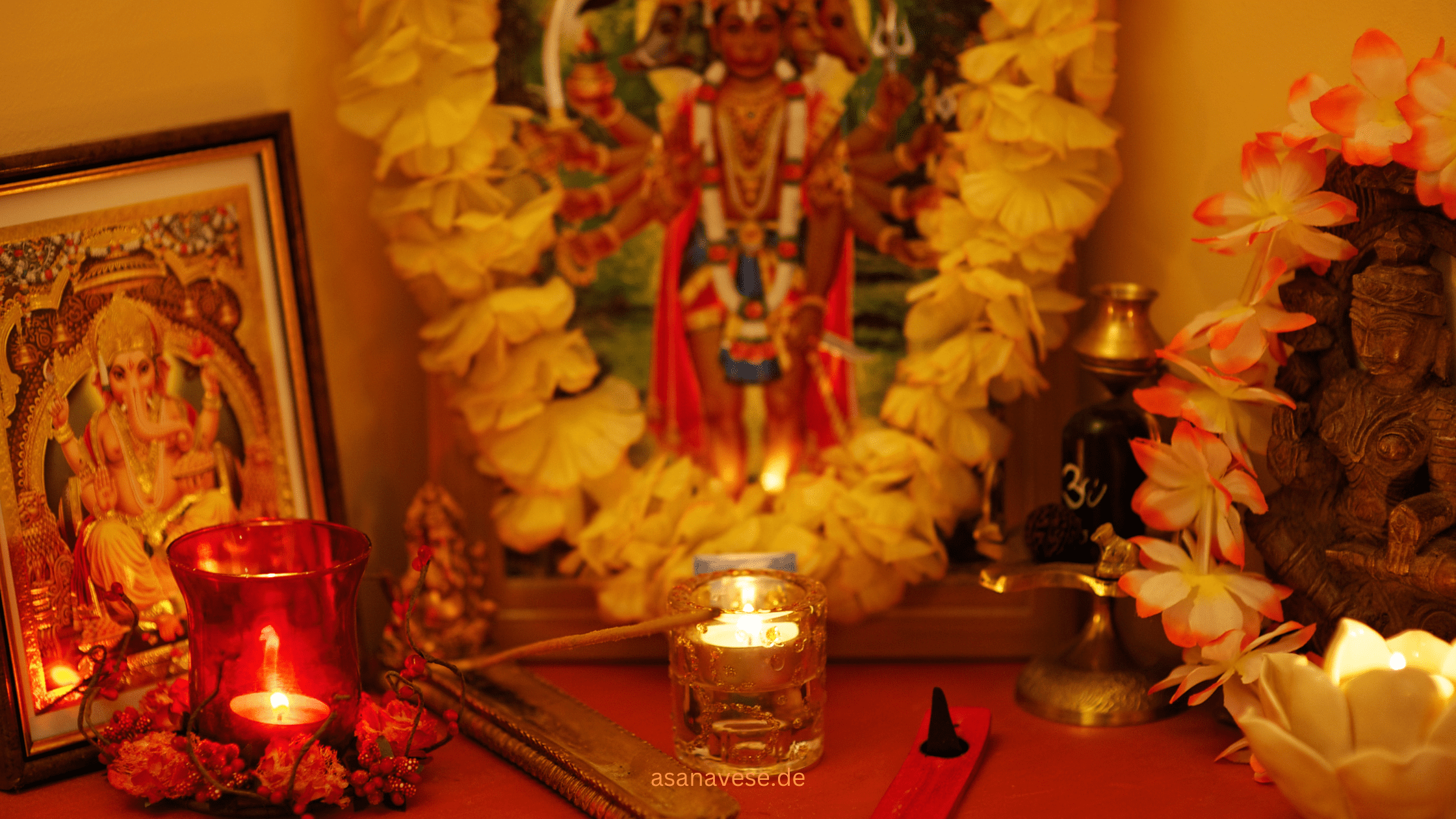
A central question is whether the altar can be understood solely as a religious instrument or whether it also has a secular, universal function:
- Primär religiöse Funktion: Traditionally, the Vedic altar is inseparably linked to ritual actions and the worship of the gods. It is the place where a connection to the divine powers is established through offerings, prayers and mantras. The Brahmanas set out in detail how and when the altar is to be used in order to uphold the cosmic order.
- Universelle Prinzipien und säkulare Anklänge: At the same time, the altar contains a symbolism that points beyond the purely religious context. The principles contained in the altar, such as order, harmony, transformation and the striving for inner knowledge, also resonate in modern spiritual practices. In this sense, the altar becomes a model that shows the connection between human beings, nature and the universe, independent of any specifically religious classification.
In this section, we look at the variety of altars, a topic deeply embedded in symbolic and energetic principles. The shape of the altar is deliberately chosen to represent different aspects of the cosmic order and the spiritual flow. Below, you will learn which forms exist, what symbolic meaning they carry and which energetic qualities they can activate in your home space.
Rectangular and Square AltarsRectangular and square altars are among the most commonly used forms in household rituals.
- Symbolik und Bedeutung: The scriptures, particularly in the Brahmanas and the commentaries on the Sulba Sutras, indicate that these forms stand for stability, order and groundedness. A square altar symbolizes a firm foundation that integrates the four cardinal directions, thus representing a stable microcosm of the universe.
- Praktische Anwendung: For household use, a rectangular or square altar is particularly suitable, since it can easily be measured precisely and integrated into existing spaces. Its clear geometric form invites you to carry out regular ritual actions such as daily puja rites, with the altar serving as a calm center point in the living space.
- Energetische Wirkung: These forms radiate a convergent energy that promotes stability and continuity. They are especially suited to anchoring the presence of the divine in everyday life and establishing a constant connection to the cosmic order.
Minimalist design meets spiritual depth. A foldable altar with high quality craftsmanship.
Round altars are described in the Vedic texts as symbols of the eternal cycle of life.
- Symbolism and meaning: The circular shape embodies the cycle of birth, death and rebirth, as well as the infinity of the universe. The ancient scriptures emphasize that the exact circle, for example through the precise spanning of a rope at a constant radius, is essential to represent perfection and the endless flow of time.
- Practical application: A round altar is energetically more dynamic than its rectangular counterparts. It is excellent for symbolizing transformation and renewal. In a domestic context, it invites you to perform ritual actions oriented toward continuous change and the cyclical nature of life.
- Energetic effect: While the rectangular altar embodies stability and order, the round altar stimulates the flow of energy, promotes flexibility and encourages inner transformation. It invites an energy that reflects the constant change of life and sharpens awareness of the natural cycle.
A round altar, inspired by the perfection of the circle.
The two most common shapes, rectangular/square and round, fulfill different energetic and symbolic functions:
- Rectangular/square:
- Symbolic: Represent structure, stability and a clear alignment with the four cardinal directions.
- Energetic: Promote the connection to the elements earth and water, creating a calm, steady space that serves as a foundation for daily rituals.
- Round:
- Symbolic: Embody the infinite cycle, wholeness and the flow of time and energy.
- Energetic: Invite a transforming, dynamic energy that emphasizes continuous change and spiritual renewal.
The choice between these shapes should therefore be aligned with your own spiritual goals. If you seek stability and a solid foundation, you choose a rectangular or square altar. If instead you want to emphasize the flow of change and the cyclical nature of life, you turn to a round altar.
The bird altar (Śyenaciti) as a symbolic exampleThe bird altar, also known as Śyenaciti, is used in vedic ritual practice mainly in complex Agnicayana ceremonies and is uncommon in a domestic context. Nevertheless, it serves here as an exemplary symbol.
- Symbolism and meaning: The bird as a shape stands for the ascent of the soul, freedom and transformation. Ancient vedic symbolism suggests that an altar in the shape of a bird facilitates access to higher levels of consciousness.
- Energetic effect: A bird altar is meant to invite an ascending, liberating energy. It symbolizes the transition from the material world into higher spiritual spheres and promotes a feeling of freedom and expansion.
- Conscious choice of form: It is important to understand that the chosen geometric shape of an altar, whether bird, turtle or another symbolic figure, is always connected to a specific energetic quality. The decision for such a shape should not be made purely on aesthetic grounds, but with awareness of the desired spiritual and energetic effect.
The choice of the respective shape always follows a deep ritual and philosophical principle grounded in the ancient scriptures. Each shape serves to make specific cosmic and metaphysical aspects visible.
The alignment of your vedic altar is a central aspect that works practically as well as energetically and symbolically. By positioning your altar according to the four cardinal directions, you create a space that fits harmoniously into the cosmic flow and allows you to deliberately invite different energetic qualities.
East, the beginning of a new dayThe east is the direction of sunrise and symbolically stands for new beginnings, inspiration and enlightenment.
- Symbolic meaning: Sunrise marks the transition from darkness to light and stands for fresh energy, creativity and the start of a new cycle. By orienting your altar towards the east, you invite in positive, regenerating energies that help you begin each day with clarity and renewed drive.
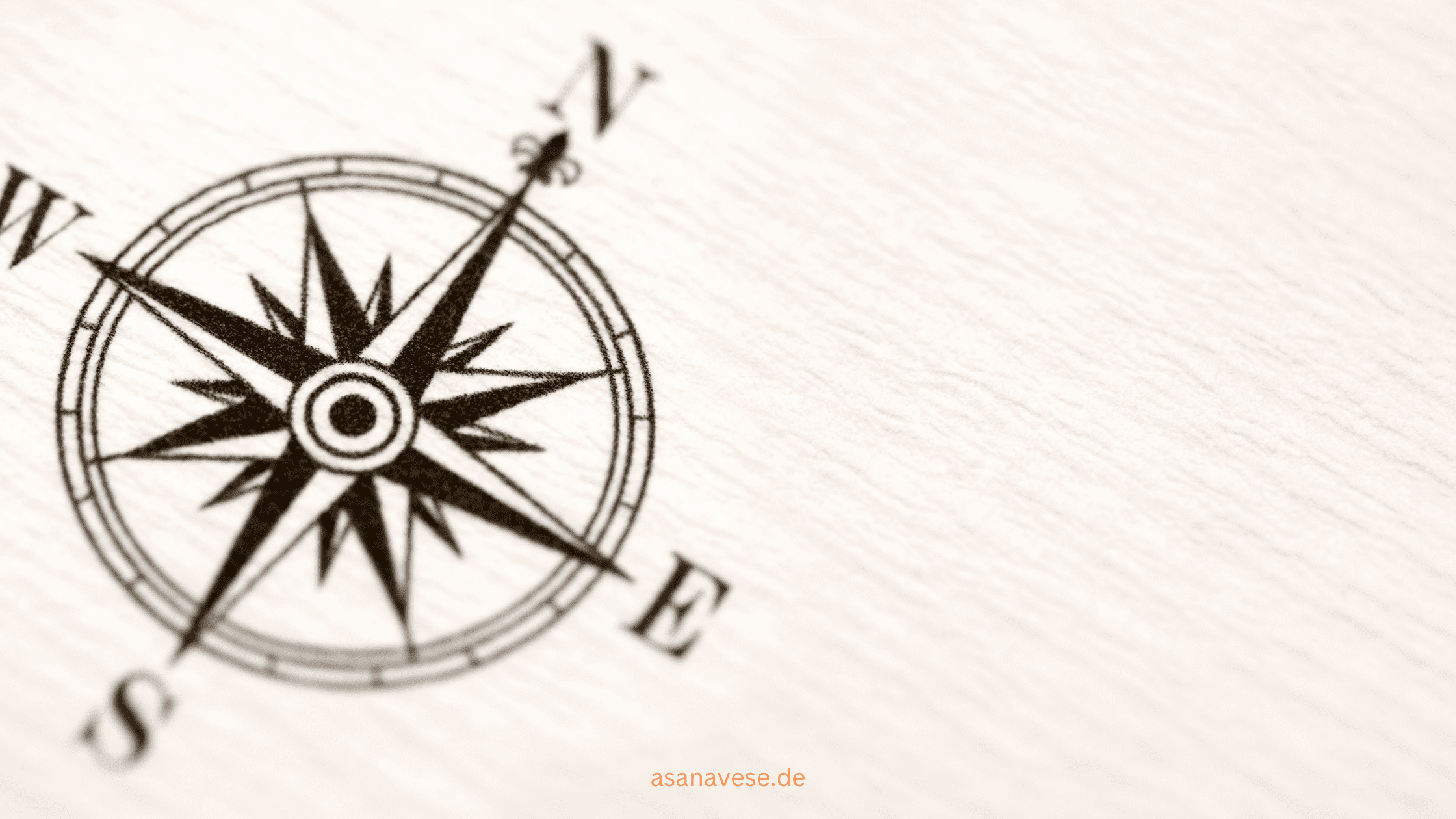
- Practical implementation: Choose a spot in your living space that receives the first rays of sunlight directly. If that is not possible, at least orient the altar so that it faces east. You can check this orientation with a compass.
- Energetic invitation: The east invites you to bring openness and fresh impulses into your spiritual and everyday life. It fosters a sense of new beginnings and inner renewal.
In the Vedic tradition, the north is honoured as the direction of stability, calm and spiritual guidance.
- Symbolic meaning: This direction stands for steadiness and the power to cultivate inner peace and clarity. In the ancient scriptures, the north is associated with wisdom and calm, focused energy.
- Practical implementation: Place meditative objects on the northern side of your altar, such as crystals, mandala depictions or statues of deities associated with wisdom and inner guidance, such as Saraswati or Shiva. These elements support your meditation practice and help fill the space with calm, stabilising energy.
- Energetic invitation: The north invites you to foster clarity and inner calm, so that you feel more secure and focused in your spiritual practices.
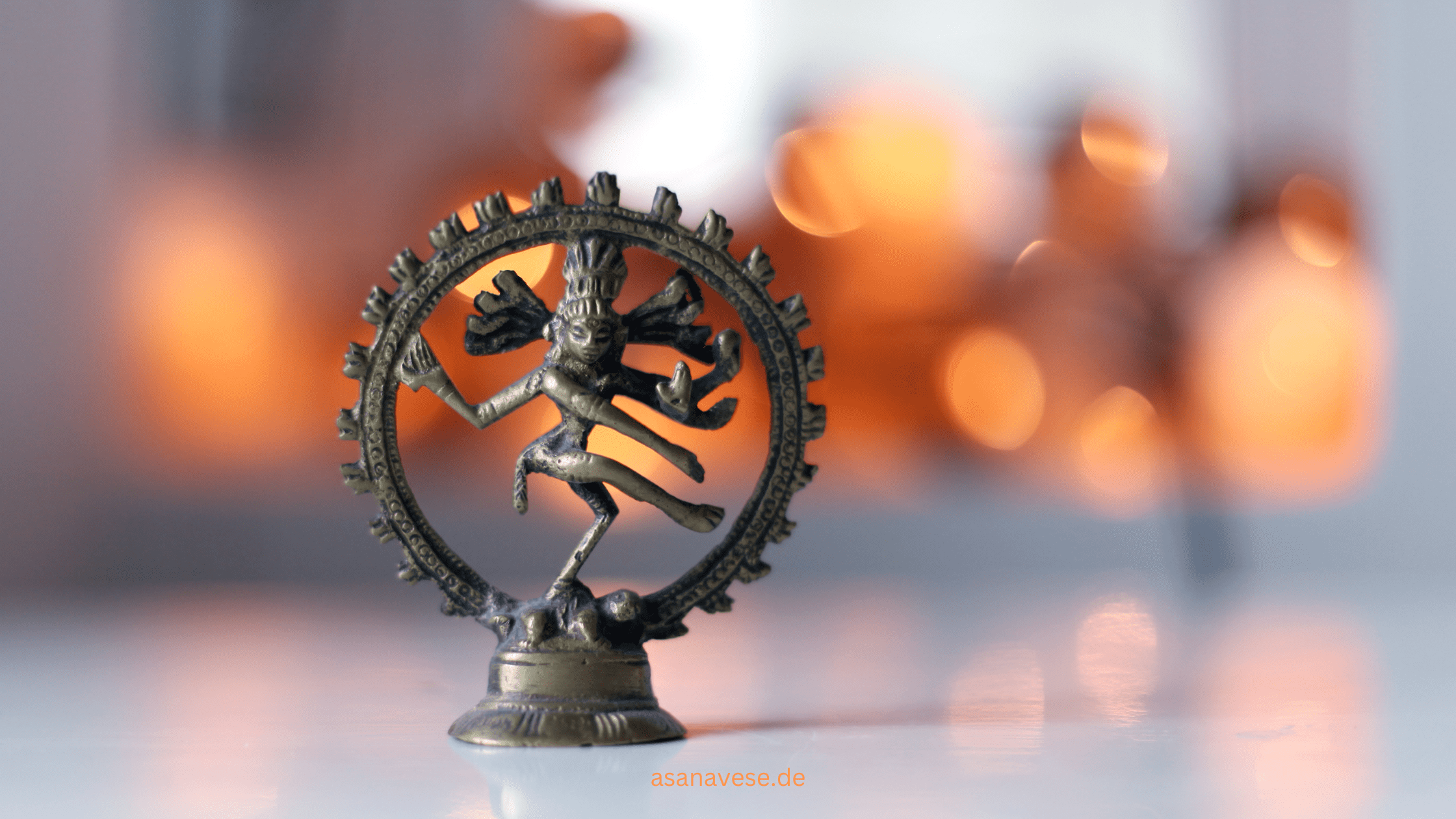
The south is the direction of intense, transformative energy. It symbolises the flow of change and the power to let go of the old and create space for the new.
- Symbolic meaning: The southern orientation is associated with dynamism, passion and the capacity for profound change. Philosophically, it stands for the constant transformation that shapes life.
- Practical implementation: Set up the southern area of your altar so that it can incorporate dynamic elements. These could be decorative pieces in vibrant colours or moving objects that symbolise the flow of energy. Deities associated with transformation, such as Durga or Kali, can also find their place here to support this intense flow of energy.
- Energetic invitation: The south fosters inner change and helps you overcome old patterns and create space for new impulses.
The west symbolises the close of a day or cycle, the return to yourself and the integration of experiences.
- Symbolic meaning: This direction stands for reflection, inner retreat and the completion of a cycle. Sunset in the west marks the end of the day and invites you to process your experiences and feel gratitude.
- Practical implementation: In your home ritual, the western area of your altar can be used for rituals that mark the close of the day, such as quiet seated meditation, prayers of gratitude or time spent in reflection. This area can be designed with soft, soothing elements to support the transition from the active day into the phase of rest.
- Energetic invitation: The west helps you integrate the day's experiences and prepares the space for a new beginning. It fosters a sense of inner balance and brings the day's cycle to a harmonious close.

The precise orientation of the altar towards the four cardinal directions ensures that your home space is brought into harmony with the universal energies. Each direction, east, north, south and west, carries its own energetic signature, and together they form a harmonious microcosm. By letting these principles inform the design of your altar, you create a space that is not only aesthetically pleasing but also spiritually powerful and energetically balanced.
Diese systematische Ausrichtung des Altars ermöglicht es dir, die tiefen, symbolischen Energien der vedischen Tradition in deinem eigenen Zuhause erlebbar zu machen und einen heiligen Raum zu schaffen, der dich täglich in deiner spirituellen Praxis unterstützt.
Satapatha Brahmana
4. Components and symbolic elements of an altarIn this chapter, the vedic altar is examined in detail in its material and symbolic components. First, the physical elements and materials used are addressed, before the underlying symbolism of the five fundamental elements (Pancha Mahabhutas) is explained. We then turn to the iconography and ritual objects that give altars their additional, multilayered meaning.
4.1 Symbolism of the Pancha MahabhutasThe material components of an altar are closely connected to the five fundamental elements of vedic philosophy, the Pancha Mahabhutas. Each of these elements carries a deeply rooted symbolic and energetic meaning, one that is reflected both in ancient wisdom and in the practical design of an altar.

The element earth embodies far more than just a physical substance. It stands for stability, permanence and the fundamental connection to the material world. In the vedic tradition, Prithvi symbolizes fertility, growth and the nourishing power that underlies all forms of life. This earth energy is understood as the secure, reliable framework that gives the entire universe its structural support.
Materials:
- Typical materials such as clay, stones and grains are used deliberately to make the earth energy physically tangible.
Placement on the altar:
- Stones can be used as a base or foundation, in the form of a weight, so that the altar has a stable, immovable ground and does not lift off. These can be placed in the corners of the altar.
- Grains, fruits or other symbols of fertility are often placed in small baskets or bowls at the sides of the altar. This arrangement strengthens the feeling of nourishment and connection to the earth.
Symbolic effect:
- Through the precise integration of these materials, a space is created that channels the quality of earth energy, an energy that gives you stability and grounding in your everyday life.
Handmade ceramic bowl in earthy tones, perfect for offerings or as a symbol for the element earth
In vedic philosophy, water is a symbol of purity, transformation and the constant flow of life. It stands for renewal, the ability to wash away the old, and the unceasing cycle of change. Water also symbolizes the emotional and spiritual element that enables the flow of energy and consciousness.

Materials and offering:
- A decorative vessel or bowl, ideally made from fine materials such as copper or clay, is used to hold water. Many practitioners include water from sacred sources, such as Ganga water or water from a local river, to strengthen the spiritual purity.
Placement on the altar:
- The water vessel should be positioned so that it stands in direct relationship to the other elements, often near the fire, to make the contrast between transformation and renewal clear.
Symbolic effect:
- The water invites you to energetically cleanse the space and to harmonize the flow of emotions and consciousness. It provides continuous renewal and supports the natural cycle of letting go and rebirth.
Hand-hammered brass bowl, inspired by the element water
Philosophical depth:
Fire is the central element of transformation. It symbolizes energy, purification, and the transition from the earthly to the spiritual. In the vedic texts, Agni is described as the medium that carries offerings into higher energetic forms and establishes the connection between human and divine. Fire is not only destructive but also creative: it transforms, purifies, and renews.
Materials and offering:
- The fire is placed centrally on the altar, for example as a diya (oil lamp), a candle, or in a small incense burner. During ceremonial rituals, the fire is often activated by lighting ghee and special oils.
Placement on the altar:
- The fire should be positioned centrally so that it can act as the pivotal point connecting the other elements with one another. Its central location emphasizes the role of fire as a transmutative force: it draws the offerings into itself and transforms them into pure, energetic impulses.
Symbolic effect:
- The central fire acts as a catalyst for transformation and spiritual illumination. It symbolizes the inner spark that slumbers within every person and invites you to experience personal and spiritual purification.
A stylish incense burner that kindles the power of fire.

Air is the carrying element of life, invisible yet omnipresent. Vayu stands for the breath that pervades life and symbolizes movement, freedom, and the invisible force that connects all things with one another. In vedic philosophy, air is often understood as the medium through which vibrations, sounds, and mantras unfold their effect.
Symbolic representation:
- Although there are no direct, visible air objects, the presence of air can be represented through moving elements such as wind chimes or even through the deliberate use of incense. The resonant sounds of ritual chants and mantras echoing through the space are likewise an expression of air energy.
Placement on the altar:
- Elements associated with air can be positioned along the upper edges of the altar, where they symbolize the breath of the space.
Symbolic effect:
- Air ensures a dynamic flow within the ritual space, supports the transfer of vibrations, and fosters the connection between physical actions and spiritual sounds.
Tibetan bell & dorje, a symbol of clarity and transformation. The sound carries the essence of the air element
Akasha represents space, the infinite medium in which all other elements exist. It symbolizes emptiness, infinity, and the transcendent. In vedic cosmology, Akasha is often regarded as the fundamental field that underlies all things and in which the vibrations of the universe resonate.
Symbolic representation:
- Unlike the other elements, Akasha is not represented through concrete materials but through the spatial arrangement and the open design of the altar. The geometric planning, whether in the form of circular patterns, mandalas, or clearly defined, empty areas, reflects the concept of infinite space.
Placement on the altar:
- Akasha can be represented by deliberately leaving areas open or by incorporating elements that let the space breathe. The aim is to create areas that serve as an “empty canvas” for the other energetic impulses.
Symbolic effect:
- Akasha brings the notion of infinity and all encompassing connection into the altar. It acts as the medium in which the energies of earth, water, fire, and air unite, forming the invisible foundation on which all transformations take place.
Through the integration and precise arrangement of these five elements, earth, water, fire, air, and ether, an altar emerges that is far more than just a physical space. It becomes a living microcosm that reflects the order of the universe and supports you in creating a space that is energetically and spiritually aligned with the ancient vedic principles.

Agni: the Vedic ritual of the fire altar
4.3 Iconography and Ritual ObjectsAlongside the basic materials, ritual objects and symbolic representations play a central role in shaping an altar. These elements are not merely decorative additions, they contribute to the energetic dynamic and the spiritual orientation of the altar. In what follows, you will find a detailed explanation of how murti, yantras, mandalas and other ritual objects can be integrated into the altar, always with attention to their deep symbolic and energetic meaning.
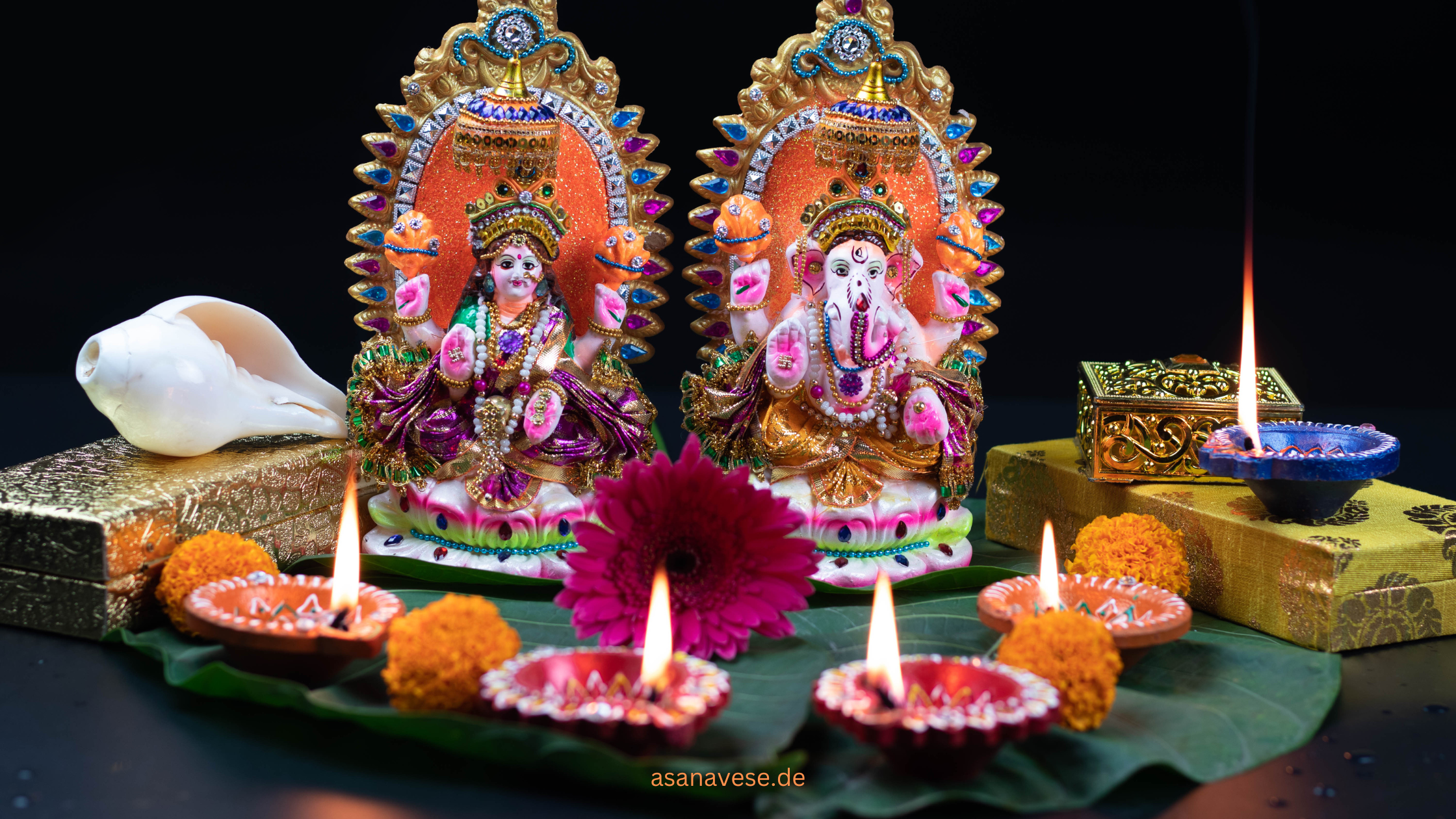
Murti, Divine Images and SculpturesSymbolism and energetic effect:
Murti are visible manifestations of deities that serve as focal points of worship. Their depiction follows strict iconographic guidelines, handed down in classical texts such as the Shilpa Shastras and Vedic commentaries. Each deity embodies specific qualities:
- Ganesha: As the remover of obstacles, Ganesha symbolizes new beginnings and success. Traditionally, his murti is placed in the northeastern area of the altar, since this direction is considered a place of departure and inspiration.
- Lakshmi: The goddess of wealth and abundance embodies prosperity and harmony. Her image is often oriented toward the east, to symbolize the sunrise and thus the beginning of a new, blessed day.
- Shiva: Shiva represents transformation and transcendent consciousness. His murti is often positioned in the southern area, to reflect the intense, transformative energy of this direction.
- Hanuman: Hanuman stands for courage, devotion and the overcoming of difficulties. He can be placed in the western part of the altar, to symbolize completion and the integration of experiences.
Other deities and spiritual symbols, whether Indian or from other traditions, can also be integrated into the altar. What matters is that the placement is always based on the energetic and symbolic meaning of the respective figure. For example, photos of spiritual teachers or personal symbols should be arranged so that they support the desired energetic flow and complement the space of worship.
Symbolism and energetic effect:
Yantras are geometric diagrams that function as visual and energetic aids. They serve to gather and channel the flow of cosmic energy.
Practical forms: Yantras can appear in different forms:
- Engraved or carved: On metal or wooden plates that serve as a fixed part of the altar.
- As a yantra murti: Sometimes yantras are used in combination with a depiction of a deity, to further strengthen the spiritual presence.
- Painted or drawn: On an altar cloth or a separate sheet, which is then placed on the altar.
Placement: The most central position on the altar is ideal for a yantra, since it then acts as a visual focus and an energetic node. It should be placed so that it supports the vibrations of the ritual mantras and offerings, and is oriented toward the deity being worshipped.
Sri Yantra, Energy & ManifestationA powerful symbol of sacred geometry, a talisman for higher vibration
Symbolism and energetic effect:
Mandalas represent comprehensive, circular diagrams that embody the infinite, cyclical character of the universe.
Practical forms: Mandalas can be integrated in many ways:
- On the altar cloth: A mandala can serve as a printed or embroidered pattern on the altar cloth.
- Painted directly onto the altar surface: This way, the altar itself becomes a canvas that visualizes cosmic order.
- On separate panels: These can be arranged as decorative elements around the altar to expand the space of meditative wholeness.
Difference from yantras: While yantras often function as focused energy conductors, mandalas emphasize the all-encompassing principle of wholeness and the cyclical flow of birth, death and rebirth. They invite meditative reflection and support inner contemplation.
Besides murti, yantras and mandalas, other objects can be integrated on the altar to give it an individual and energetically complete design:
- Photos of gurus, teachers or beloved family members:
These personal elements can serve as inspiration and as a symbol of ongoing spiritual support. They are often placed at the edges of the altar, where they fill the space with personal history and warmth.
- Natural elements:
Feathers, flowers and jewelry can be presented as offerings.
- Feathers: Represent lightness and spiritual ascent.
- Flowers: Symbolize impermanence, beauty and the constant renewal of life.
- Jewelry: Can represent the radiance and appreciation of the divine.
- Crystals:
Different crystals each possess specific energetic properties, ranging from clarity and protection to healing and transformation. They should be placed so that their vibrations support the energetic flow of the altar, often at central or strategic points.
- Musical instruments and other symbolic objects:
Singing bowls, small drums or even branches can be used as ritual instruments to fill the space with vibrations that energetically charge the altar and ease the transition between the elements.
The selection and placement of these ritual objects is by no means random. Every component and every personal element contributes to creating an altar that is not only aesthetically pleasing but also energetically coherent. By consciously including murti, yantras, mandalas and other symbolically charged objects, you can create a personal, living space that corresponds to the ancient Vedic wisdom while supporting your individual spiritual journey.
Crystal set, energy & harmonySelected healing stones for clarity, protection and spiritual balance.
Vedic ritual practice is characterized by a detailed, multi-step process in which every action, every sound and every gesture is precisely defined. In the following, the course of a yajna is presented in its various facets, from the distribution of roles among the priests to the linguistic and symbolic meaning of the mantras, through to practical instructions.
The Vedic Sacrifice
5.1 Course of a formal yajnaVedic ritual practice is characterized by a detailed, multi-step process in which every action, every sound and every gesture is precisely defined. In the following, the course of a yajna is presented in its various facets, from the distribution of roles among the priests to the linguistic and symbolic meaning of the mantras, through to practical instructions.
Distribution of roles and ritual sequence
A traditional yajna is divided into three main roles, each of which takes on a specific area of responsibility:
- Hotṛ (Rezitationspriester): Verantwortlich für die Rezitation der vedischen Hymnen, ruft der Hotṛ die göttlichen Kräfte an. Er spricht die Mantras in einer festgelegten, rhythmischen Abfolge, deren genaue Intonation und Betonung essenziell sind, um die richtige Schwingung zu erzeugen.
- Adhvaryu (Handlungspriester): Dieser Priester übernimmt die praktischen Aspekte des Rituals, das Aufbauen des Altars, das Platzieren der Opfergefäße, das Anzünden des Feuers und das körperliche Darbringen der Opfergaben. Der Adhvaryu folgt den exakten geometrischen Vorgaben der Sulba Sutras, um die rituelle Ordnung im physischen Raum herzustellen.
- Udgātṛ (Sänger): Der Udgātṛ ergänzt die rituellen Handlungen durch Gesänge und melodische Rezitationen. Seine Mantras verstärken die energetische Schwingung und tragen dazu bei, dass die physische Handlung des Opferns in einen spirituellen Kontext überführt wird.
Die Rollen arbeiten synchron, sodass jede Bewegung und jeder Vers in präziser Abstimmung erfolgt. Die zeitliche Koordination, wer wann spricht, wer wann handelt, ist zentral, um die kosmische Ordnung (ṛta) im rituellen Ablauf zu manifestieren.
Sprachliche und symbolische Bedeutung der Mantras
Jeder gesprochene Vers ist nicht nur ein Klang, sondern trägt eine tief verwurzelte symbolische Bedeutung:
- Mantra-Struktur: Die Mantras bestehen aus Versen, die in metrischen Einheiten (Chandas) angeordnet sind. Diese metrische Struktur sorgt für eine gleichmäßige Schwingung, die den energetischen Fluss im Ritual lenkt.
- Symbolik der Worte: Die Worte selbst verankern kosmische Prinzipien, sie rufen spezifische Gottheiten an, rufen die Elemente ins Gleichgewicht und leiten die Transformation der Opfergaben ein.
- Rituelle Synchronität: Die Mantras werden in einem strengen Zeitplan rezitiert, sodass die Schwingungen mit den physischen Handlungen des Adhvaryu und den klanglichen Darbietungen des Udgātṛ korrespondieren. Dies stellt sicher, dass der gesamte rituelle Raum in harmonischer Resonanz schwingt.
In the domestic context, daily puja is seen as an essential part of transforming the living space into a sacred place and maintaining the connection to the transcendental powers as well as to the elements. Traditionally, this practice takes place at an altar that is strictly aligned to the east, in order to receive the first rays of the sun and, with them, the symbolic new beginning.
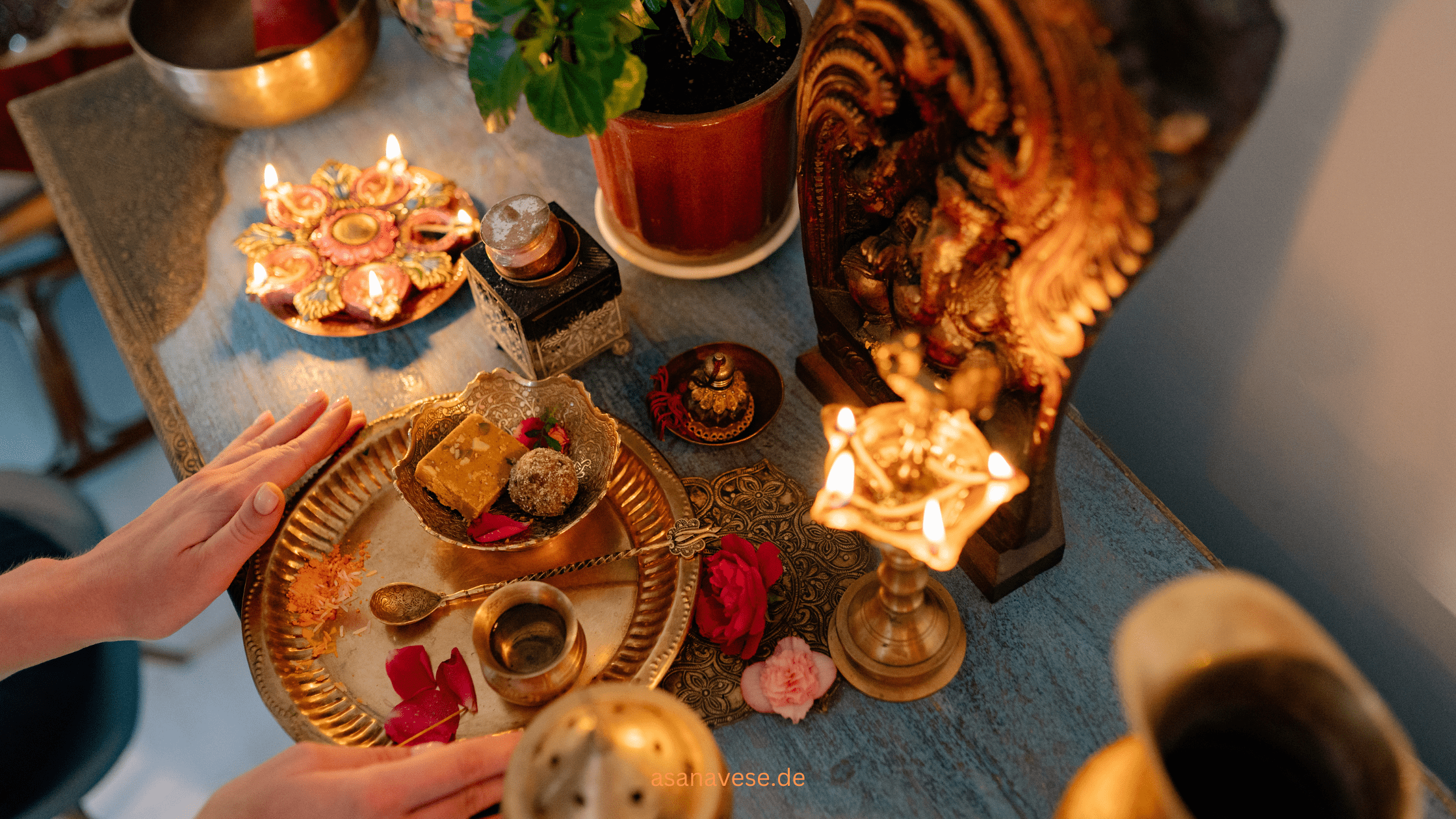
A) Setting up a small pūjā sthān- Place and orientation: The altar is placed in a quiet area of the house where undisturbed ritual actions are possible. Care is taken to position the altar in a constant eastward orientation, so that it is exposed, when possible, to the first rays of sunrise. This eastward orientation symbolises the beginning of a new day and the continuous cycle of renewal and enlightenment. A compass can help you determine the exact direction.
- Purification and preparation: Before the altar is set up, the chosen area is thoroughly cleaned, often by sprinkling it with water and smudging it with herb bundles, in order to drive away negative energies. The altar is then set up on the clean surface.
- Light and fragrance: A diya (oil lamp) is placed centrally on the altar to symbolically represent the light of enlightenment. Alternatively, as described earlier in the article, candles or incense can also be used, their gentle fragrance contributing to the energetic purification of the space. These elements stand for inner awakening and the flow of positive vibrations.
- Offerings: Fresh flowers, small pieces of fruit or sweet foods are prepared as offerings and arranged in decorative vessels or on plates. These gifts symbolise the abundance and fertility of nature and act as a connecting element between the earthly and the spiritual.
- (Application of the tilak: As part of the ritual practice, red powder (kumkum) is traditionally applied to the forehead, a sign of blessing and of consciously turning towards the divine.)
- Mantra and prayer: The recitation of traditional mantras or silent prayer serves the energetic purification and the symbolic transmission of the offerings to the heavenly powers. The vibrations of the words strengthen the energetic structure of the altar and create a meditative state.

- Central orientation: Since the altar is strictly aligned to the east, the ritual begins with honouring this direction, the sign of new beginnings and enlightenment associated with sunrise.
- Gratitude to all directions: After the initial bow to the east, respect is also paid to the other cardinal directions:
- In the north, gratitude is given for stability and guidance,
- in the south, for transformation and intense life energy,
- in theWest for reflection and the completion of a cycle. These honorings can be done either verbally or through symbolic gestures.
- Silence and Meditation: After the offerings and the recitation of the mantras, sit in silence at the altar for a few minutes. Use this time to absorb the energetic connection to the elements and the celestial forces within yourself.
- Closing Prayer: The ritual closes with a final prayer or meditation that blesses the day and evokes a feeling of inner peace and gratitude. This conclusion serves as a ritual integration of the gathered energies and prepares the space for the next day.

The vedic altar practice shows that rituals are far more than symbolic actions: they create a holistic space in which material and immaterial levels merge with each other. Modern spiritual movements, whether in the form of yoga, meditation, or mindfulness practices, often use similarly structured rites to calm the mind and sharpen awareness for a deeper connection with nature and community. In this way, the concept of "sacred space" is reinterpreted: a home can become a temple if it succeeds in transforming this space through conscious ritual and energetic alignment.
The vedic altar practice thus remains a living heritage that fosters the dialogue between past and present, between tradition and modernity. It is a dialogue that continues to provide impulses for a holistic way of life and a deeper understanding of the universe.
Note: Some of the links in this article may be affiliate links, which can bring us compensation at no cost to you if you decide to buy something. These are products we have personally used and stand behind. This website does not serve as financial advice but is intended for entertainment purposes only. You can read the disclosure of our partners in our privacy policy.